

After merging 5 communes: Ngoc Thien, Ngoc Van, Song Van, Ngoc Chau and Viet Ngoc, Ngoc Thien commune became a large, populous area with outstanding strengths in agricultural production.
Currently, the whole commune has about 5,244 hectares of cultivated land, of which more than 3,500 hectares are high-quality rice and key crops such as sweet corn, vegetables, potatoes, and fruit trees. To improve economic efficiency, the commune directs villages to promote the conversion of crop structure according to advantages, towards large-scale commodity production. Thanks to that, many agricultural models have standardized processes, achieved OCOP certification, and initially formed a stable production - consumption chain. The average rice yield reaches 56 - 58 quintals/ha; the income value per unit of cultivated land area reaches 170 - 175 million VND/ha/year, a significant increase compared to the beginning of 2020.
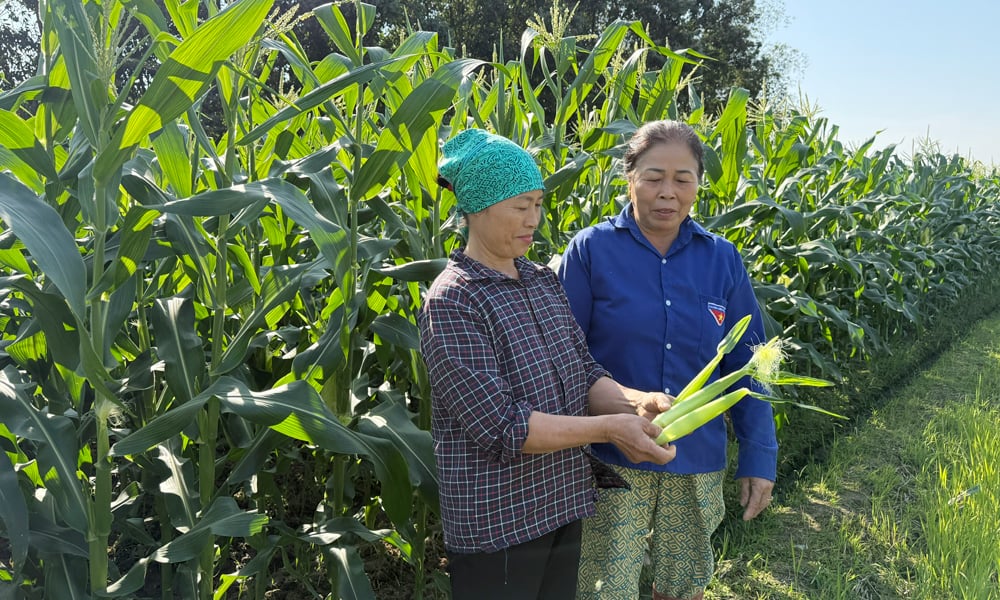 |
People in Dong Lang village, Ngoc Thien commune take care of corn. |
Along with cultivation, the livestock industry of Ngoc Thien commune has developed rapidly in the direction of concentrated farms and ranches, applying biosafety. The whole commune currently has more than 86,000 pigs and 593,000 poultry. About 300 hectares of aquaculture water surface have also been invested in the direction of intensive and semi-intensive farming, creating a stable source of income for people in the villages: Thuy Cau, Van Lap, Cau Moi...
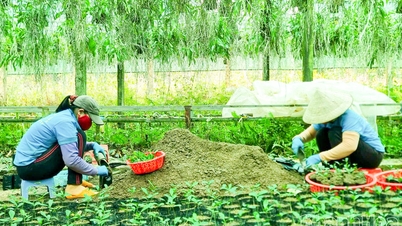
To prepare for the new development stage, the People's Committee of Ngoc Thien commune has organized a review of the entire production area, initially identifying 11 concentrated rice areas with 638 hectares; 6 concentrated livestock areas of 24.6 hectares; 6 perennial crop areas of 28.65 hectares and 7 aquaculture areas of about 40 hectares. From these results, the commune has built an orientation for agricultural development in each region, focusing on key crops and products with competitive advantages. In particular, many large specialized areas have been formed: 100-hectare rice area in Tan The and Nanh Ton villages; 143-hectare rice area in Van Lap, Hoi Phu and Cau Moi villages; 5-hectare medicinal plant area in Thuy Cau and Hoi Phu villages; 5-hectare bamboo shoot area; 10-hectare high-tech vegetable area jointly invested by GO Company. These growing areas are gradually becoming the core of a concentrated, high-quality production model, linked to market demand and food safety standards.
Corn is one of the crops that brings in a good income and is grown by Ngoc Thien people on an area of 150 hectares. In Dong Lang village, dozens of households grow from 5 to 8 sao of sweet corn and waxy corn, bringing in outstanding income. Ms. Hoang Thi Thinh, Head of the village Women's Association, shared: "My family has 8 sao of sweet corn. Recently, nearly 4 sao were sold, with a yield of 4 quintals/sao, and a selling price of 17,000 VND/kg. This type of plant is easy to care for, low cost, and has a stable output because there are people who come to buy it on site."
The expansion of high-quality agricultural production areas is bringing many practical benefits to Ngoc Thien commune. When the production areas are planned in a concentrated manner, the commune has the conditions to invest synchronously in the internal transport system, irrigation, and production electricity, helping to reduce investment costs and increase labor efficiency. Large production areas also attract businesses and cooperatives to cooperate in consumption, creating stable output and limiting the situation of abandoned fields. Notably, the application of science and technology in production contributes to environmental protection, gradually forming a modern, green - clean - sustainable rural landscape, in accordance with the criteria of advanced new rural areas.
According to the leaders of Ngoc Thien commune, the local development perspective is to build a modern, efficient and sustainable commodity agriculture on a commune-wide scale after the merger. In the coming time, the commune will continue to accumulate and concentrate land; expand concentrated production areas; strengthen the linkage between farmers - enterprises - cooperatives; promote digital transformation in growing area management and product traceability. The commune strives for an agricultural growth rate of 10 - 12%/year in the period of 2026 - 2030, with an average income per capita of over 80 million VND/year.
Source: https://baobacninhtv.vn/xa-ngoc-thien-mo-rong-vung-san-xuat-nong-nghiep-chat-luong-cao-postid432484.bbg

![[Photo] Cat Ba - Green island paradise](/_next/image?url=https%3A%2F%2Fvphoto.vietnam.vn%2Fthumb%2F1200x675%2Fvietnam%2Fresource%2FIMAGE%2F2025%2F12%2F04%2F1764821844074_ndo_br_1-dcbthienduongxanh638-jpg.webp&w=3840&q=75)
![[Photo] 60th Anniversary of the Founding of the Vietnam Association of Photographic Artists](/_next/image?url=https%3A%2F%2Fvphoto.vietnam.vn%2Fthumb%2F1200x675%2Fvietnam%2Fresource%2FIMAGE%2F2025%2F12%2F05%2F1764935864512_a1-bnd-0841-9740-jpg.webp&w=3840&q=75)



































































Comment (0)