

Exports depending too much on FDI enterprises is not a new issue, but has always received great attention in Vietnam in recent times.
FDI sector accounts for over 70% of total export turnover.
According to statistics, in recent years, the export value of the region business Foreign direct investment (FDI) businesses consistently dominate the domestic business sector. From 2018 to 2024, exports from FDI businesses accounted for over 70% of Vietnam's total export value.
Specifically, in 2018, according to data from the Foreign Investment Agency ( Ministry of Planning and Investment ), exports of the FDI sector, including crude oil, reached 175.5 billion USD, up 12.9% over the same period in 2017 and accounting for nearly 71.7% of turnover. export nationwide. Excluding crude oil, exports of the FDI sector in 2018 reached 173.2 billion USD, up 13.6% over the same period and accounting for 70.7% of Vietnam's export turnover.
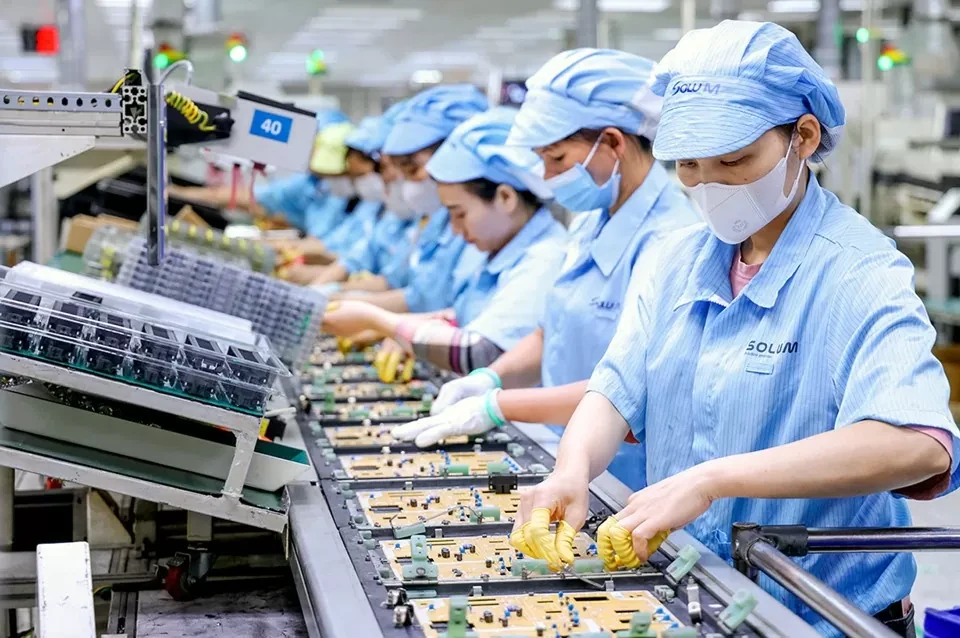
Similarly, in 2024, exports from the FDI sector, including crude oil, are estimated to reach nearly US$290.9 billion, an increase of 12.3% compared to 2023, accounting for nearly 71.7% of total export turnover. Exports excluding crude oil are estimated to reach over US$289.2 billion, an increase of 12.5% compared to 2023, accounting for over 71.3% of the country's total export turnover.
However, alongside strong export growth from the FDI sector, imports from this sector also grew significantly. Specifically, imports from the FDI sector in 2018 reached US$142.7 billion, an increase of 11.6% compared to the same period in 2017 and accounting for 60.1% of total import turnover.
In 2024, the FDI sector's imports are estimated to reach nearly 240.7 billion USD, up 15.1% compared to 2023 and accounting for 63.2% of the country's total import turnover. Thus, in 2024, the FDI sector will have a trade surplus of nearly 50.3 billion USD including crude oil and a trade surplus of more than 48.6 billion USD excluding crude oil.
In his speech at the 6th National Forum on Developing Vietnamese Digital Technology Enterprises recently, General Secretary To Lam frankly mentioned the export issue of the FDI enterprise sector recently.
General Secretary To Lam stated: Vietnam ranks second in the world in exporting smartphones; fifth in the world in exporting computer components; sixth in the world in exporting computer equipment; seventh in the world in software outsourcing; and eighth in the world in electronic components and equipment.
“ These are impressive numbers, but have we ever looked deeply into the nature of these figures? How much % do we contribute? in those that value? ” - The General Secretary asked a question.
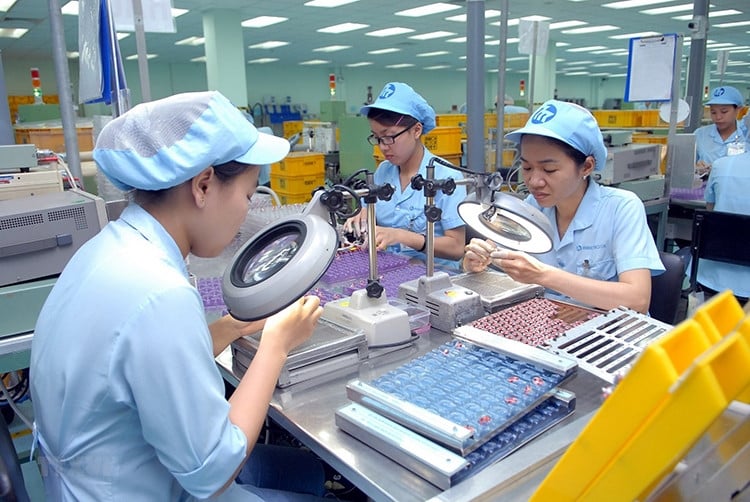
Where do domestic businesses stand in the value chain?
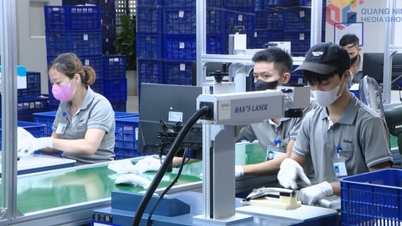
According to General Secretary To Lam, the foreign direct investment enterprise sector exports 100% of the value of phones and components but imports up to 80% of the value of these components .
“I want to clarify these shortcomings so that we can look straight at where our businesses stand in the global value chain as well as in international competitiveness”? - General Secretary To Lam expressed his concerns.
Perhaps, this is not the concern of General Secretary To Lam alone. In fact, the fact that foreign-invested enterprises dominate exports has been mentioned at many forums in recent years.
At the 2024 working conference, deploying the 2025 tasks of the Department of Industry (Ministry of Industry and Trade), Minister of Industry and Trade Nguyen Hong Dien frankly pointed out: Over 70% of export value comes from the FDI enterprise sector. This means that domestic enterprises account for a small proportion of the total industrial production value and total export value of the industries.
Also expressing concerns that Vietnam's import and export growth heavily depends on the foreign direct investment (FDI) sector, Dr. Nguyen Dinh Cung – former Director of the Central Institute for Economic Management Research - CIEM (Ministry of Planning and Investment) – stated that the domestic business sector remains very weak and private sector investment is still low.
To overcome these shortcomings in 2025, according to Dr. Nguyen Dinh Cung, Vietnam needs to create a 'new breath' in reform and improvement. investment environment business, creating more favorable conditions for domestic private enterprises to operate.
'Because the private sector does not need monetary incentives, what they need is a transparent, accompanying, and trustworthy mechanism for their investment and business opportunities. they ' - Dr. Nguyen Dinh Cung affirmed.
Besides creating mechanisms, policies and creating 'new momentum' for the domestic business sector, economic experts believe that in order to participate more deeply in the global value chain, domestic businesses themselves also need to strive to rise up and assert their position in the global supply chain.
Regarding this issue, according to General Secretary To Lam, Vietnamese enterprises need to have greater consensus, determination and aspiration. This is not only an opportunity but also the responsibility of each enterprise in contributing to realizing the great goal set by the Party and State in Resolution 57/NQ-TW of the Politburo on breakthroughs in science and technology development, innovation and national digital transformation, to turn the aspiration to lead into concrete actions.
Source


![[Photo] Urgently help people soon have a place to live and stabilize their lives](/_next/image?url=https%3A%2F%2Fvphoto.vietnam.vn%2Fthumb%2F1200x675%2Fvietnam%2Fresource%2FIMAGE%2F2025%2F12%2F09%2F1765248230297_c-jpg.webp&w=3840&q=75)

























































































Comment (0)