

(CLO) The Kumbh Mela festival, with approximately 400 million Hindu devotees participating in a mass bathing ritual, will take place in India starting on January 13th.
The Prayag Kumbh Mela 2025, or Maha Kumbh 2025, will be held at the confluence of the Triveni Sangam River, the meeting point of the Ganges, Yamuna, and Saraswati rivers in Prayagraj (Uttar Pradesh) from January 13 to February 26, 2025.
The last time the festival was held here was in 2013, attracting 120 million people.
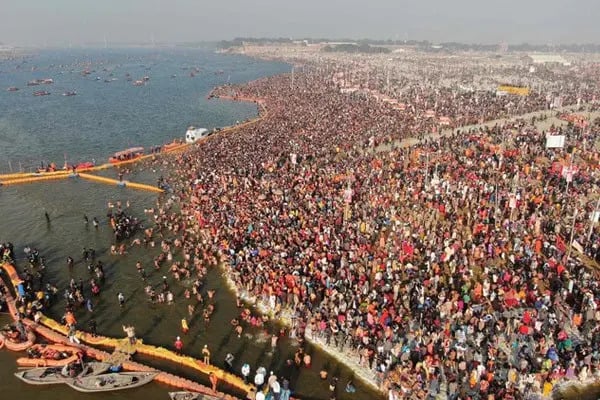
Kumbh Mela is the largest spiritual festival in India and the world . Photo: AD
Approximately 150,000 toilets were erected, along with a network of communal kitchens capable of serving up to 50,000 people simultaneously. 68,000 LED light poles were installed for the festival, so large that the light from the area was visible from outer space.
Authorities and police have set up a network of search centers on a mobile app to connect with visitors lost in the massive crowds.
As the world's most populous country with 1.4 billion people, India is accustomed to hosting large-scale events.
In 2019, the country held the "Ardh Kumbh Mela," or "Half-Kumbh Mela," a smaller version of the Kumbh Mela festival, attracting 240 million followers, according to government statistics. In Hindi, the word "ardh" means "half." This festival is held alternately between the two main Kumbh Melas, which take place every 12 years.
The government describes Kumbh Mela as a vibrant blend of cultures, traditions, and languages, representing a microcosm of India where millions of people gather.
Hindus believe that bathing in streams helps cleanse sins, break free from the cycle of reincarnation, and achieve salvation. Many devotees choose to live simply during the festival, committing to non-violence, observing precepts, giving alms to the poor, and focusing on prayer and meditation.
The Kumbh Mela (Festival of the Sacred Water Pot) is one of the world's largest religious festivals, taking place every four years, rotating among four holy cities in India: Allahabad, Haridwar, Ujjain, and Nasik. The festival was recognized as an intangible cultural heritage by UNESCO in 2017.
Many international news agencies consider the Kumbh Mela 2025 not only one of the most spectacular cultural events on the planet, but also an opportunity for India's tourism industry to boom. However, they also do not rule out the possibility that this festival will contribute to exacerbating the already extremely dangerous levels of environmental pollution in the country of over a billion people...
UNESCO recognized Kumbh Mela as a World Intangible Cultural Heritage in 2017. This is a significant recognition for the festival, acknowledging the cultural, religious, and community value of Kumbh Mela, as well as its impact on the millions of devotees who participate each year.
Source: https://www.congluan.vn/400-trieu-nguoi-tham-du-le-hoi-tam-tap-the-lon-nhat-hanh-tinh-post330071.html









![[Video] Hue and Quang Ninh mark strong tourism growth](https://vphoto.vietnam.vn/thumb/402x226/vietnam/resource/IMAGE/2025/12/12/1765555481742_dung00-22-16-02still007-jpg.webp)










![[Photo] Prime Minister Pham Minh Chinh holds a phone call with the CEO of Russia's Rosatom Corporation.](/_next/image?url=https%3A%2F%2Fvphoto.vietnam.vn%2Fthumb%2F1200x675%2Fvietnam%2Fresource%2FIMAGE%2F2025%2F12%2F11%2F1765464552365_dsc-5295-jpg.webp&w=3840&q=75)










































Comment (0)