

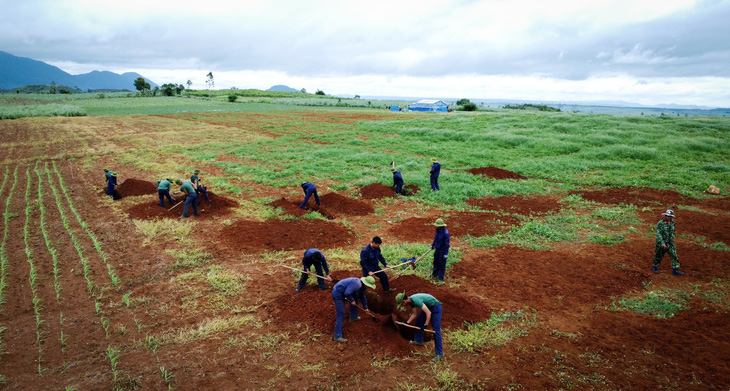
Soldiers of Team K52 of the Gia Lai Provincial Military Command diligently dig from one hillside to another hoping to find the remains of fallen soldiers – Photo: TAN LUC
Numerous search operations have been organized, involving thousands of man-days and tens of thousands of square meters of earth and rock excavated, but the whereabouts of the ancient mass grave remain unknown.
Heroic Battle
At noon on June 24, 1954, a lightning ambush broke out on National Highway 19 (now in Dak Po district, Gia Lai province) against a French military convoy. In this battle, the 96th Regiment and its affiliated units of Military Region V annihilated the 100th Mobile Brigade of the French, which had just been deployed from Korea to the Central Highlands (Vietnam).
In his house overlooking the road in Dak Po town, 96-year-old veteran Thai Diep still vividly remembers the bloody battle of that year. Sitting and gazing out at the road that was once the battlefield, the old veteran emotionally recounted the battle, which lasted about 5 hours, from 2 PM on June 24th until dusk. Our soldiers ambushed the convoy on the hillsides along National Highway 19, from the area of the Dak Po Victory Monument to the end of the town.
During the battle, Mr. Diep was an 82mm mortar soldier in Company 3, Battalion 40, tasked with eliminating infantry. When the French convoy entered the battlefield, it was blocked by gunfire, causing a traffic jam stretching for a kilometer. All the guns on the high ground simultaneously unleashed fire down on the panicked enemy troops.
Trapped with no escape route, the French concentrated all their firepower, raining bullets down on the battlefield. The reeds on the hillside were cut down by machine guns, leaving clean, even streaks.
As dusk fell and the battle ended, the enemy scattered, splitting into small groups to retreat, leaving behind a large amount of weapons and artillery. After the battle, 700 French soldiers were killed or wounded, and 1,200 surrendered.
But the price for this victory was the loss of 147 soldiers from the 96th Regiment, along with civilian workers and volunteer youth, who perished on the battlefield, their remains now lost to time.
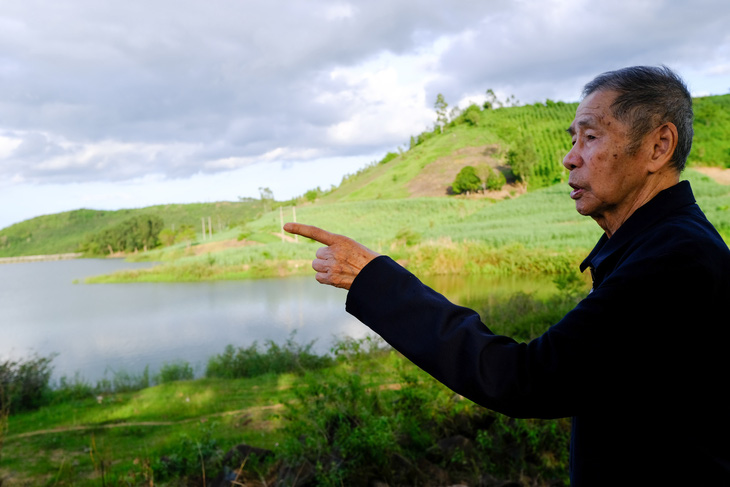
Veteran Thai Diep of the 96th Regiment guesses this is the burial ground for fallen soldiers next to Lake Ktung 4 – Photo: TAN LUC
The place where they lie, shrouded in the hazy memories of their comrades.
At 93 years old, veteran Nguyen Anh Hoi, residing in An Khe town (Gia Lai province), was overcome with emotion when asked about the burial place of fallen soldiers. About an hour into the battle, Mr. Hoi was hit by a bullet in the shoulder and was taken to a field hospital for emergency surgery.
The surgical station was located on a low hill, only about a kilometer from the battlefield. “From the hospital to the martyrs' burial ground was about 300-400 meters because there were no porters, so we couldn't transport the bodies far. The burial team consisted mainly of local civilian laborers and guerrillas; I doubt many of them are still alive now!” Mr. Hoi said emotionally.
Recalling tragic memories, the old soldier spent many sleepless nights, tears streaming down his face as he remembered his comrades. He grieved for his brothers, who had lain in the desolate mountains for 70 years without receiving any offerings or incense!
According to the recollections of Mr. Pham Long (93 years old), a former youth volunteer, the burial ground was a relatively flat sandy and gravelly area in the middle of a valley, about 3-4 acres wide, covered entirely with oil trees and shrubs.
“Back then, we were rushing to the battlefield, so the burials were very hasty. The graves were only about half a meter deep. The soldiers wrapped whatever they had, mainly tarpaulins, parachute fabric, and a few sets of clothes for the fallen soldiers. Later, we searched for a long time but couldn't find them, and we thought about it a lot. Could it be that during the war, they had to bury the bodies hastily, in the middle of a forest where tigers, leopards, and other wild animals dug up and desecrated the remains of our comrades?” Mr. Long said, his eyes welling up with tears.
Back then, the march was rushed, and burials were done very quickly; the graves were only about half a meter deep. The soldiers wrapped whatever they had, mainly tarpaulins, parachute fabric, and a few sets of clothes for the fallen soldiers...
Veteran Pham Long
A tireless journey to find a shared grave.
Pieced together from fragmented accounts, vague memories, and meager information, the searches repeatedly reached dead ends, but the authorities did not give up.
One day in mid-July 2024, dozens of officers and soldiers from the Fallen Soldiers' Remains Collection Team (K52, Gia Lai Provincial Military Command) landed on a low hillside in Hamlet 2, Dak Po town. On the red soil hillside next to where the locals were tending their corn crops, they divided themselves up, wielding hoes to dig rectangular plots, only to unearth red soil and small pebbles.
For weeks on end, the young soldiers regularly carried shovels and picks up the hillside twice a day, digging with all their might in the hope of finding some trace of the common grave, but there was nothing but earth and rocks.
Lieutenant Dao Xuan Thien decided to choose this location for exploratory excavation because it relatively matched the accounts of the veterans. One person who had participated in burying the fallen soldiers recounted that the burial site was a patch of red soil on a hillside, and after completing their task, they washed their hands in a small stream nearby, not far from a large rock. After surveying, only this area had red soil and was also close to the large rock, fitting the accounts.
Besides the field search team, experienced officers from Team K52 fanned out to nearby villages to gather information. One villager reported that a few years ago, someone digging in an old field had discovered a set of human remains.
Meanwhile, others recounted that many years ago, while hunting, they encountered elderly Ba Na people from the resistance era who told them that the patch of forest in front of the Dak Po monument was where many martyrs had sacrificed their lives.
Following the information, Lieutenant Colonel Hoang Viet Ngoc – political officer of Team K52 – found the landowner, Mr. Do Van Nguyen (60 years old), residing in Hamlet 4, An Thanh Commune, Dak Po District. Hearing that the Provincial Military Command was searching for fallen soldiers, Mr. Nguyen was moved and quickly led the way across the vast sugarcane fields to his family's eucalyptus plantation.
Having cultivated the land for many years, Mr. Nguyen said he had very strange feelings whenever he came here. Although he was a "tough guy" who didn't believe in spiritual matters, this man said he never slept a wink during the nights he stayed in the fields. Therefore, he immediately agreed when Lieutenant Colonel Ngoc suggested excavating the fields for exploration.
Everyone prayed that the heroic martyrs would be gathered in the cemetery so that their spirits could be comforted by the incense offered by their compatriots.
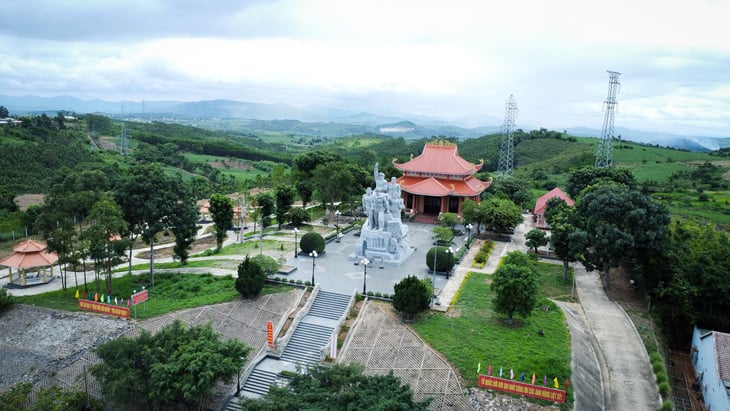
The Dak Po Victory Monument on the hill overlooking National Highway 19 – Photo: TAN LUC
Identify two areas
Leading us to the Ktung 4 irrigation lake area north of the Dak Po victory monument, Lieutenant Colonel Ngoc said that since 2016, soldiers of Team K52 have excavated many locations around the lake. Pointing to the vast expanse of water, Lieutenant Colonel Ngoc said that only the lakebed remains to be excavated.
Before the Gia Lai Provincial Military Command joined the search, starting in 2011, the Dak Po District People's Committee organized numerous workshops to gather information. Through information from the Liaison Committee of Veterans of Regiment 96 and local residents, two areas were identified as potential burial sites for fallen soldiers: the area near the communal house in Kuk Kon village (An Thanh commune) and the surgical station area west of Ktung Lake.
According to the Dak Po District Military Command, since 2016, they have coordinated with Team K52 to conduct numerous excavation and search operations, involving thousands of man-days. In total, they excavated an area of 21,500 square meters but yielded virtually no results.
Except for the 2023 search which uncovered the remains of an unidentified soldier in Hamlet 4, An Thanh Commune.
Tuoitre.vn
Source: https://tuoitre.vn/70-nam-sau-chien-thang-dak-po-van-dau-dau-tim-mo-147-liet-si-20240727075336029.htm


![[Photo] Prime Minister Pham Minh Chinh holds a phone call with the CEO of Russia's Rosatom Corporation.](/_next/image?url=https%3A%2F%2Fvphoto.vietnam.vn%2Fthumb%2F1200x675%2Fvietnam%2Fresource%2FIMAGE%2F2025%2F12%2F11%2F1765464552365_dsc-5295-jpg.webp&w=3840&q=75)






























































Comment (0)