


Attending and speaking at the opening ceremony at Plekhanov University of Economics were Deputy Prime Minister of the Russian Federation Dmitry Chernyshenko, Co-Chairman of the Russian-Vietnamese Intergovernmental Committee on Trade, Economic, Scientific and Technical Cooperation; First Vice Chairman of the Federation Council Andrei Yatskin; Deputy Minister of Education and Science of the Russian Federation Konstantin Mogilevsky; Vietnamese Ambassador to the Russian Federation Dang Minh Khoi; Permanent Vice President of the Vietnam Academy of Science and Technology Tran Hong Thai; and Rector of Plekhanov University of Economics Ivan Lobanov. In addition, numerous leaders from ministries, departments, and higher education institutions of Russia and Vietnam also participated.
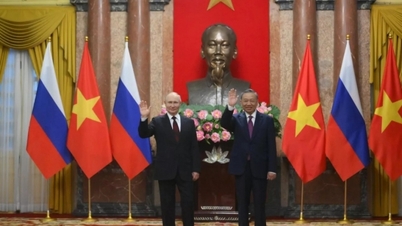
Welcoming the scientists, Russian Deputy Prime Minister Chernyshenko emphasized that this year the two countries are celebrating the 75th anniversary of the establishment of diplomatic relations, and President Vladimir Vladimirovich Putin stressed that over the years, the two countries have developed a special relationship. Russia was honored to welcome General Secretary To Lam on an official visit in May, and he attended events commemorating the 80th anniversary of the Great Patriotic War. According to Deputy Prime Minister Chernyshenko, organizing the "Russia - Vietnam: 75 Years of Cooperation" Forum at Plekhanov University of Economics – which has more than 1,000 international students, including 263 high-achieving students from Vietnam – is of great significance.
Meanwhile, First Vice President of the Federation Council Andrei Yatskin said that during his recent visit to Vietnam, he clearly sensed the aspiration for innovation and achievement in Vietnam. The Vietnamese people have confidence in the success of the major higher education projects that the two countries will complete in 2026.

In a video message sent to the Forum, Deputy Prime Minister Tran Hong Ha recalled his years of study in Russia. He called the training of human resources in the former Soviet Union an invaluable strategic contribution to Vietnam's development, like giving Vietnam a "golden key" to knowledge. Many generations of Vietnamese scientists, leaders, and managers have grown up under the education system of the Soviet Union and Russia today, becoming invaluable assets and a "red thread" connecting the two nations. Building on that historical foundation, both sides aim for reliable, strong, and effective cooperation in the digital age and the knowledge economy to jointly create a prosperous future for each country as well as the progress of humanity. Mr. Tran Hong Ha suggested that, in addition to the traditional strength in basic science, the two countries could expand cooperation to research strategic technologies.
Ambassador Dang Minh Khoi emphasized that cooperation in science and education has been and will continue to be a solid bridge between the two countries, established since the early years of diplomatic relations when President Ho Chi Minh sent the first group of officials to study in the Soviet Union.
The first day's program of the Forum included a plenary session on strategic partnerships, the signing ceremony of the marine research roadmap, and discussion sessions on hydrology, ecology, biomedical science, and pharmacology.

Speaking with a Vietnam News Agency (VNA) reporter in Russia, Professor, Dr. Tran Hong Thai - Permanent Vice President of the Vietnam Academy of Science and Technology (VAST) - emphasized that science and technology is a field of long-term cooperation. Over the past 75 years, cooperation between Vietnam and the Soviet Union and the Russian Federation in this field has helped build a solid foundation for the adoption of technology from Russia as well as other countries around the world. The year 2026 has been chosen to focus on science and training, ushering in an era of long-term strategies in cooperation. Regarding future directions and prospects, Professor, Dr. Tran Hong Thai stated that from basic sciences, cooperation will expand to other necessary fields for Vietnam such as nuclear energy, high-speed rail technology, heat-resistant materials technology, and technologies related to ecology.
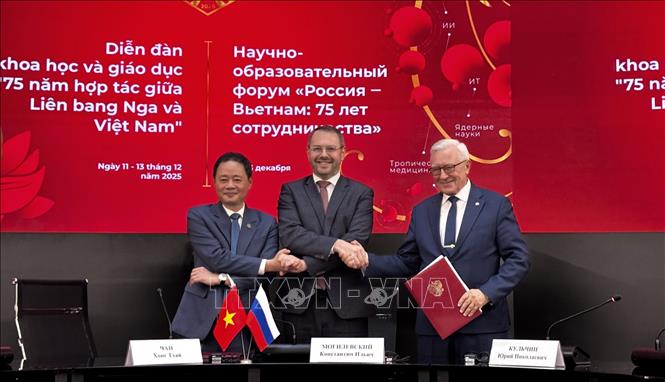
On the same day, Professor, Doctor Tran Hong Thai and Professor Academician, Vice President of the Russian Academy of Sciences Yuri Kulchin signed a cooperation agreement between the two Academies.
Regarding another crucial aspect of cooperation, namely finance, Mr. Ngo Si Quoc, Deputy Executive Director of the National Foundation for Science and Technology Development (NAFOSTED), stated that the Foundation recently signed a memorandum of understanding with the Russian Science Foundation (RSF) on coordinating the selection and funding of advanced research projects in the fields of natural sciences, engineering, social sciences, and humanities. RSF will provide funding to Russian research groups ranging from 4 to 7 million rubles per year, depending on the project size, while NAFOSTED will support Vietnamese research groups with a maximum of 10 billion VND for a 3-year period, and may consider increasing support for projects with exceptional academic value or high potential for application. The readiness of both countries to provide financial resources for scientific cooperation demonstrates their confidence in effective collaboration in this field.
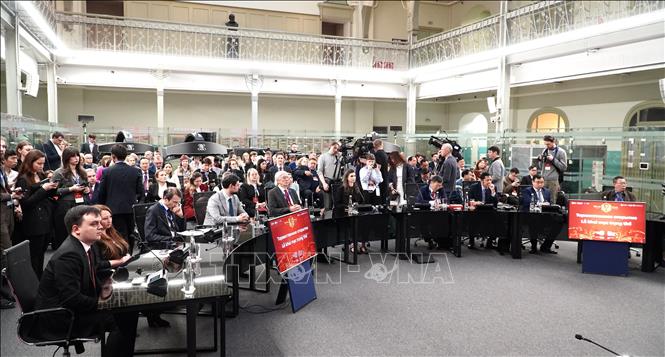
During the forum, numerous discussions also took place on social and humanitarian cooperation, inter-university collaboration, and cultural dialogue.
Source: https://baotintuc.vn/thoi-su/75-nam-quan-he-viet-nam-nga-soi-chi-do-xuyen-suot-ket-noi-hai-dan-toc-20251212080541269.htm















![[Photo] Prime Minister Pham Minh Chinh holds a phone call with the CEO of Russia's Rosatom Corporation.](/_next/image?url=https%3A%2F%2Fvphoto.vietnam.vn%2Fthumb%2F1200x675%2Fvietnam%2Fresource%2FIMAGE%2F2025%2F12%2F11%2F1765464552365_dsc-5295-jpg.webp&w=3840&q=75)













































Comment (0)