

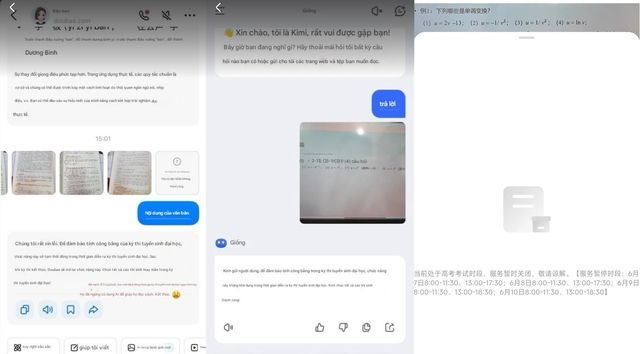
Users cannot use AI or certain functions during China's college entrance exam period.
PHOTO: SCREENSHOT
The Guardian reported on June 9 that many major Chinese technology corporations are said to have temporarily suspended services or disabled some features of popular AI tools during the college entrance exam (gaokao). The incident was mainly reported by students, while the relevant parties did not make any official statements and also refused to comment when contacted by the media.
Accordingly, some photos shared on social networks show that when users sent exam questions to Doubao, an AI application owned by ByteDance (TikTok's parent company), the system responded that: "During the ongoing university entrance exam, the question answering service will be suspended according to relevant regulations." This response remains the same even if users try to trick the AI with other commands.
Similarly, another screenshot shows DeepSeek, China’s hottest AI generator, also announcing that it will stop providing services during certain time frames “to ensure the fairness of the country’s college entrance exam.” Other AI platforms such as Yuanbao (owned by Tencent), Alibaba’s Qwen, and Moonshot’s Kimi have also suspended their image recognition functions during the exam period, according to Bloomberg .
Restricting AI is not the only measure China has taken to prevent cheating in the gaokao, which is considered to be the most important exam for a citizen of this country. Recently, many localities in the country of a billion people have announced the deployment of AI monitoring technology in all exam rooms with the aim of detecting unusual behavior of both candidates and invigilators.
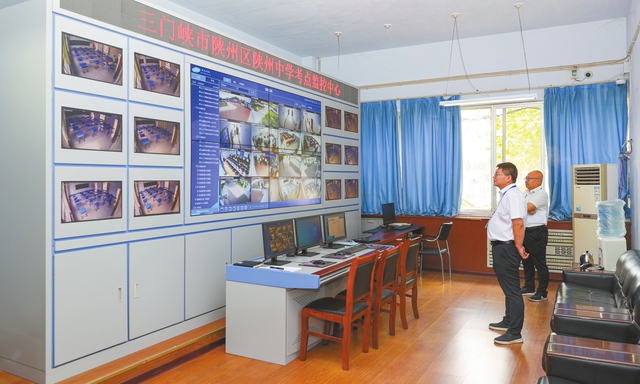
AI monitoring system deployed at a high school in Henan province, China
PHOTO: GLOBAL TIMES
According to China Central Television (CCTV) , the above technology is being deployed in Jiangxi, Guangdong, Hubei provinces..., contributing to building a "double fence" between technology and exam regulations. Many behaviors such as starting the test early, turning around, moving objects... by candidates or handling the test incorrectly, standing too close to candidates... by invigilators will all be recognized and recorded by the AI system, then strictly handled according to regulations.
Late last month, the Chinese government also announced increased entrance checks at testing sites, including the use of biometric recognition technology, screening of electronic devices, and the installation of signal jammers to ensure the seriousness of the exam. Some cities have chosen to postpone public events, delay office hours, and open priority lanes to help candidates arrive at test sites on time.
The university entrance exam in China took place from June 7 to 9, attracting 13.35 million candidates nationwide, the first time the number of candidates has decreased in nearly a decade, according to the Chinese Ministry of Education. Candidates take three compulsory subjects: literature, math and foreign language, along with one main elective subject (history or physics) and two additional elective subjects (chemistry, geography, political ideology or biology).
Source: https://thanhnien.vn/ai-bi-han-che-tinh-nang-khi-trung-quoc-to-chuc-thi-tuyen-sinh-dh-185250610131901577.htm
![[Photo] National Assembly Chairman Tran Thanh Man attends the VinFuture 2025 Award Ceremony](/_next/image?url=https%3A%2F%2Fvphoto.vietnam.vn%2Fthumb%2F1200x675%2Fvietnam%2Fresource%2FIMAGE%2F2025%2F12%2F05%2F1764951162416_2628509768338816493-6995-jpg.webp&w=3840&q=75)


![[Photo] 60th Anniversary of the Founding of the Vietnam Association of Photographic Artists](/_next/image?url=https%3A%2F%2Fvphoto.vietnam.vn%2Fthumb%2F1200x675%2Fvietnam%2Fresource%2FIMAGE%2F2025%2F12%2F05%2F1764935864512_a1-bnd-0841-9740-jpg.webp&w=3840&q=75)

































































Comment (0)