

Almost every Khmer family in Tri Ton district and Tinh Bien town, An Giang province, has from a few to several dozen palm trees planted along the land boundaries, both to prevent soil erosion and to provide income for the people.
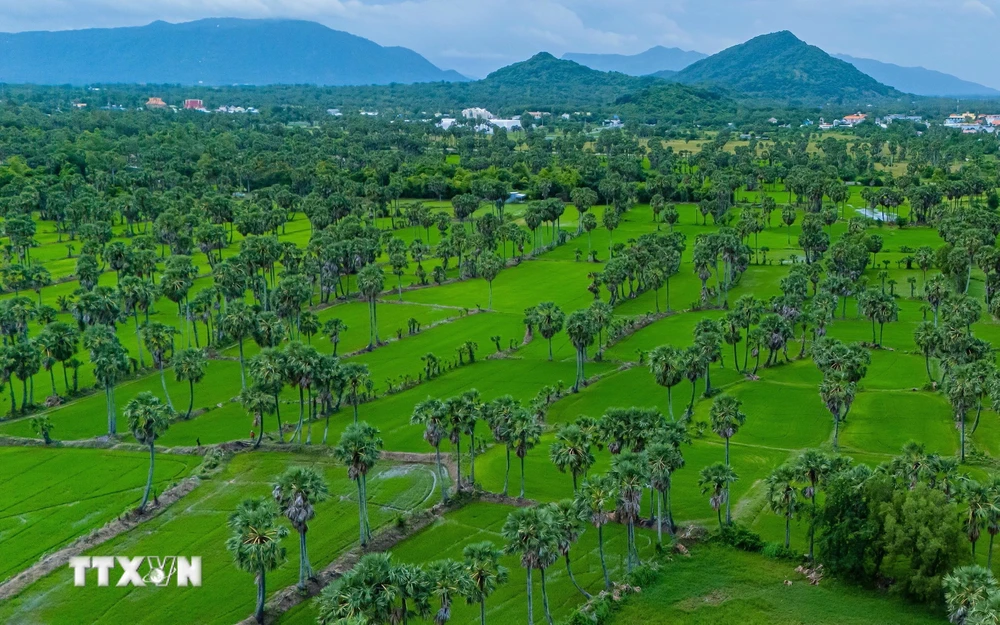
For the Khmer people in the Bay Nui region of An Giang province, the palmyra palm has long been familiar and closely associated with their daily lives.
The word "thốt nốt" originates from the Khmer word "th'not." Locals sometimes pronounce it as "thốt nốt," and the word has become familiar to locals and people throughout the country.
The origins of palm sugar making
Almost every Khmer family owns from a few to several dozen palm trees. Typically, Khmer people plant palm trees along their land boundaries, both to prevent soil erosion and to provide income. The trees only bear fruit and produce palm sap after 15 years or more.
The story of making sugar from palm trees is a legend passed down through generations of the Khmer people.
The story goes: "There was a farmer tending his cows who was resting under a palm tree at noon. While dozing off, he was suddenly startled awake by a drop of sweet water falling from above into his mouth. He sat up and looked around but couldn't see anything. Curious, he climbed the tree to investigate and discovered that the drops of water had fallen from the broken top of the palm tree. He quickly took his bamboo water container and collected the water, a gift from Heaven, to show his wife and children."
Since then, the people have maintained the custom of using bamboo tubes to collect palm sap from the trees. Because palm sap ferments and turns sour if left for a long time, rendering it unusable, the Khmer people devised a way to process it into alcohol and concentrate it into palm sugar as it is today.
Typically, the palm sugar harvest begins in October of the lunar calendar year and lasts until April of the following lunar calendar year. In An Giang province, the Khmer people climb the palm trees and use containers to collect the sap from the flower stalks. This sap is then used by the locals to make sugar, resulting in batches of golden, fragrant, and delicious palm sugar.
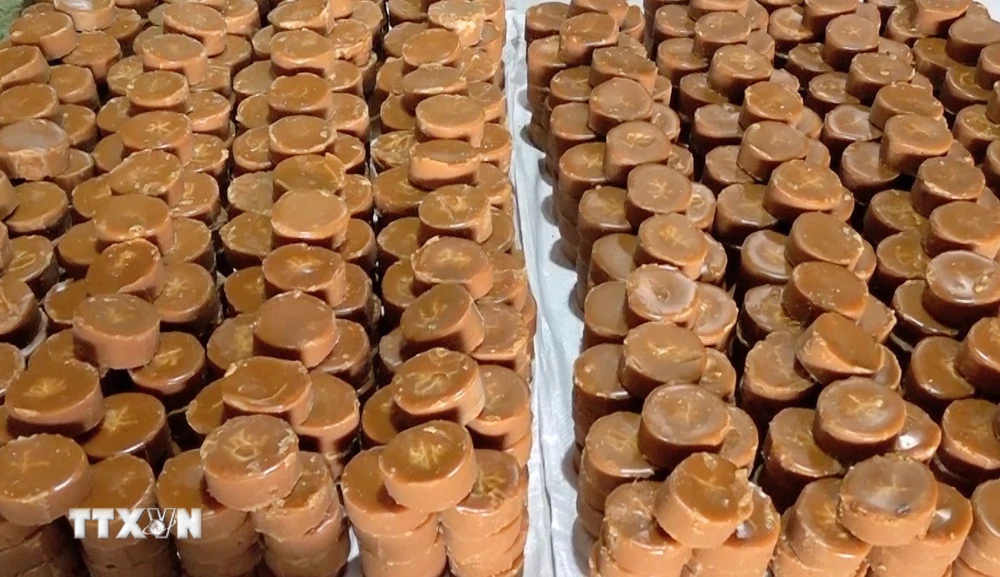
Palm trees are known in the market for their fragrant and refreshing palm sugar, used in making desserts or preparing various dishes. Its refreshing taste enhances the flavor of food and also has cooling properties, helping to soothe sore throats. The process of making palm sugar is quite elaborate, and the quality of the sugar can vary depending on the skill of the craftsman.
The sap from the palm tree must be boiled and reduced to a liquid syrup on the same day because if left for too long, it easily turns sour due to the fermentation process occurring inside the palm sap.
The kiln is built right inside the house and can use various fuels for the fire, such as rice husks, firewood, coal, etc., but rice husks are the most common because they are easy to find and inexpensive. The secret lies in the fact that by observing the boiling point of the sugar, the craftsman can know and adjust the kiln temperature precisely. In addition, intuitively, the craftsman can tell the sugar content by tasting the palm sap and calculate the amount of lime to add to neutralize the acidity.
The sugar is poured into a pot and melted to remove impurities from the previous processing. The sugar temperature must not exceed 80 degrees Celsius because if the temperature is too high, the sugar will caramelize and turn dark yellow, reducing its quality.
The cook must stir continuously and skim off the foam and impurities on top of the sugar until the water inside the sugar evaporates and the sugar thickens. The liquid sugar is then poured into cylindrical molds made from cut-up tin cans or beer cans placed on a flat surface.
The natural cooling process of sugar is when it crystallizes into fine crystals. If you bite into a piece, the sweet and rich taste of the palm sugar crystals dissolving in your mouth will be an unforgettable experience for visitors from afar. Therefore, palm sugar has traveled with friends across the globe, affirming its status as a specialty of An Giang province.
Furthermore, all parts of the palm tree are utilized by the locals: the old trunk is used to make tables and chairs, the leaves are used for roofing, the pulp and fruit are used to make refreshing drinks, and the sap can be fermented to make palm wine called arac wine or concentrated to make palm sugar.
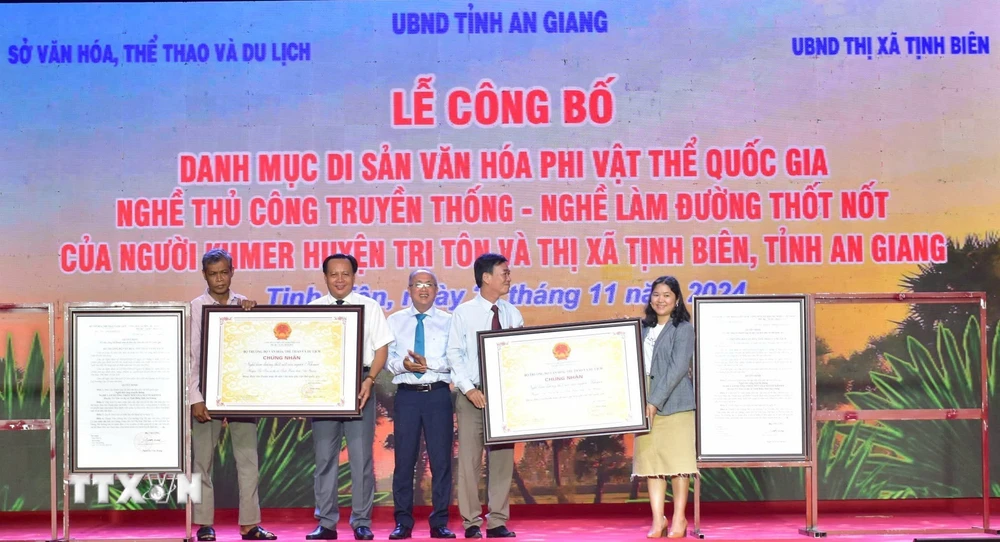
Palm sugar has been recognized as a National Intangible Cultural Heritage.
Over time, with generations of traditional folk experience, the people of Tri Ton district and Tinh Bien town have preserved the secrets of making palm sugar, a craft recognized as a distinctive National Intangible Cultural Heritage of the region. Palm sugar is an ingredient in many delicious dishes such as sweet soups and pickled vegetables, but the most distinctive is the famous palm sugar rice cake.
On November 27th, speaking at the ceremony announcing the decision of the Minister of Culture, Sports and Tourism to inscribe the palm sugar making craft of the Khmer people in Tinh Bien town and Tri Ton district into the National Intangible Cultural Heritage list, Mr. Truong Ba Trang, Deputy Director of the Department of Culture, Sports and Tourism of An Giang province, congratulated the local authorities, the palm sugar making artisans, and the Khmer people in Tinh Bien town and Tri Ton district on receiving this special honor.
Simultaneously, it was determined that the Department of Culture, Sports and Tourism, together with local authorities, will develop a plan to preserve and promote the value of the palm sugar making craft in the period 2025-2030.
Before the Khmer palm sugar making craft was recognized as a National Intangible Cultural Heritage, An Giang province had 7 recognized heritages, including the Via Ba Chua Xu Nui Sam Festival; the Bay Nui Bull Racing Festival; the knowledge and techniques of writing on palm leaves of the Khmer ethnic group; the Ky Yen Festival at Thoai Ngoc Hau communal house, Thoai Son district; the life cycle rituals of the Cham Muslims in Tan Chau town and An Phu district; the brocade weaving craft of the Cham people in Chau Phong commune, Tan Chau town; and the Di Ke theatrical performance art of the Khmer people in O Lam commune, Tri Ton district.
Finding a new direction for palm sugar
According to Mr. Truong Ba Trang, Deputy Director of the Department of Culture, Sports and Tourism of An Giang province, the palm tree not only brings economic value to the people, but also contains national cultural values, especially the culture of the Khmer people, contributing to the preservation and promotion of local traditional crafts.
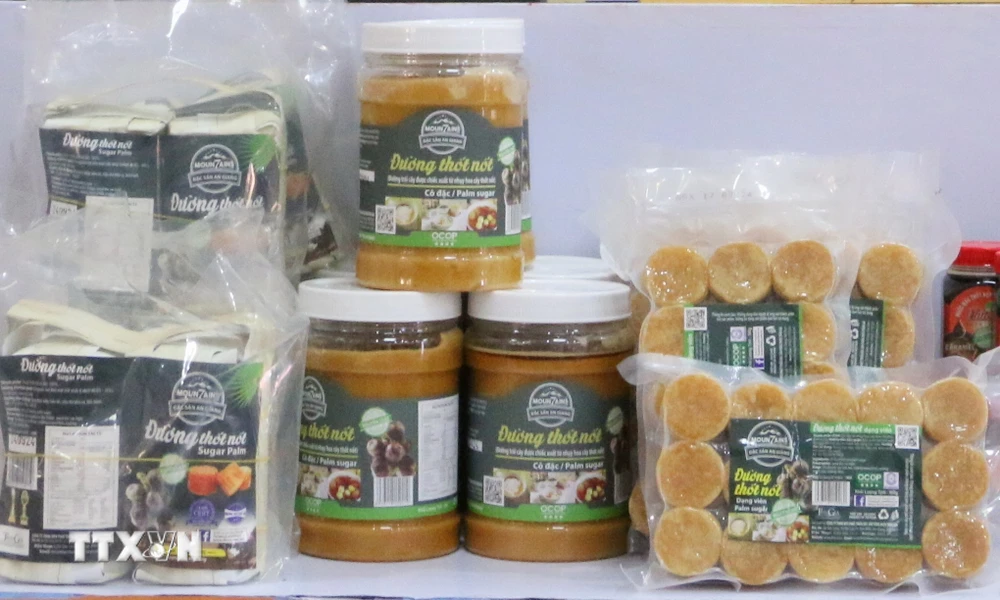
Nowadays, the palmyra palm is not only famous for its sweet sap used to make sugar, but also for many other products such as palmyra palm wine, palmyra palm juice, palmyra palm tea, palmyra palm jelly, palmyra palm leaf paintings, palmyra palm rice cakes, candied palmyra palm, palmyra palm jam, palmyra palm coloring, etc., which are supported in developing into OCOP (One Commune One Product) products.
According to statistics from Tinh Bien town, the entire town has 305 palm sugar production facilities, with 780 workers directly involved in production, yielding 3,138 tons annually. Among the famous palm sugar production facilities in Nha Bang town, Tinh Bien district, An Giang province, notable examples include Ngoc Trang and Lan Nhi. Their palm sugar has been exported to countries such as Taiwan, Japan, South Korea, and the United States, and is highly favored by locals for its unique flavor.
To contribute to the revitalization and progress of the palm sugar making craft of the Khmer people in the Bay Nui region of An Giang province, Deputy Director of the Provincial Department of Culture, Sports and Tourism, Truong Ba Trang, believes that in the coming time, support from all levels of government and relevant agencies is needed in creating policy mechanisms, providing vocational training, connecting and finding markets for products, promoting the development of craft village tourism to help people have more livelihoods and stay committed to the craft, and strengthening communication and promotion of the craft village...
In addition, the Khmer people need to promote awareness of preserving traditional crafts, contributing to the preservation of ethnic culture; proactively access and expand marketing channels, especially social media platforms… Coordinate with tourism tours, inviting visitors to come and learn about and experience…
In An Giang, while many other traditional crafts are gradually disappearing, the palm sugar making craft continues to thrive; providing livelihoods for the people while contributing to preserving and promoting traditional culture in modern life.
Not only has Chau Ngoc Diu, the female General Director of Palmania Joint Stock Company in Tri Ton district, An Giang province, established the Palmania palm sugar brand in the market with a 4-star OCOP rating and a 2-star Great Taste Awards, but she is also a pioneer in bringing An Giang province's palm sugar products to the European market.
That woman has contributed to elevating the value of traditional palm sugar products of the Khmer people in the Bay Nui region of An Giang province.
Despite knowing that exporting to the Netherlands and Europe has strict requirements and standards, Ms. Dịu strived to perfect her products to bring the first official shipment to the Netherlands in July 2021, and then continued to expand the market to Sweden, Finland, and several other markets.
"After the European market, we hope that in the future, Palmania palm sugar products can conquer other demanding international markets such as Japan and the United States, thereby helping the palm trees of An Giang people reach further," Ms. Dịu shared.
Source: https://www.vietnamplus.vn/an-giang-bao-ton-va-phat-huy-nghe-lam-duong-thot-not-cua-dong-bao-khmer-post995940.vnp

![[Photo] Closing Ceremony of the 10th Session of the 15th National Assembly](/_next/image?url=https%3A%2F%2Fvphoto.vietnam.vn%2Fthumb%2F1200x675%2Fvietnam%2Fresource%2FIMAGE%2F2025%2F12%2F11%2F1765448959967_image-1437-jpg.webp&w=3840&q=75)
![[Photo] Prime Minister Pham Minh Chinh holds a phone call with the CEO of Russia's Rosatom Corporation.](/_next/image?url=https%3A%2F%2Fvphoto.vietnam.vn%2Fthumb%2F1200x675%2Fvietnam%2Fresource%2FIMAGE%2F2025%2F12%2F11%2F1765464552365_dsc-5295-jpg.webp&w=3840&q=75)





































![[OFFICIAL] MISA GROUP ANNOUNCES ITS PIONEERING BRAND POSITIONING IN BUILDING AGENTIC AI FOR BUSINESSES, HOUSEHOLDS, AND THE GOVERNMENT](https://vphoto.vietnam.vn/thumb/402x226/vietnam/resource/IMAGE/2025/12/11/1765444754256_agentic-ai_postfb-scaled.png)












































Comment (0)