

To make this unique cake, the locals have to put in a lot of effort right from the first step. Ant eggs only appear in abundance during the Qingming Festival, pure white and rich in flavor. To collect them, people have to follow the hillsides, find ant nests on high branches, then skillfully scare the ants away, after which they sift through the eggs and bring them back to make the cake.
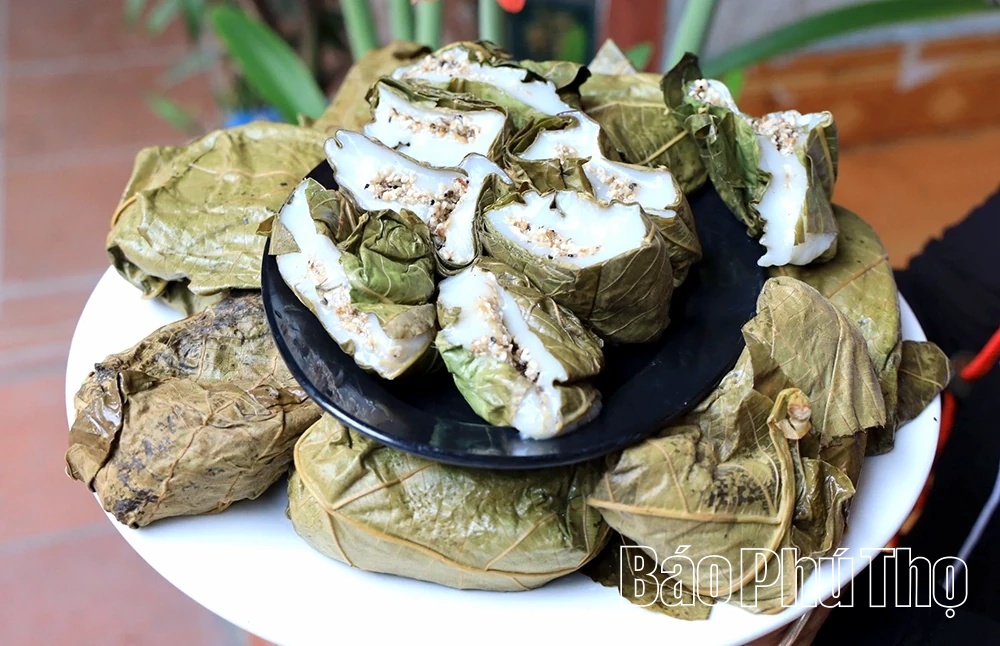
Ant egg cake - a unique dish of the San Diu people.
Ms. Duong Thi Sau from Dong Gieng village said: "The steps in making ant egg cakes are not simple at all, but it's a tradition passed down through generations, so no one is afraid of the difficulty. We make them every year. Since we were children, our parents gave us these cakes to eat, and as we grew up, we taught ourselves how to make them and then passed the knowledge on to our children and grandchildren. Every family looks forward to this occasion to enjoy the cakes they made themselves."
The ingredients for ant egg cakes are also unique. Glutinous rice – a famous fragrant and sticky rice from the Tam Dao region – is finely ground to make the cake's outer layer. There are two types of fig leaves: young, small leaves for the inner wrapping; and older, larger leaves for the outer wrapping. When wrapping, a layer of glutinous rice flour is spread on the fig leaf, the ant egg filling (which has been lightly stir-fried to enhance the aroma) is evenly distributed, then folded in half, shaped into a square, and wrapped with another layer of leaves. The cake is steamed for about twenty minutes until cooked, then cooled and cut in half with scissors before being served. The special thing is that when eating, diners enjoy the fig leaf layer inside, creating a rich, unique, and unforgettable flavor.

The process of making ant egg cakes is extremely elaborate and laborious, resulting in a unique flavor that sets them apart from other types of cakes.
Enjoying a hot cake fresh from the pot, one can clearly feel the harmonious blend of the chewy texture of glutinous rice, the rich flavor of ant eggs, and the earthy taste of the ngoa leaves. The cooler it gets, the better it tastes, and it can be kept for two to three days without refrigeration. However, this is also a dish that may not appeal to everyone, as some people are allergic to insects and may experience itching after eating it. Therefore, those trying it for the first time should eat a small amount to test their body's reaction.
Besides making them for offerings and family consumption, many households also sell these cakes to visitors from afar. Mrs. Sau's family receives hundreds of orders every year. Mrs. Sau happily shared: "We're very happy to earn extra income and introduce our ethnic group's traditional dish to tourists." Therefore, ant egg cakes are not only a familiar dish on the Thanh Minh (Qingming) festival feast table but have also become a highly anticipated specialty each year.

Ant egg cakes have become a popular delicacy, with many tourists ordering them as souvenirs, creating an additional source of income for local people.
According to local leaders, the San Diu people have a custom of visiting ancestral graves on Thanh Minh (Qingming Festival). After offering incense in the fields, families return home and prepare a feast to worship their ancestors, which always includes ant egg cakes. This simple cake is a connecting thread between generations, a symbol of community solidarity, and a representation of filial piety towards ancestors.
Local authorities also consistently encourage people to preserve this traditional dish as part of their cultural identity, contributing to enriching the treasure trove of Vietnamese cuisine . From the mountains of Tam Dao, ant egg cake not only nurtures the memories of generations of San Diu people but also becomes a bridge bringing the ethnic cultural identity to friends near and far.
Le Minh
Source: https://baophutho.vn/banh-trung-kien-huong-vi-nui-rung-doc-dao-cua-nguoi-san-diu-239299.htm
![[Photo] Closing Ceremony of the 10th Session of the 15th National Assembly](/_next/image?url=https%3A%2F%2Fvphoto.vietnam.vn%2Fthumb%2F1200x675%2Fvietnam%2Fresource%2FIMAGE%2F2025%2F12%2F11%2F1765448959967_image-1437-jpg.webp&w=3840&q=75)
![[Photo] Prime Minister Pham Minh Chinh holds a phone call with the CEO of Russia's Rosatom Corporation.](/_next/image?url=https%3A%2F%2Fvphoto.vietnam.vn%2Fthumb%2F1200x675%2Fvietnam%2Fresource%2FIMAGE%2F2025%2F12%2F11%2F1765464552365_dsc-5295-jpg.webp&w=3840&q=75)































![[OFFICIAL] MISA GROUP ANNOUNCES ITS PIONEERING BRAND POSITIONING IN BUILDING AGENTIC AI FOR BUSINESSES, HOUSEHOLDS, AND THE GOVERNMENT](https://vphoto.vietnam.vn/thumb/402x226/vietnam/resource/IMAGE/2025/12/11/1765444754256_agentic-ai_postfb-scaled.png)































Comment (0)