

TPO - Instead of wallowing in tragedy, step out and fight adversity. What if you're disabled? You can still do things others can't, with your own willpower and determination. That's how Cao Ngoc Hung rose above his disability.
The Olympics are where heroes are created, like Hoang Xuan Vinh for example. And the Paralympics are where heroes emerge. Just by going there, these disabled athletes show everyone that they truly are heroes, overcoming their fate, fighting for recognition, and then winning to prove that nothing is impossible.
And here we have a "superman" - the disabled athlete Cao Ngoc Hung.
 |
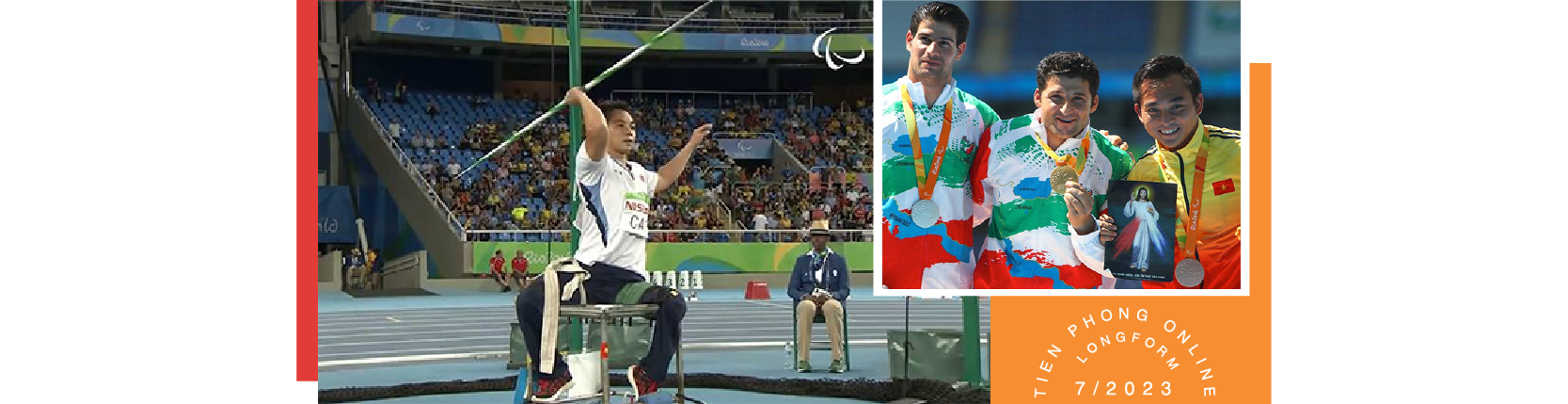
On a summer evening in 2016 at the Estedio Olimpico in Rio de Janeiro, Brazil, Ngoc Hung leaned back in his wheelchair and, with all his might, threw a javelin into the air. The javelin soared, carrying with it his hope and his prayer…
Hung understood that winning a medal at the 2016 Paralympic Games was extremely difficult, even impossible. According to previous statistics, the top two athletes were far ahead of the rest. There were about seven competitors vying for the bronze medal, and Hung was ranked sixth, only a few points ahead of them.
 |
"When many competitors successively threw past the 42m mark, while my career best was 41.71m, it was obvious I had no chance of winning a medal. To surpass them, I would have to throw up to 43m, which was impossible for me," Cao Ngoc Hung recalled.
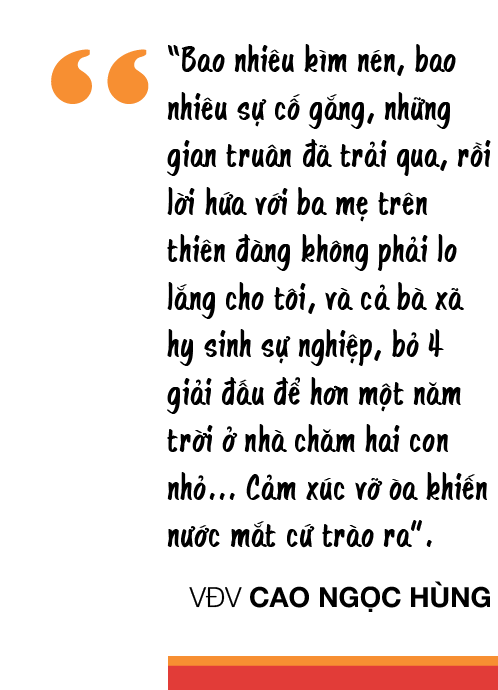 |
In that moment, images of his parents, wife, and children, along with the years of hardship, effort, and sacrifice, flashed through his mind. He was fighting not only for himself, but for his family. Therefore, he had to win at all costs.
After flying far enough, the harpoon pointed downwards and embedded itself in the grass. Hung reached a height of 43.91 meters, much to the astonishment of everyone present.
It was incredible. He not only broke his own best but also surpassed his competitors. But the competition wasn't over yet. Hung still had to wait a little longer, after the other two athletes had finished their throws, to find out if he would win the bronze medal.
Then the long-awaited moment arrived. Cao Ngoc Hung became the first athlete in the history of Vietnamese disabled athletics to win a medal at the Paralympic Games. "Oh my God, I was so nervous. When I found out I had won a medal, I was overjoyed beyond words," he recalled emotionally.
 |
Many years ago in Tuyen Hoa, Quang Binh , a boy returned home after receiving a polio vaccination. His mother discovered his left leg was swollen. The only thing she could do was try a folk remedy, applying heated papaya leaves to the swollen area. It was ineffective, and his left leg gradually atrophied.
Hung said that in his early years, he wasn't aware of his disability. It wasn't until second grade that curious stares and malicious teasing began to bother him. Many times he wondered why such terrible things happened to him? Why was he different? Why couldn't he be like other children?
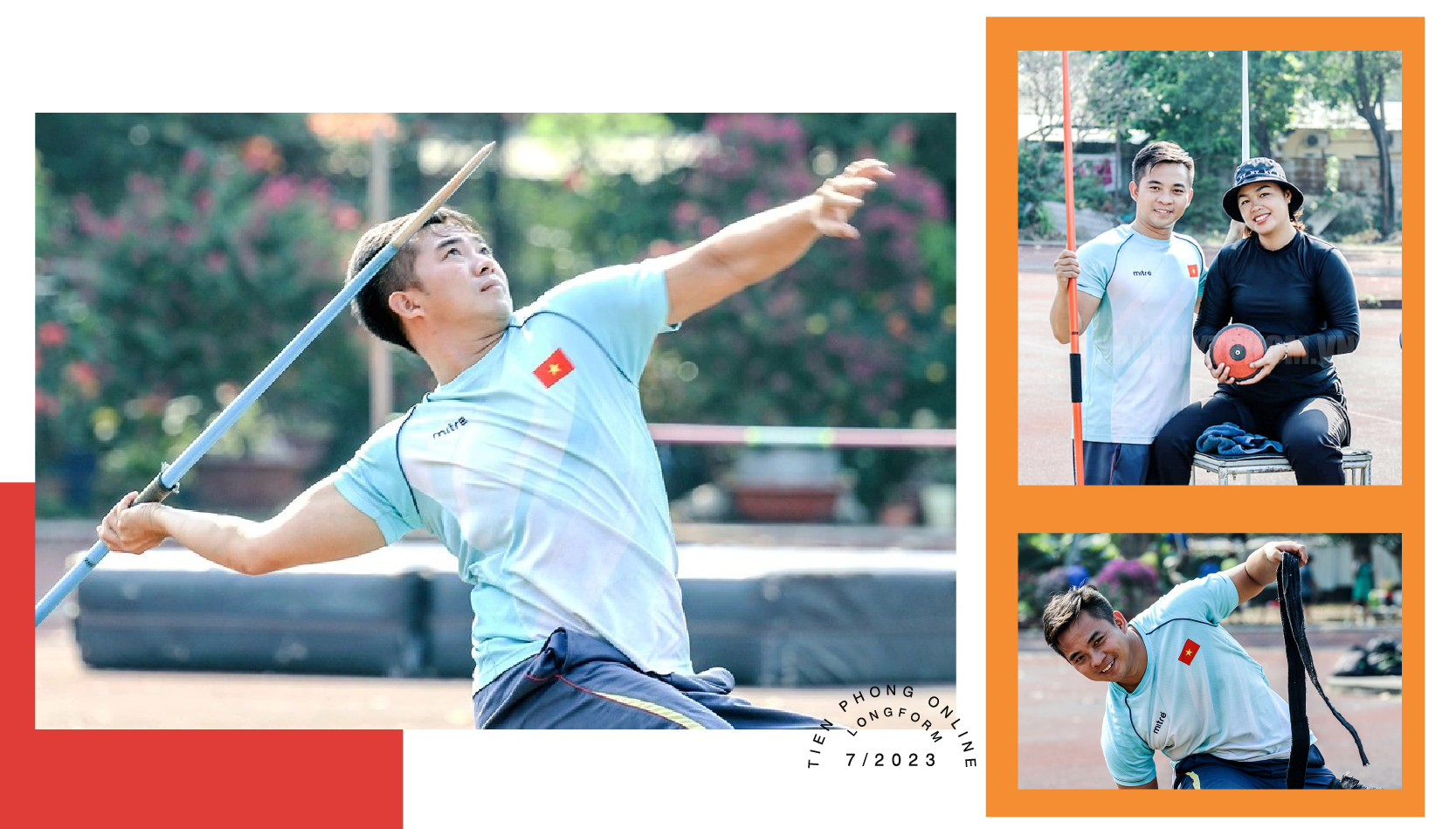 |
Hung's inferiority complex continued until his sixth grade year, when his physical education teacher suggested he join the sports team. Hung's initial reaction was to look at the teacher with a skeptical expression. "Are you kidding me, teacher? Playing sports? With a body like this?" he thought.
Then the teacher said, "If you play sports for people with disabilities, you'll get lots of prizes." And so Hung agreed. Hung's family was very poor. His father was a militia member in the neighborhood with only a symbolic salary, and the family's finances depended entirely on his mother, who worked as a part-time house cleaner. Their income was meager, while the family had so many members, and Hung was in this condition. Playing sports and winning prizes would at least make his parents happy, and maybe help ease their financial burden a little.
If we're talking about athletic talent, perhaps Hung doesn't have it. But he plays with determination and willpower, with his family as his motivation. That's how Hung made a name for himself at the Asian Youth Paralympic Games, winning three gold medals in the 100m race, long jump, and javelin throw. Besides the glittering medals, Hung also brought home 2,350,000 VND in prize money for his parents. He gave it to them, only asking to keep some for a celebratory meal with friends and to buy some essential training equipment.
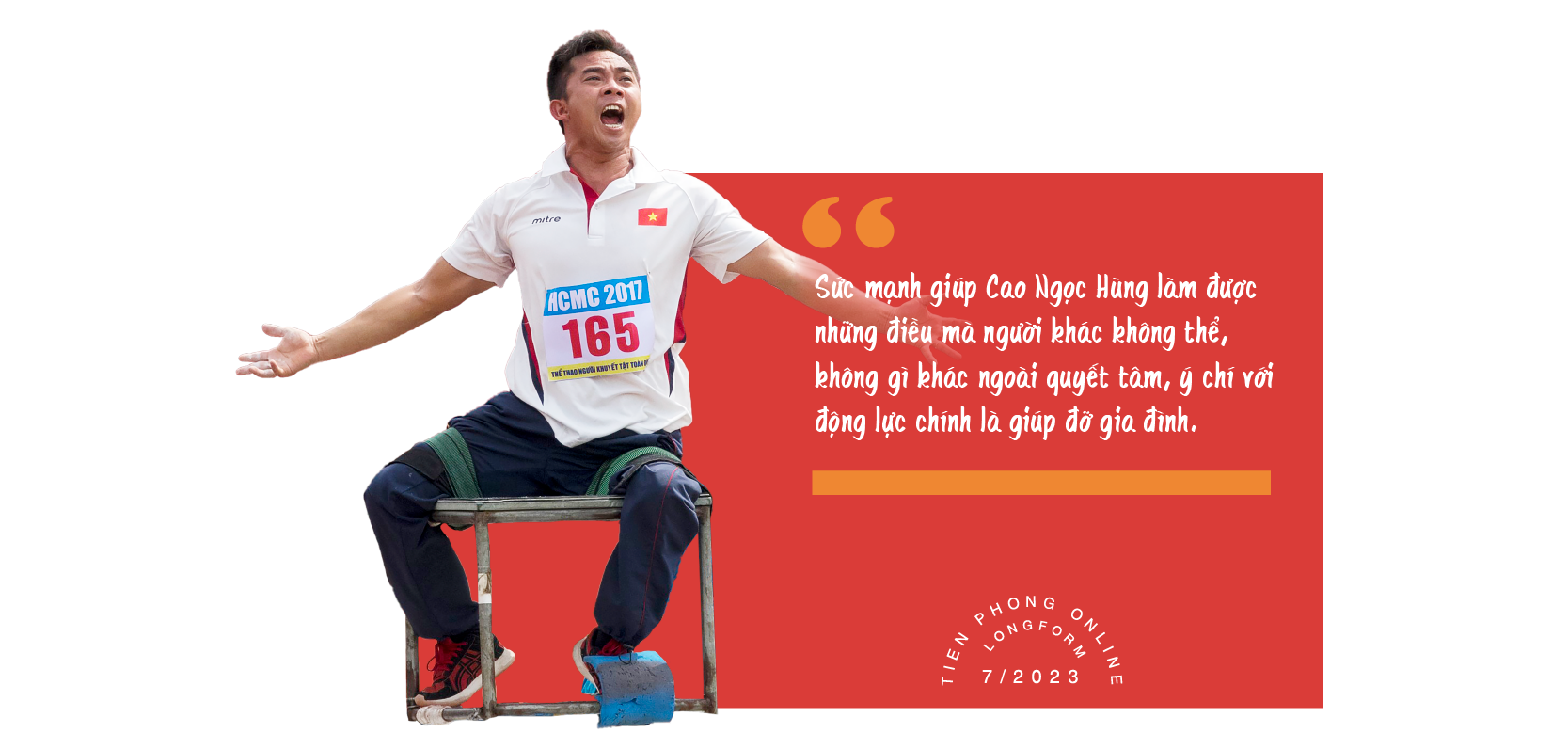
While many of his peers were only focused on studying, Hung, despite his disability, earned money to help his parents. His long-standing feelings of inferiority gradually faded away. Hung knew he could do things others couldn't. He became stronger.
 |
 |
But everything was just beginning, and many challenges awaited Cao Ngoc Hung. Since 2005, he has been using a wheelchair. This change boosted Hung's confidence by concealing his limp. However, it was difficult to adapt to the feeling of being restricted, and being limited to using only his upper limbs restricted his throwing power. Hung was forced to practice more advanced exercises, constantly strengthening his shoulder and arm muscles.
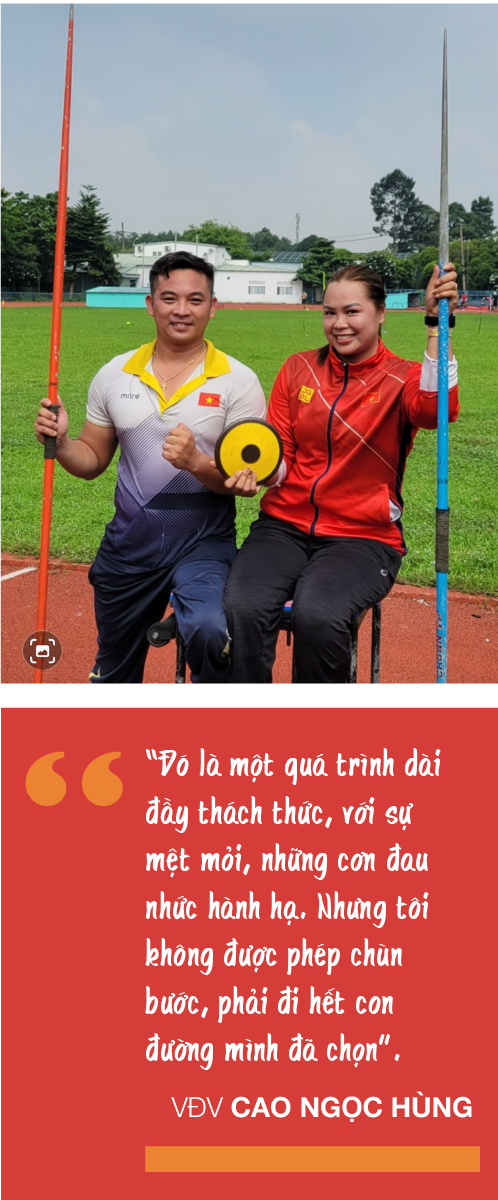 |
"It was a long and challenging process, filled with fatigue and agonizing pain," Hung said.
Around that same time, his mother, the family's main breadwinner, suffered a severe stroke, leaving her paralyzed on one side. His father was also getting old, and his siblings had all gotten married and had countless responsibilities. With no other options, Hung had to drop out of school to help his sister sell pho, and also took on various odd jobs like selling shoes on the street, anything to earn money.
Every day, Hung had to wake up at 4 a.m. to help his sister set up the stall, carry things, and sweep. At 8:30, he would ask his sister's permission to go to his fitness class, returning at 11 a.m. to stand guard at the stall so his sister could rest. Only when his sister came down at 1:30 p.m. could he get a short nap before rushing to the Phu Tho Stadium for his professional training. By 6:30 p.m., Hung was back at the stall, continuing to sell with his sister until late at night. This routine repeated itself for years, enough to break even the strongest person. But Hung didn't.
"Sometimes it's tough, but I need to keep going. Once I've chosen a path, I have to see it through; I can't afford to falter. I think if I turned in a different direction, I'd have to start all over again, which would be even more difficult. I have to train and give 100% effort with the thought that winning a medal will provide money for my mother's medication, and to take care of my father and twin sister," Hung confided.
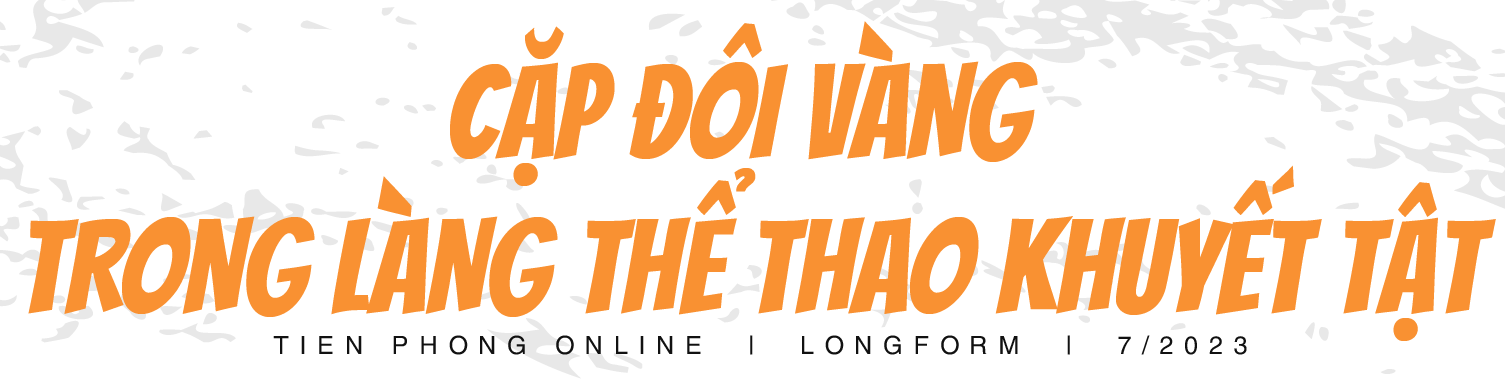 |
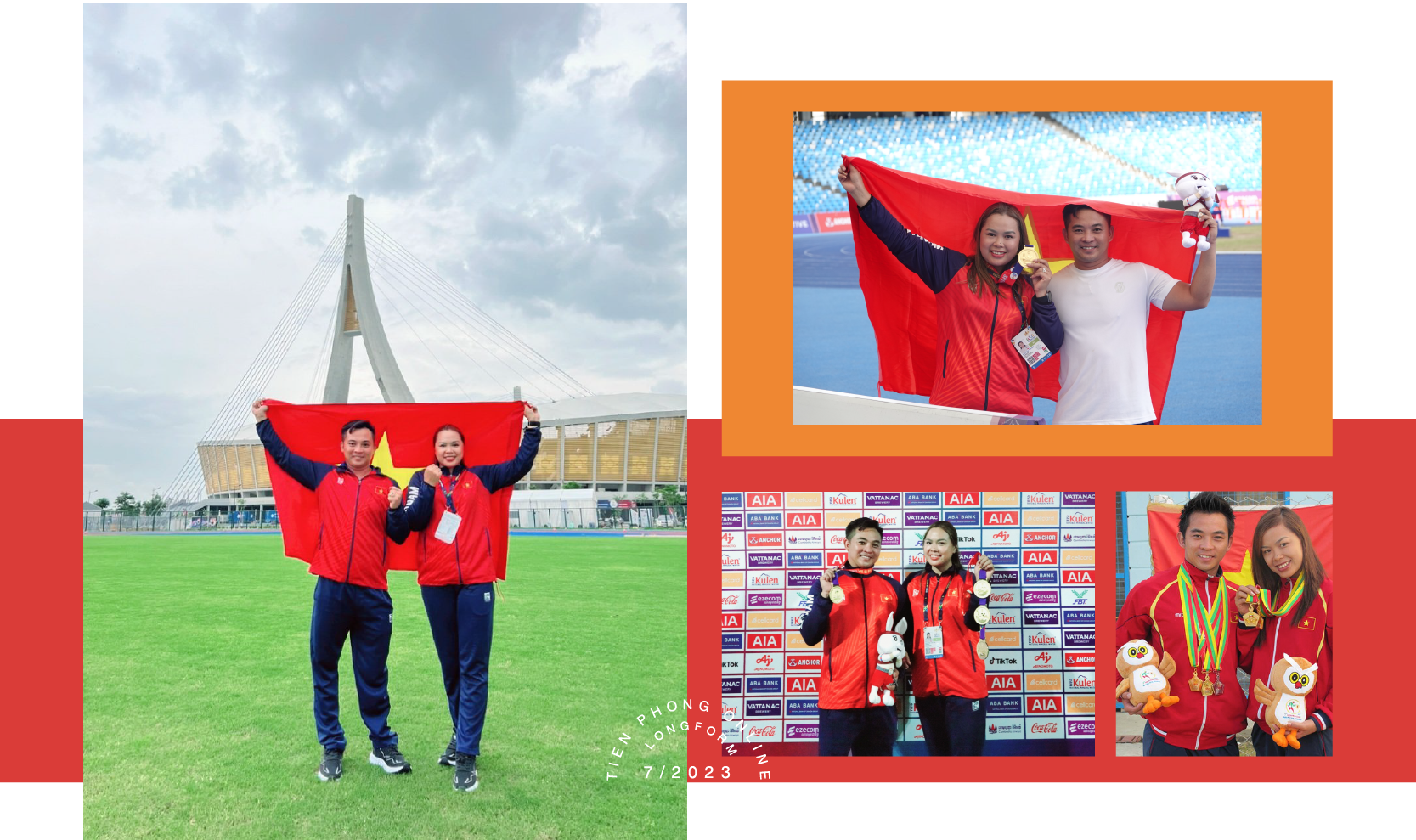
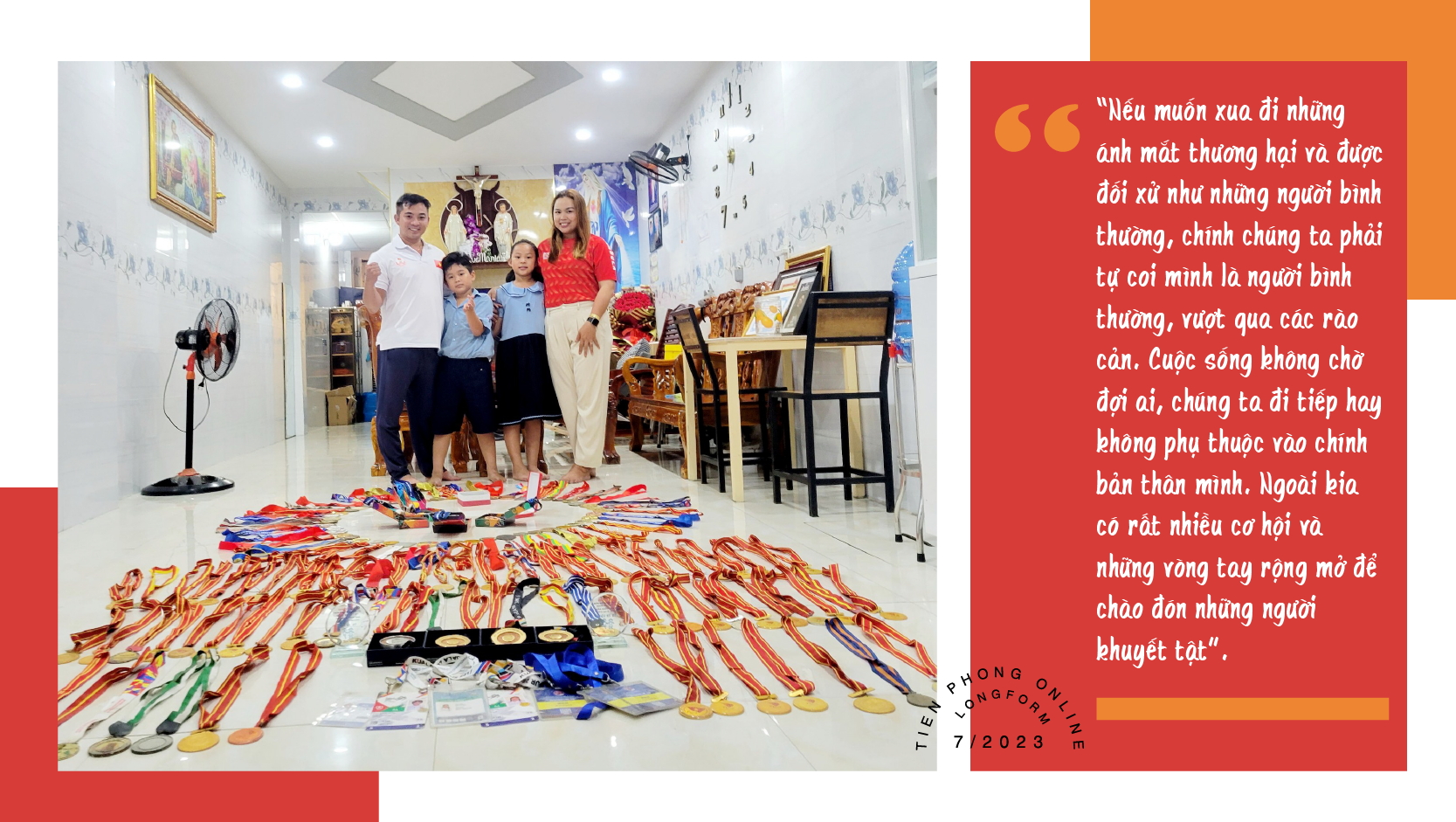
Later, Hung's family also included his wife, disabled athlete Nguyen Thi Hai, and their two children. Hai, originally from Nghe An province, was paralyzed in her right leg from a young age before moving to Saigon to learn a trade at the An Binh Charity Club. Hung met Hai in 2005 when they were both in the same F58 disability category and competed in three sports: javelin throw, discus throw, and shot put, supporting each other from training to competition.
 |
From their very first meeting, Hung had a crush on Hai. He confessed his feelings many times but never received a positive response. She dismissed him as "childish" (Hai was 5 years older than Hung). However, through his care and sincerity, Hung's persistent love was finally reciprocated. After returning from the London Olympics, in March 2013, he confessed his love again, and Hai finally agreed.
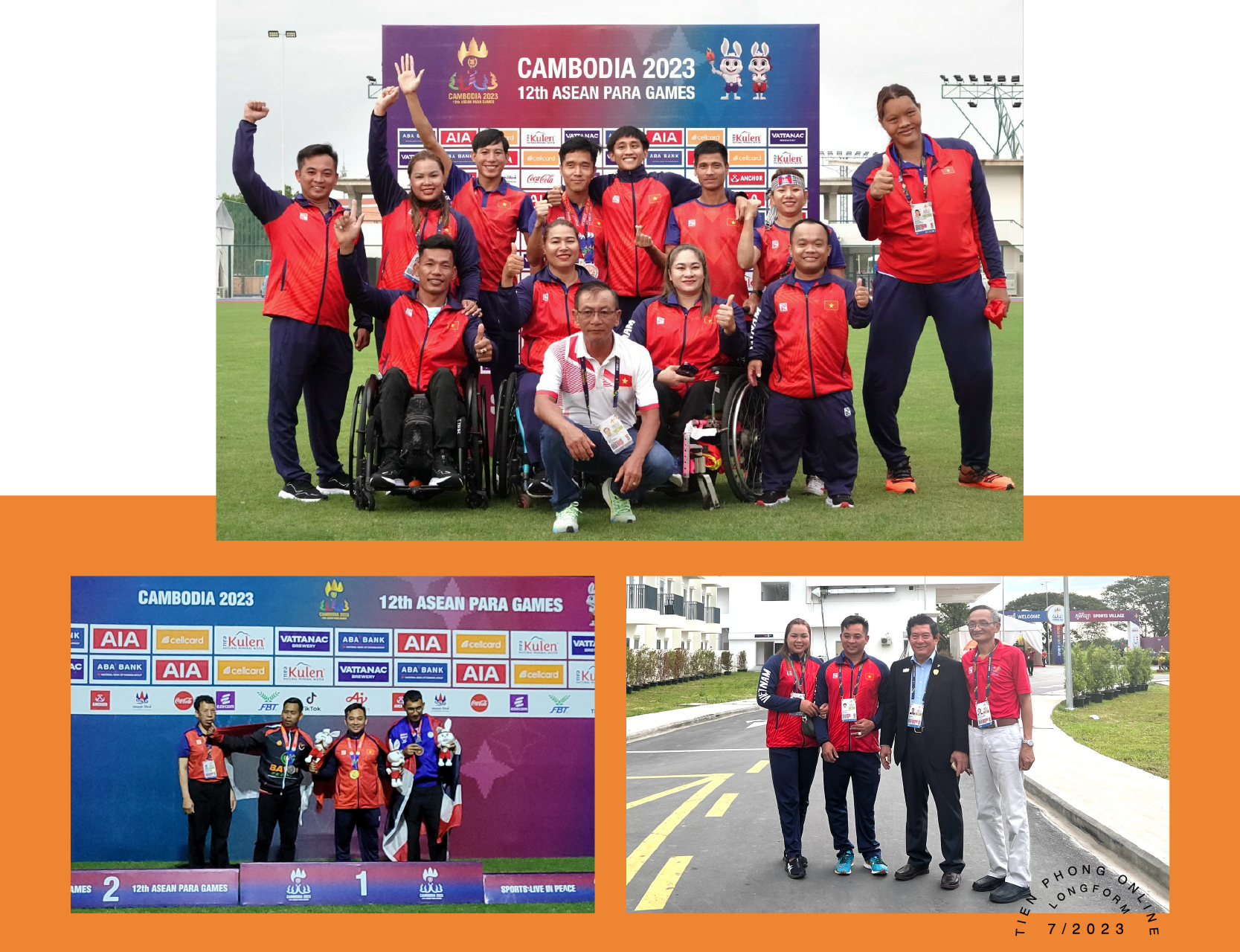
They became a golden couple in the world of disabled sports, building a happy family while achieving sporting success. Hai won two gold medals at the 2014 ASEAN Para Games, including a world record-breaking throw of 24.88 meters in the discus throw. At the recent SEA Games 32, Hai won three gold medals while her husband continued to assert his dominance in the regional javelin throw.
However, their lives weren't easy. Hai and Hung had opened a restaurant, but after closing it, they had to rely on prize money from their medals. Things became even more difficult when Hai had to temporarily put her career on hold to care for their child, becoming a strong support system so Hung could focus on training.
 |
"Life as an athlete is so difficult. Before, there was no special support system; we just trained without any benefits and waited for medals to receive decent bonuses. It was okay when I was alone, but now that I have a wife and children, I'll probably have to find another job to make ends meet," Hung shared.
Therefore, the spear Hung threw also represented his love for his wife, the food and milk his children received.
 |
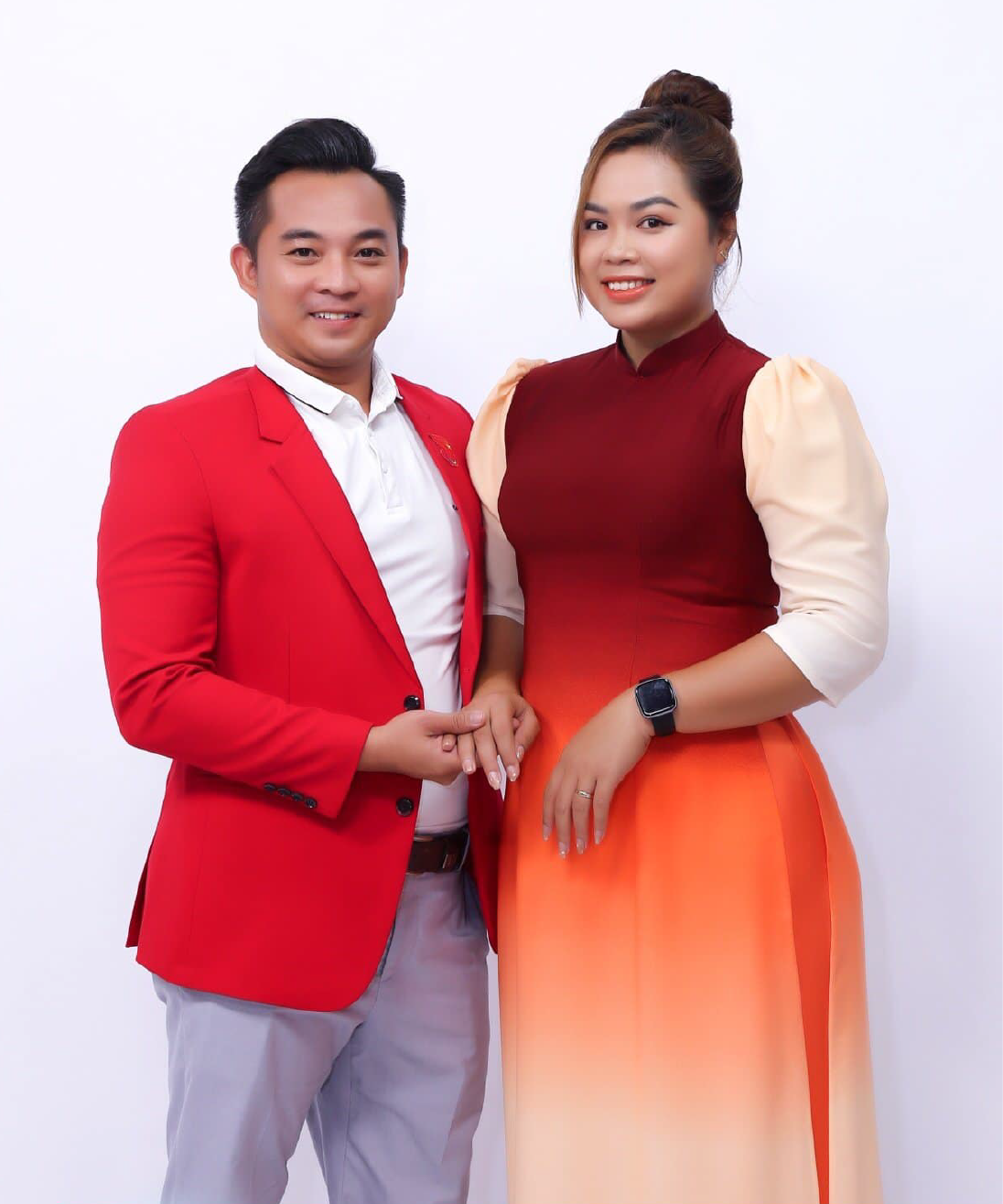
Now the hardships are over. Hung and his wife's life is more stable. Besides her athlete's allowance, Hai also runs a cosmetics business while Hung works in construction and contracting. That's when Hung started thinking about the future. As he says, "at the end of every journey there will be a new door, a new path."
Of course, the journey is not yet complete. The children have grown up, Hai can continue to pursue records, and so can Hung. He is aiming for two Paralympic Games in Paris 2024 and Los Angeles 2028.
 |
Through his athletic achievements, Hung has become well-known, including among people with disabilities. They call him for advice and motivation. Not long ago, a young man named Khoa, who had bone and spinal problems, called to thank Hung. Khoa said that thanks to Hung's example, sharing, and physical exercises, his condition was gradually improving, and his feelings of inferiority had also disappeared. Happy for Khoa, Hung felt he should do something to help more people.
With his own experiences, Hung can point them to a path: sports. “Through my own experience, I realized that sports is a remedy that helps people with disabilities like me forget their limitations and gives them the confidence to step out into society,” he said. “Not only that, it also allows us to socialize, make new friends, and access knowledge and cultures we’ve never known before.”
Hung will soon open a club. In his role as a coach, he wants to pass on all his knowledge and experience to young people with disabilities. First, they will have good health, and then they can become a new generation of disabled athletes, contributing to the development of Vietnamese sports.
 |
 |



Source

































































Comment (0)