

The tax debt threshold of VND 10 million for individuals and VND 100 million for businesses is appropriate in Vietnam currently, but much lower than in many other countries. A mechanism is needed to monitor administrative agencies and prevent abuse of power in making decisions to temporarily suspend exit from the country.
A draft government decree stipulating the tax debt threshold and repayment period for cases of temporary travel bans is currently open for public comment.
The Ministry of Finance proposes that, starting January 1, 2025, individuals/household business owners with overdue tax debts exceeding 120 days of 10 million VND will be temporarily prohibited from leaving the country. For enterprises/cooperatives/cooperative unions subject to enforcement of tax debt collection exceeding 120 days of 100 million VND, the legal representative will also be temporarily prohibited from leaving the country.
Suitable for Vietnam but lower than the global standard.
Speaking to VietNamNet reporters, Mr. Bui Quang Cuong, Director of iViet Business Development Solutions Co., Ltd., said that for individuals, setting the overdue tax debt threshold at 10 million VND to apply the measure of temporarily suspending exit from the country is considered reasonable, avoiding the application of this measure for small debts, which would cause unnecessary inconvenience.
For businesses, the 100 million VND threshold is also appropriate, especially for small and medium-sized enterprises. This threshold puts pressure on businesses to comply with their tax obligations, while not being too low to hinder their business operations.
Regarding the deadline for overdue tax payments exceeding 120 days, Mr. Cuong also assessed it as "reasonable." This period is sufficient for taxpayers to arrange their finances and fulfill their tax obligations. At the same time, it helps tax authorities manage more effectively, avoiding prolonged tax arrears.
Lawyer Pham Thanh Long, founder of Gia Pham Law Firm, analyzed: Considering the current situation in Vietnam, the proposed tax debt thresholds of 10 million and 100 million VND and a deadline of 120 days can be considered reasonable.
However, compared to many other countries, the threshold for tax debt that would result in a temporary travel ban is still too small; the number of people at risk of being prevented from leaving the country would be very large.
"In the US, a tax debt of $55,000 (approximately over 1.3 billion VND), including interest and penalties, can lead to consideration for a temporary travel ban," Mr. Long cited as an example.
Regarding the 120-day period, lawyer Pham Thanh Long suggested that consideration should be given to the starting point: whether it should be calculated from the time the tax debt transaction occurs or after other tax enforcement measures have been applied. In many cases, tax debt notices are sent via mail or text message, and taxpayers do not receive the information, thus being unaware of their tax debt.
In Canada and many other countries, the temporary travel ban procedure is almost a last resort, when other measures such as asset seizure and bank account freezing have failed to collect taxes.
According to Lawyer Truong Thanh Duc, Director of ANVI Law Firm, when determining the threshold for tax debt that may lead to a temporary travel ban, if the amount is too low and the duration is too short, it will affect business operations as well as socio-economic development.
"Each figure presented needs to have a logical basis and be linked to other legal regulations to make it simple, easy to remember, and easy to implement; then, people and businesses will comply better," Mr. Duc said.
For example, instead of setting a specific amount of 10 million VND for individuals, Mr. Duc proposed using the starting point for personal income tax payment or the minimum wage as a basis for determining the threshold for tax debt that would necessitate a temporary travel ban. This would avoid the need to adjust the figure later due to inflation or changes in circumstances.
Behind the tax debt threshold regulations
"Many of my friends have been detained at border crossings. Now, whenever we're about to go anywhere, 'Have you checked your taxes yet?' has become a common phrase," lawyer Pham Thanh Long recounted.
From a lawyer's perspective, Mr. Long emphasized that the authority of any agency or organization to use travel restrictions as an administrative measure needs to be considered thoroughly and in detail to avoid abuse of power.
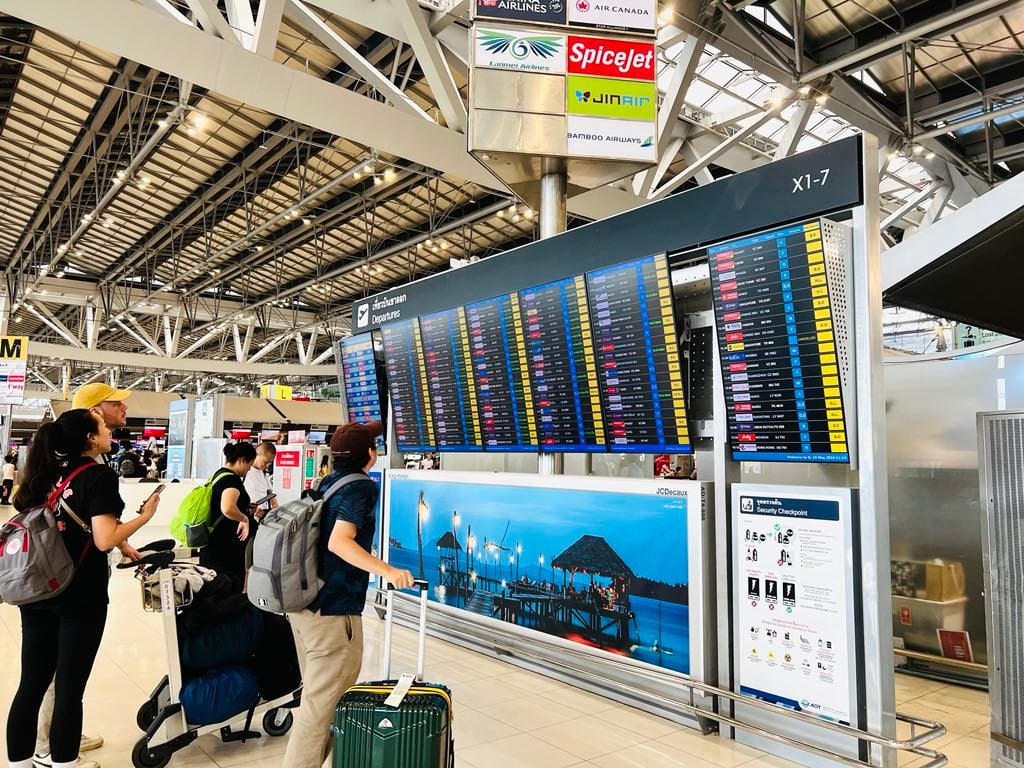
Given the recent situation where many people only find out at the airport that their departure has been delayed, causing significant waste as they have already booked flights and arranged their itineraries, the director of iViet suggested that the authorities should "make sure that those who owe taxes know that they are on the list of those banned from leaving the country."
In addition to diversifying notification methods for taxpayers (from electronic tax accounts, eTax Mobile to VNeID and email, SMS, Zalo...), tax authorities need to educate taxpayers about places where they can check tax debts and lists of those whose departure is postponed.
"Not everyone knows how to use the eTax Mobile application or the electronic transaction account (thuedientu.gdt.gov.vn) to look up information themselves. Diversifying notification methods helps ensure taxpayers receive timely and accurate information," Mr. Cuong commented.
In addition, there needs to be better coordination between tax authorities, airlines, and immigration agencies. Tax authorities should regularly update the list of individuals whose departure is temporarily suspended due to tax arrears and share this information with immigration agencies.
"With the support of modern technology, this process can be completed in a short time, even in real time, helping taxpayers quickly obtain permission to leave the country after fulfilling their tax obligations," Mr. Cuong affirmed.
According to Mr. Cuong, airlines and immigration authorities should also check passenger information based on the list of those temporarily prohibited from leaving the country; passengers should be immediately informed about any outstanding tax debts and the possibility of being temporarily prohibited from leaving the country.
When a passenger is found to be subject to a temporary departure ban, the airline or immigration authorities should notify them immediately, giving them time to settle their tax debts before the flight, thus avoiding wasted time and money.

Proposal to temporarily suspend exit from the country for individuals with overdue tax debts of 10 million VND or more.

We must prevent businesspeople from finding out at the airport that their departure has been delayed.
Businessman delayed from leaving the country due to debt of several million or billions: 'I don't joke about my career'
Source: https://vietnamnet.vn/dn-luat-su-noi-gi-ve-nguong-no-thue-tam-hoan-xuat-canh-bo-tai-chinh-de-xuat-2350033.html
![[Photo] Prime Minister Pham Minh Chinh holds a phone call with the CEO of Russia's Rosatom Corporation.](/_next/image?url=https%3A%2F%2Fvphoto.vietnam.vn%2Fthumb%2F1200x675%2Fvietnam%2Fresource%2FIMAGE%2F2025%2F12%2F11%2F1765464552365_dsc-5295-jpg.webp&w=3840&q=75)

![[Photo] Closing Ceremony of the 10th Session of the 15th National Assembly](/_next/image?url=https%3A%2F%2Fvphoto.vietnam.vn%2Fthumb%2F1200x675%2Fvietnam%2Fresource%2FIMAGE%2F2025%2F12%2F11%2F1765448959967_image-1437-jpg.webp&w=3840&q=75)
















































![[OFFICIAL] MISA GROUP ANNOUNCES ITS PIONEERING BRAND POSITIONING IN BUILDING AGENTIC AI FOR BUSINESSES, HOUSEHOLDS, AND THE GOVERNMENT](https://vphoto.vietnam.vn/thumb/402x226/vietnam/resource/IMAGE/2025/12/11/1765444754256_agentic-ai_postfb-scaled.png)















































Comment (0)