

On January 30th, information from Can Tho Central General Hospital indicated that doctors at the hospital's Orthopedic Trauma Center had successfully performed surgery on a large tibial tumor that had invaded soft tissue using a long-stem knee replacement. This is considered the first time this technique has been performed in the Mekong Delta.
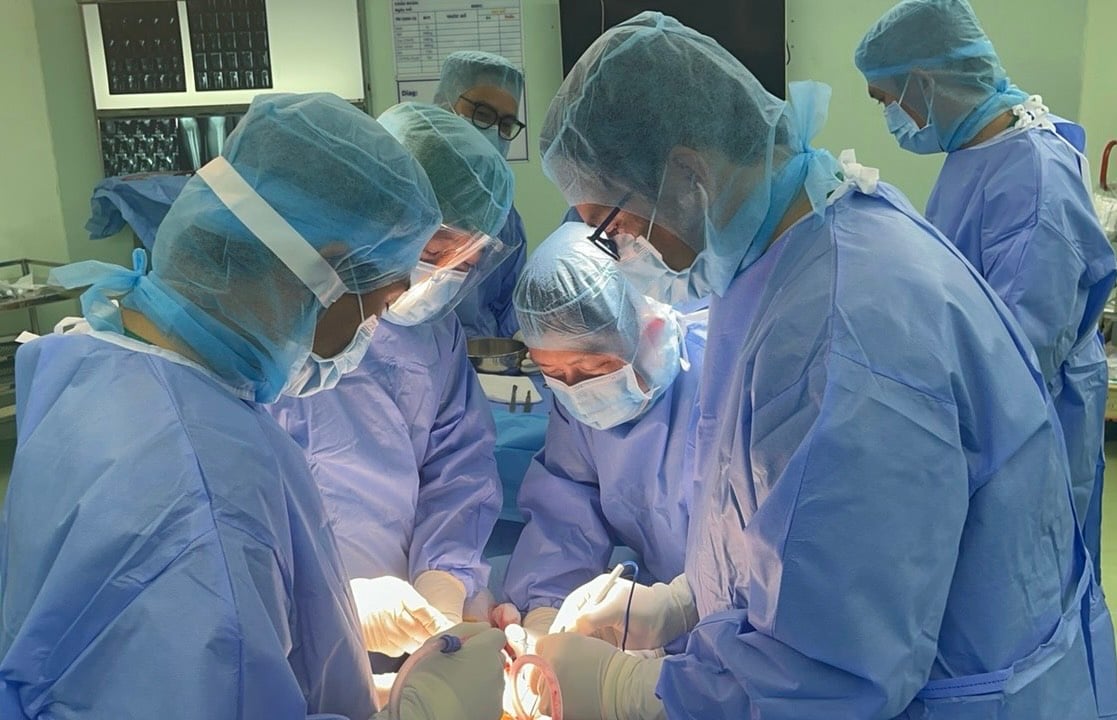
Doctors at the Orthopedic Trauma Center, Can Tho Central General Hospital, performed surgery on the patient.
Previously, patient LTBN, 59 years old, residing in Ninh Kieu District, Can Tho City, was brought to Can Tho Central General Hospital by family members in a condition of severe pain in the left knee joint, limiting movement. Approximately 6 months prior, the patient suffered a left knee injury in a traffic accident, after which the left knee joint frequently swelled and was very painful when standing, making movement and daily activities extremely difficult.
The MRI results of the patient's left knee joint revealed: A bone-destroying lesion at the proximal end of the left tibia, invasive, cortical destruction, extending to the articular surface, measuring 5.5 cm x 5.7 cm x 6.7 cm, with surrounding soft tissue edema. The patient underwent surgical biopsy of the tumor tissue at the proximal tibia for histopathological examination, and the diagnosis was a giant cell tumor.
This was a very difficult case as the large macrophage tumor invaded almost all of the soft tissue and articular surface of the left knee, involving major blood vessels and nerves in the left popliteal region. Early surgery was necessary to minimize the risk of bone destruction.
After consultation, the doctors chose the option of removing the tumor and replacing the patient's knee joint with a long-stem artificial joint; the long stem will function to replace the removed bone segment.
More than 10 doctors and nurses, divided into two teams, performed surgery on the patient. First, the doctors dissected and widely excised the tumor, cutting down to the tibia about 12 cm from the tibial plateau, examining all tumor tissue, and dissecting blood vessels and nerves.
Immediately afterward, the second team proceeded with a total left knee replacement using a long-stem hinge, while simultaneously rotating a gastrocnemius muscle flap to cover the missing bone. The surgery was successfully completed after 5 hours.
Currently, the patient is awake after surgery, the incision is dry, the foot is warm and pink, ankle and toe movement is good, and the patient has started standing and walking with the help of a walker.
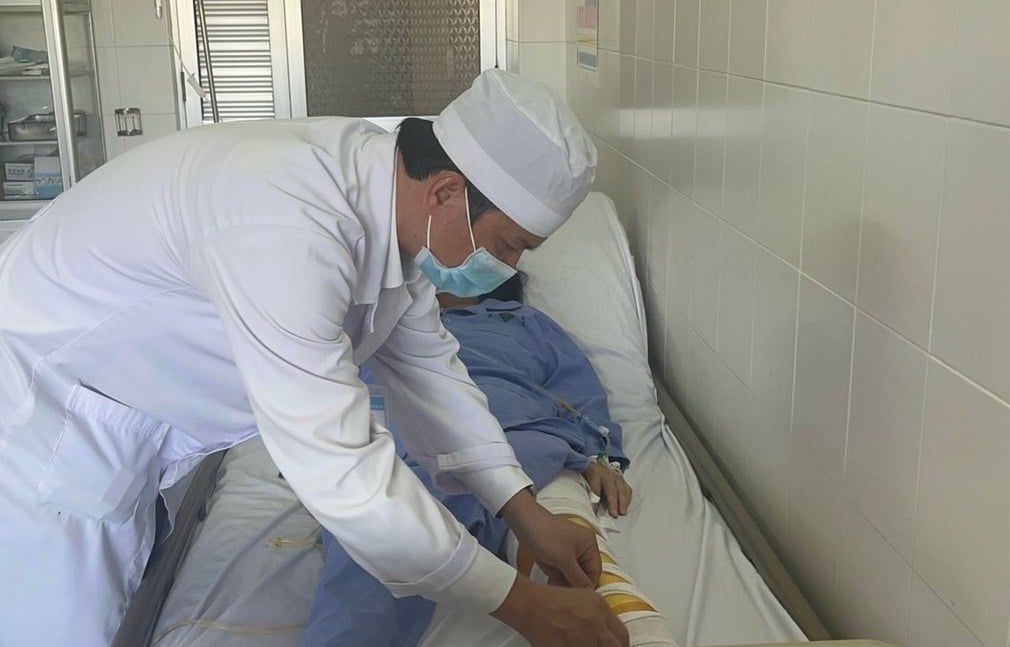
After surgery, the patient was conscious and the recovery process progressed smoothly.
Dr. Duong Khai, Head of the Joint Replacement and Orthopedic Oncology Department (Orthopedic Trauma Center, Can Tho Central General Hospital), said: Surgical treatment for large bone cancers or bone tumors causing bone destruction has traditionally involved wide excision of the tumor and fusion of the joint or amputation of the limb. This method often leaves severe psychological and functional sequelae after surgery, significantly impacting the quality of life of patients, especially young patients.
"Globally, the application of long-stem artificial joints is one of the advancements in science and technology applied to medicine. Specifically in this case, doctors used a long-stem hinged artificial knee joint to replace the removed upper part of the tibia. Currently, this surgery is only performed at large orthopedic trauma centers in developed countries. In Vietnam, this is the first time this surgery has been performed in the Mekong Delta, opening up many hopes for patients with bone tumors who can still undergo surgery to preserve their limbs, restore joint function, and help patients recover better," said Dr. Khai.
Source link
















![[Photo] Prime Minister Pham Minh Chinh holds a phone call with the CEO of Russia's Rosatom Corporation.](/_next/image?url=https%3A%2F%2Fvphoto.vietnam.vn%2Fthumb%2F1200x675%2Fvietnam%2Fresource%2FIMAGE%2F2025%2F12%2F11%2F1765464552365_dsc-5295-jpg.webp&w=3840&q=75)













































Comment (0)