

At approximately 4:30 a.m. on September 23rd, at the world's busiest container port, Ningbo-Zhushan, the Istanbul Bridge quietly weighed anchor. On board were nearly 4,900 containers filled with goods ranging from high-value lithium batteries to e-commerce packages catering to the Christmas shopping season in Europe.
However, its destination was not the familiar route through the Suez Canal. The ship was heading north, beginning a revolutionary voyage: the first trial of a regular container shipping route connecting Asia and Europe across the Arctic Ocean.
More than just a train journey, this is a dress rehearsal for the future of global logistics, a bold economic test, and a strategic move in the context of a redrawing of the world trade map.
A promise of speed and efficiency
On paper, the economic feasibility of the China-Europe Arctic Express route, operated by the emerging shipping company Sea Legend (Haijie Shipping), is extremely convincing.
The most significant advantage is the travel time. The journey from Ningbo to Felixstowe port (UK) takes only 18 days, an incredible figure compared to the 40-50 days of the traditional route via the Suez Canal. This reduction in travel time by more than half brings enormous financial benefits:
Working capital costs are drastically reduced: Faster delivery of goods to consumers means faster capital recovery for businesses. For high-value shipments such as electronics or electric vehicles, reducing 3-4 weeks of inventory at sea can save millions of dollars in working capital costs.
Meeting supply chain demands "just-in-time": In the era of e-commerce and flexible manufacturing, speed is king. The Arctic Shortcut allows European retailers to quickly replenish peak season goods, avoiding the usual November port congestion.
Fuel and operating cost savings: A shorter range of approximately 30-40% (around 14,000 km compared to 21,000 km) directly reduces fuel consumption, one of the biggest costs in the maritime industry.
Furthermore, this route helps avoid risky geopolitical bottlenecks such as the Red Sea or the Malacca Strait, offering a desirable stability in a volatile world.
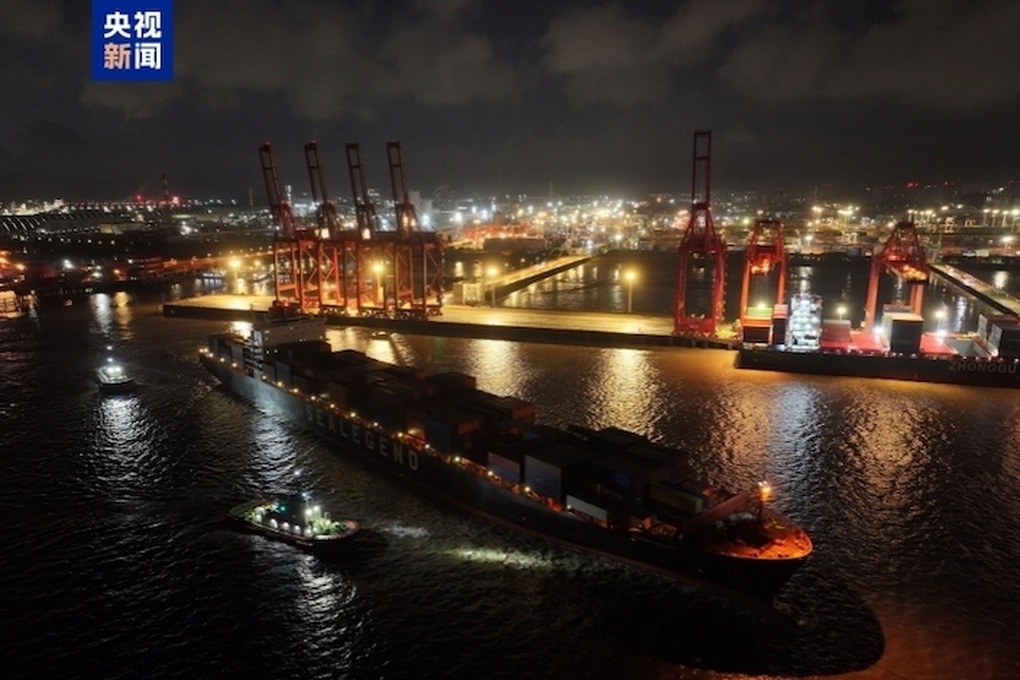
The Istanbul Bridge ship departed Ningbo port on September 23rd and is expected to arrive at Felixstowe port (UK) after 18 days (Photo: CCTV).
Hidden costs and risks of frost
However, when you turn to the "costs and liabilities" side, the picture becomes much more complex. This icy path is not cheap and carries significant financial risks.
First, insurance costs skyrocket. The Arctic is a harsh environment with a lack of rescue infrastructure. Even a small oil spill can cause a large-scale and irreparable environmental disaster, forcing insurance companies to charge extremely high premiums to cover the risk.
Second, specialized operating costs. To navigate these waters, ships must adhere to the International Maritime Organization’s (IMO) strict Polar Code on safety, crew training, and environmental protection. In many cases, ships must be escorted by Russian icebreakers, a service that is not cheap.
Ironically, the pioneering vessel, Istanbul Bridge, was a 25-year-old ship that had not been reinforced to withstand ice, highlighting the experimental and risky nature of the voyage itself.
Third, there are seasonality and limitations in scale. The route is currently only feasible during a short "time window" from July to the end of September when the ice melts. It cannot be a year-round solution.
Furthermore, the economies of scale offered by ultra-large container ships (over 20,000 TEU) on the Suez route are not feasible here. The Istanbul Bridge, with its modest capacity of nearly 4,900 TEU, is unlikely to compete in terms of cost per container.
As Leonardo Parigi, coordinator of the Arctic Observatory, concluded: "Currently, the benefits and costs may only break even. The more the time is shortened, the higher the compliance costs become."
A strategic move for the future.
If the immediate economic problem is only about breaking even, why is China so determined to pursue it? The answer lies in the long-term strategic vision.
Istanbul Bridge's voyage is seen as a move to "plant the flag for the future." "Whether they make a profit or not is not important; what matters is accumulating knowledge and training the crew," said Malte Humpert from the Arctic Institute.
Climate change is causing the Arctic ice to melt faster than predicted. Ten years ago, container shipping through the Arctic was thought to be a prospect of 2050. Now, it has become a reality. By staying ahead, Chinese companies are accumulating invaluable shipping data, training crews, and building operational experience in one of the harshest environments on the planet.
Furthermore, this represents a move to diversify geopolitical risks. Over-reliance on the Suez Canal makes global supply chains fragile. Developing an alternative route, even as a supplementary option, offers significant resilience and strategic leverage.
Finally, we cannot ignore the ESG (Environmental, Social, and Governance) factor. Ironically, this opportunity is created by climate change itself, but exploiting it risks exacerbating the problem. Black carbon emissions from ships have a five times greater impact on melting ice in other regions. The risks of noise pollution, oil spills, and impact on pristine ecosystems are enormous.
Any company that enters the "Arctic game" will face intense scrutiny from investors and consumers who are increasingly environmentally conscious.
The Istanbul Bridge voyage was therefore not the end, but the starting point. It may fail commercially in the short term, but the lessons learned will be invaluable. The Arctic is no longer a remote and forgotten land. It has officially become a new arena where economic powers will compete to shape the trade routes of the 21st century.
Source: https://dantri.com.vn/kinh-doanh/chuyen-tau-huong-bac-nay-se-dinh-hinh-lai-thuong-mai-hang-hai-the-gioi-20250926110233957.htm


































































































Comment (0)