

There are about 8 billion people today, just a fraction of the number of people who have ever existed, let alone the number of animals that have ever lived on Earth.
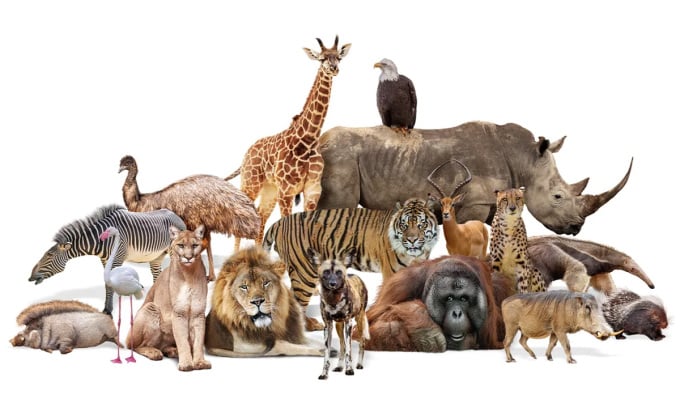
Number of animals that have ever lived on Earth. Photo: adogslifephoto/Getty
Estimating the total number of animals that have ever lived on Earth is extremely difficult. Perhaps the easiest way to start, says David Jablonski, a geophysicist at the University of Chicago, is to estimate the total number of species.
According to the International Union for Conservation of Nature (IUCN) Red List, about 2.16 million animal species have been formally described as of 2022. But according to a 2013 study in the journal Science , 20% of them may be duplicates, recorded by multiple scientists . Assuming this estimate is correct, the actual number of species is about 1.7 million.
This number is not fixed. Every year, researchers scientifically describe about 14,000 - 18,000 new animal species, which means they only have a rough grasp of the number of animals in the world .
In 2011, Camilo Mora, a geobiologist at the University of Hawaii, and colleagues presented a study in the journal PLOS Biology that estimated the total number of eukaryotic species on Earth. Eukaryotes are organisms made up of one or more cells with a separate nucleus containing chromosomes.
The final figure they came up with was around 8.7 million, of which around 7.7 million were animals and half were insects. The study was hugely influential and is still frequently cited today.
To know how many species of animals there were, however, experts need to look further back and use the fossil record. Life appeared on Earth 3.7 billion years ago. But the first organisms were very simple cells. Multicellular organisms appeared 2.3 billion years ago. Animals probably appeared even more recently, about 800 million years ago.
Only a handful of these early animals have survived in the fossil record. This is because soft-bodied creatures are difficult to preserve, and even hard-bodied creatures only fossilize under certain conditions. In addition, tectonic plates slowly and constantly churn the Earth’s surface, erasing ancient traces.
“The standard estimate is that 99.9 percent of all species that ever existed are extinct. But of course that’s a rough estimate,” says Jablonski. Assuming that percentage is correct, the total number of animal species that ever lived would be about 770 million. So how do you calculate the total number of individuals of every animal species that ever lived?
The Earth is home to about 8 billion humans and 130 billion other mammals, 428 billion birds, 3.5 trillion fish, and 10 trillion insects. Assuming that current abundances are fairly stable, it is possible to speculate on relative numbers. For example, if there are 3.85 million insect species on Earth today, compared to 385 million species in the past, the number of individuals would be 3.85 x 10 27 .
Since insects are so numerous, that number is probably not far off the total. So, a rough estimate is that, including arthropods, invertebrates, and vertebrates, about 4.5 x 10 27 animals have ever lived on Earth.
Counting animal populations helps scientists understand Earth’s baseline biodiversity and how it’s changing. Thanks to climate change, deforestation, pollution, and other factors, the world is headed toward a mass extinction. Experts need to know baseline extinction rates to grasp the scale of the current crisis.
Thu Thao (According to Live Science )
Source link

![[Photo] National Assembly Chairman Tran Thanh Man attends the VinFuture 2025 Award Ceremony](/_next/image?url=https%3A%2F%2Fvphoto.vietnam.vn%2Fthumb%2F1200x675%2Fvietnam%2Fresource%2FIMAGE%2F2025%2F12%2F05%2F1764951162416_2628509768338816493-6995-jpg.webp&w=3840&q=75)


![[Photo] 60th Anniversary of the Founding of the Vietnam Association of Photographic Artists](/_next/image?url=https%3A%2F%2Fvphoto.vietnam.vn%2Fthumb%2F1200x675%2Fvietnam%2Fresource%2FIMAGE%2F2025%2F12%2F05%2F1764935864512_a1-bnd-0841-9740-jpg.webp&w=3840&q=75)







































































































Comment (0)