

According to the Deputy Minister of Science and Technology , Vietnam has an open market, a young and ambitious research force, and a clear direction in national strategies such as the AI Strategy, Science, Technology and Innovation Strategy, AI Law, and List of 11 strategic technologies.

Deputy Minister of Science and Technology Bui The Duy said that Vietnam has a great opportunity to become an emerging bright spot in the region in responsible AI.
At the seminar "AI for humanity: AI ethics and safety in the new era", within the framework of VinFuture 2025 Science and Technology Week, the Deputy Minister of Science and Technology also emphasized that Vietnam issued its first AI Strategy in 2021. But AI is developing at an extraordinary speed, so by the end of this year, Vietnam will announce an updated AI Strategy and AI Law.
"This is not only a legal framework but also a declaration of national vision, identifying that AI must become Vietnam's intellectual infrastructure, contributing to social welfare, sustainable development and enhancing national competitiveness," said Deputy Minister Bui The Duy.
Deputy Minister Bui The Duy also outlined three major action directions for Vietnam.
Firstly , promote education and develop AI talent, from popularizing AI knowledge to training in-depth teams of experts. Human resources will be the decisive factor for Vietnam's AI to develop responsibly and sustainably.
Second , promote multidisciplinary collaboration, bringing together scientists, experts, engineers, doctors, teachers and policymakers to design, test and monitor AI systems. Only by connecting intelligence from many fields can we translate ethical principles into practical operational standards.
Third , strengthen international cooperation, learn from governance models from leading countries and contribute to global efforts on safe and humane AI. Vietnam will continue to actively participate in international forums and coordinate with VinFuture Foundation to bring its voice to major discussions on the future of AI.
AI could be smarter than humans in the next 20 years
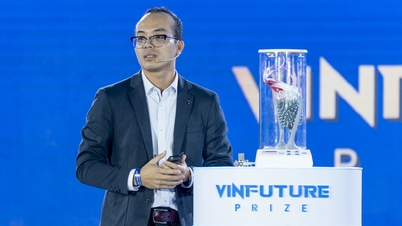
At the seminar, Professor Toby Walsh, Professor of Science at the University of New South Wales, Australia, said that since the industrial revolution until now, many new technologies have appeared and changed our lives - electricity, the Internet, and mobile phones.
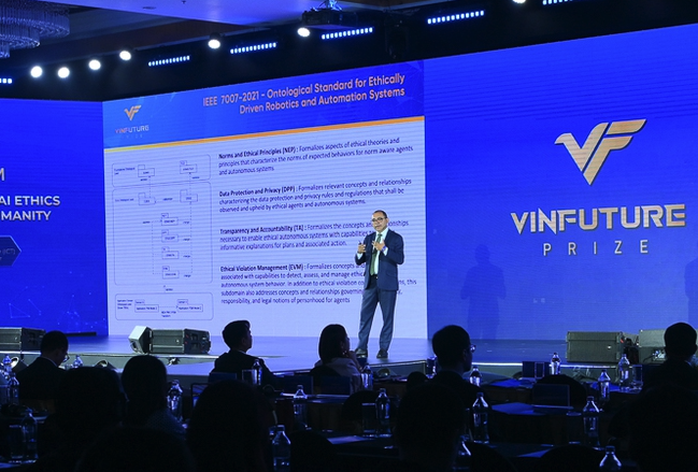
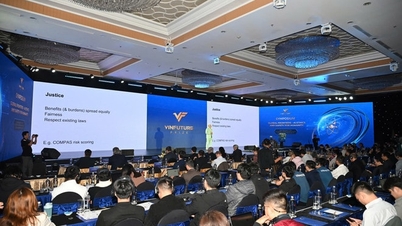
World-leading speakers share insights into the future of AI
Every technology transforms the way we live, work, and interact, and AI is no different. But AI poses some very different challenges, particularly the speed, scale, and cost of its implementation, which can make it have impacts we have never faced before.
Therefore, in addition to the four fundamental principles of beneficence, non-maleficence, autonomy, and justice, Professor Toby Walsh mentioned a fifth principle: the precautionary principle, which is related to the level of uncertainty that AI brings.
"When there is a high level of uncertainty, when the speed and scale of technology deployment far exceeds our ability to predict, caution is not only necessary but also responsible. AI certainly falls into that category. We must prepare for unintended consequences that we have not yet imagined," shared Professor Toby Walsh.
Speaking via video, Professor Geoffrey Hinton, winner of the 2024 Nobel Prize in Physics and honored as the "Father of AI", said that AI is developing very rapidly, bringing both great benefits and potential risks.
AI can help with health care, education, drug design and new materials development, but it can also create dangerous viruses, carry out cyberattacks, disrupt elections or put millions of people out of work if society is not prepared.
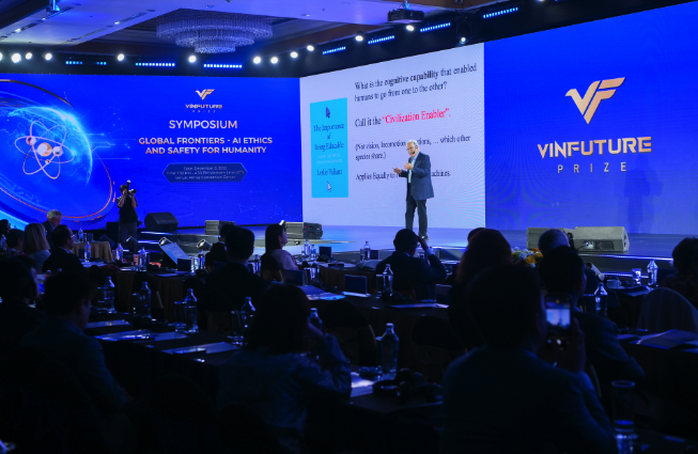
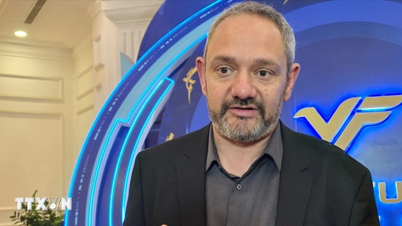
World-renowned professors share at the seminar “AI for humanity: AI ethics and safety in the new era”
The biggest risk, according to Professor Geoffrey Hinton, is that AI could become smarter than humans in about 20 years. Scientists and engineers have a responsibility to find stronger ways to keep AI in line with human values - and to help the public and politicians better understand the nature of AI so they can make the right decisions.
Analysis shows that the potential risks from AI may exceed the predictions of its creators, while requirements for transparency, data fairness, human supervision and social trust are becoming global bottlenecks.
Source: https://nld.com.vn/cong-bo-chien-luoc-ai-cap-nhat-va-luat-ai-vao-cuoi-nam-2025-196251203102934396.htm


![[Photo] Parade to celebrate the 50th anniversary of Laos' National Day](/_next/image?url=https%3A%2F%2Fvphoto.vietnam.vn%2Fthumb%2F1200x675%2Fvietnam%2Fresource%2FIMAGE%2F2025%2F12%2F02%2F1764691918289_ndo_br_0-jpg.webp&w=3840&q=75)



















![[Photo] Worshiping the Tuyet Son statue - a nearly 400-year-old treasure at Keo Pagoda](/_next/image?url=https%3A%2F%2Fvphoto.vietnam.vn%2Fthumb%2F1200x675%2Fvietnam%2Fresource%2FIMAGE%2F2025%2F12%2F02%2F1764679323086_ndo_br_tempimageomw0hi-4884-jpg.webp&w=3840&q=75)






















































Comment (0)