

China surpasses 5,000 AI companies.
Over the past five years, the number of AI companies in China has surged from over 1,400 to more than 5,000. This growth was announced at the ongoing World Smart Industry Exhibition 2025 in Chongqing.
China has built more than 40,000 smart factories, 11 national pilot zones for AI innovation, and 17 national demonstration zones for testing smart connected vehicles. This is a crucial foundation for promoting the application of AI in manufacturing and transportation.

A humanoid robot interacts with visitors at the World Smart Industry Exhibition 2025 in China. (Source: Xinhua)
The Chinese government established an AI investment fund worth 60 billion yuan (approximately $8.4 billion) and issued more than 240 core technical standards for AI. AI ethics codes and an AI cooperation center with BRICS have also been implemented.
Since 2017, China has had plans to develop next-generation AI. Recently, the country has further promoted its "AI Plus" initiative to build a smart economy and a cooperative society between humans and machines.
According to Wan Gang, Chairman of the China Association for Science and Technology, the rapid development of China's AI industry stems from leveraging abundant data, a complete industrial system, diverse application scenarios, and a vast market.
OpenAI is projected to spend up to $115 billion on AI by 2029.
OpenAI, the company behind ChatGPT, is expected to spend up to $115 billion between now and 2029 to maintain and develop its AI technology. This figure is $80 billion higher than previous forecasts, indicating a growing investment in infrastructure and computing power.
To reduce its reliance on cloud service providers, OpenAI is planning to develop its own AI chip and build its own data center. According to reports, the first chip will be produced next year, in collaboration with Broadcom, and will be for internal use only, not for sale to the market.

OpenAI CEO Sam Altman at an event. (Source: Yahoo)
OpenAI has strengthened its partnership with Oracle, with plans to build 4.5 gigawatts of data center capacity as part of the $500 billion Stargate project. Additionally, Google Cloud has been added to the list of computing power providers.
In 2025, OpenAI is expected to spend over $8 billion, an increase of $1.5 billion compared to previous forecasts. This figure is projected to rise to $17 billion in 2026, $35 billion in 2027, and $45 billion in 2028.
A micro-nuclear reactor buried deep underground.
Nuclear energy startup Deep Fission is developing an entirely new type of reactor: compact, cylindrical, and buried a mile underground in boreholes just 30 inches wide.
This design aims to address the inherent problems of traditional nuclear technology, such as the risk of core meltdown and security risks. Each reactor has a capacity of 15 megawatts and uses high-pressure water for cooling – similar to the technology used in modern nuclear submarines.
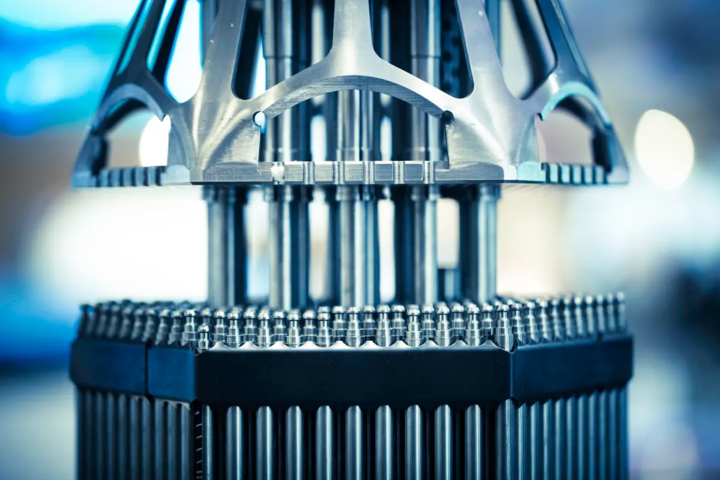
A close-up view of the nuclear fuel system, showing the precisely arranged metal fuel rods within the support frame. (Source: Getty Images)
Deep Fission has signed a contract with Endeavor, a data center developer, to build a total of 2 gigawatts of capacity from underground reactors. Additionally, the company has been selected to participate in a U.S. Department of Energy pilot program that simplifies the licensing process for new nuclear technologies.
In September 2025, Deep Fission officially went public through a reverse merger with Surfside Acquisition Inc., raising $30 million. The funds raised are expected to give Deep Fission more time to operate, with the goal of starting its first reactor in July 2026.
Source: https://vtcnews.vn/cong-nghe-9-9-trung-quoc-vuot-moc-5-000-cong-ty-ai-ar964413.html















![[Photo] Prime Minister Pham Minh Chinh holds a phone call with the CEO of Russia's Rosatom Corporation.](/_next/image?url=https%3A%2F%2Fvphoto.vietnam.vn%2Fthumb%2F1200x675%2Fvietnam%2Fresource%2FIMAGE%2F2025%2F12%2F11%2F1765464552365_dsc-5295-jpg.webp&w=3840&q=75)















































Comment (0)