

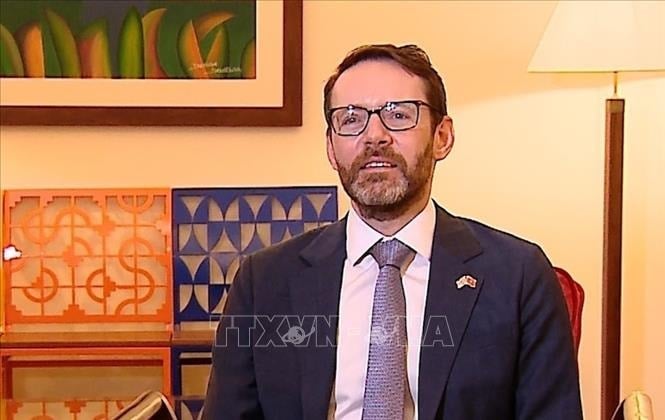
On this occasion, the British Ambassador to Vietnam, Iain Frew, gave an interview to a reporter from the Vietnam News Agency (VNA).
- With the upcoming official visit of the General Secretary of the Communist Party of Vietnam, To Lam, to the United Kingdom, what are your assessments of this visit and your expectations, Ambassador?
- This visit is of great significance, marking a new stage in the development of relations between the two countries to a higher level. This is also the first visit of the General Secretary of Vietnam to the UK in 13 years - a historic and very important event.
I believe the highlight of the visit was the high-level political dialogue between the leaders of the two countries. Maintaining trust and dialogue at the highest level will help both countries advance common interests—from free trade and global security to addressing international challenges in a world of great instability.
This visit will strengthen and clearly demonstrate the substantive nature of cooperation between the two sides. Specifically, we have high expectations in the following areas:
Firstly, regarding economic and technological cooperation, we will continue to strengthen economic cooperation, especially in the fields of technology, artificial intelligence (AI), semiconductors, and emerging technologies – key elements for Vietnam's next phase of development.
Secondly, in the financial sector, Vietnam is aiming to establish international financial centers in Ho Chi Minh City and Da Nang. The UK is working closely with Vietnam to share expertise and support the development of professional financial services and legal services. The development of the financial sector will provide capital for the sustainable development of the entire economy.
Third, in the area of education and skills training, this will continue to be a focus of the new agreements. We want to ensure that the younger generation of Vietnam is equipped with the necessary skills for the future economy.
Fourth, in the area of green transition, cooperation in energy and green transition will be accelerated. I believe that the discussions in London will concretize ambitions into practical cooperation programs that will benefit both countries.
Finally, regarding global cooperation, in a rapidly changing global landscape, we share many common interests – from protecting the rules-based international system to ensuring free trade and secure and stable supply chains. This visit will guide the two countries toward deeper cooperation in the future.
- General Secretary To Lam's upcoming visit to the UK takes place against the backdrop of the two countries celebrating the 15th anniversary of the establishment of their Strategic Partnership. Could the Ambassador share some key milestones in the recent partnership between Vietnam and the United Kingdom?
- This year we are celebrating the 15th anniversary of the establishment of the Strategic Partnership between the UK and Vietnam. This means that over the past 15 years, we have continuously deepened the relationship between the two countries in many different areas.
I am truly delighted and impressed with the progress made in trade, education, finance, security cooperation, and climate.
In terms of trade and investment, what impresses me most is perhaps the strong growth rate. Over the past decade, bilateral trade has almost tripled, now exceeding £9 billion annually. This growth is bolstered by the free trade agreement between the two countries. With Vietnam's support, the UK also joined the Comprehensive and Progressive Trans-Pacific Partnership (CPTPP) last year.
In education, we have witnessed very impressive cooperation. Over the past 15 years, more than 75,000 Vietnamese students have studied in the UK, and currently around 12,000 Vietnamese students are studying there each year. More importantly, this helps build bridges between the two countries – connecting people who once studied and lived in the UK, and who are now contributing to society, thus strengthening the ties between the two nations.
Not only are Vietnamese students going to the UK, but British education is also becoming an important part of Vietnam's future development. Many British organizations are supporting the Vietnamese Ministry of Education and Training in implementing the program to make English a second language in the national education system. Simultaneously, we are also witnessing the strong development of joint higher education programs, allowing students in Vietnam to access high-quality British courses, such as those offered by the University of London and many other leading universities, taught right in Vietnamese educational institutions.
Furthermore, cooperation on Climate and Green Transition is developing very strongly. Following Vietnam's historic commitment at the COP26 conference in 2021 towards net-zero emissions by 2050, the two countries are cooperating closely through the Just Energy Transition Partnership (JETP). Recently, a UK energy delegation visited Vietnam to support the development of the offshore wind power sector, an area in which the UK has extensive practical experience.
Finally, in defense and security cooperation, the UK has supported Vietnam on its path to international integration, for example in United Nations peacekeeping operations. This is a very dynamic area of cooperation today, contributing to regional and global security.
- It is evident that the bilateral cooperation between Vietnam and the UK has contributed significantly to Vietnam's development. How does the Ambassador assess Vietnam's economic achievements in recent years?
- I'm very happy to talk about this, because Vietnam's development story is truly one of the most impressive globally. Looking back over the past three decades, Vietnam has transformed dramatically – from a low-income country to a middle-income country, lifting millions out of poverty. That achievement is the result of the persistent efforts and long-term investment of the Vietnamese people and government.
Currently, Vietnam is in a very strong position with important foundations for the next stage of development: a young, well-educated population, a favorable geostrategic location, a developed manufacturing sector, and deep integration into global supply chains as well as a wide network of free trade agreements.
However, Vietnam also faces the challenge of how to move up the value chain and attract investment in high-tech industries. I find Vietnam's recent directions very encouraging – for example, Resolution 57 emphasizes innovation as central to economic development, and Resolution 68 identifies the private sector as the main driving force of the economy. These are very positive steps towards Vietnam achieving its goal of becoming a developed, high-income country by 2045.
I believe that with partners like the UK, along with seizing opportunities and overcoming global challenges, Vietnam is fully capable of continuing to succeed and realizing its great aspirations and potential in this new phase of development.
Thank you very much, Ambassador!
Source: https://daibieunhandan.vn/dai-su-iain-frew-chuyen-tham-vuong-quoc-anh-cua-tong-bi-thu-to-lam-la-su-kien-mang-tinh-lich-su-va-rat-quan-trong-10393107.html

![[Photo] Prime Minister Pham Minh Chinh holds a phone call with the CEO of Russia's Rosatom Corporation.](/_next/image?url=https%3A%2F%2Fvphoto.vietnam.vn%2Fthumb%2F1200x675%2Fvietnam%2Fresource%2FIMAGE%2F2025%2F12%2F11%2F1765464552365_dsc-5295-jpg.webp&w=3840&q=75)

































































Comment (0)