

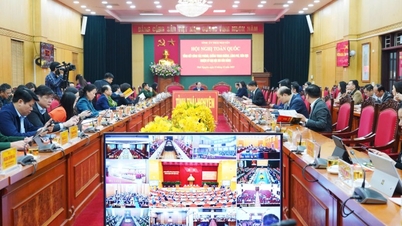
Continuing the agenda of the 8th Session, on the morning of October 23rd, under the chairmanship of Deputy Speaker Nguyen Khac Dinh, the National Assembly discussed in the plenary hall several remaining points of disagreement in the draft Law on Juvenile Justice.
Institutionalizing the need for more humane treatment of juvenile offenders.
Presenting a summary of the Report explaining, receiving feedback, and revising the draft Law, the Chair of the Judicial Committee, Le Thi Nga, stated that many opinions agreed with the provisions of the draft regarding the penalties applicable to... minors sin.

Many opinions suggest further thorough review of the specific regulations in the four types of penalties mentioned in the draft to ensure that the requirement for more humane treatment of juvenile offenders is institutionalized.
According to the National Assembly Standing Committee, in addition to fixed-term imprisonment, the draft Law continues to inherit the provisions of the Criminal Code regarding three other types of penalties: warning, fine, and non-custodial rehabilitation. This regulation aims to ensure consistency with the nature and severity of each criminal act, while also institutionalizing Resolution No. 49-NQ/TW of the Politburo - reducing imprisonment penalties and expanding the application of fines and non-custodial rehabilitation penalties...
Taking into account the opinions of many National Assembly deputies, the Standing Committee of the National Assembly proposed retaining the provisions of the draft Law on four types of penalties. The Standing Committee directed a thorough review of the content of the provisions for each of these penalties to ensure both deterrence and prevention of crime, while also promoting humanity and rehabilitation in handling juvenile offenders.
Commenting on the implementation of prison sentences for minors, National Assembly representative Nguyen Thi Viet Nga (from Hai Duong province) proposed adding a regulation to "prioritize minors serving prison sentences in detention facilities near their families and places of residence." This demonstrates humanity, creating conditions for families to visit, meet, and encourage juvenile offenders, contributing to improving the psychological well-being of minors in a positive way.
Article 113 of the draft Law stipulates fines, with Clause 3 stating that "The fine for minors aged 14 to under 16 who commit crimes shall not exceed one-third of the fine prescribed by the law."
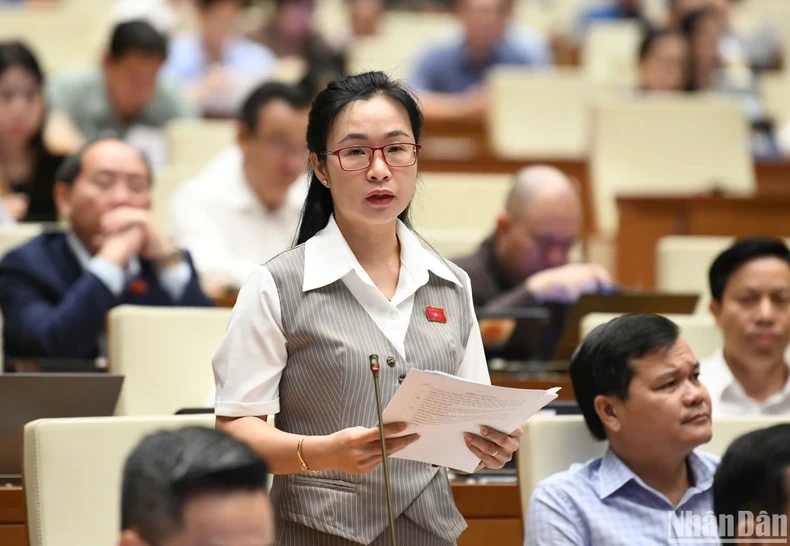
Representative Tran Thi Thu Hang (Dak Nong delegation) proposed a review to ensure compliance with the provisions of the 2015 Penal Code regarding the application of penalties to individuals aged 16 to under 18 if they have income or private property.
Accordingly, the fine for offenders aged 16 to under 18 is no more than half of the fine stipulated in the law, and there are no provisions for fines for those aged 14 to under 16. The purpose of this law is to ensure the best interests of minors, not to increase their obligations.
Ensure the principle of resolving cases involving minors quickly and promptly.
Regarding the authority to apply diversion measures, according to the report of the Standing Committee of the National Assembly, there are suggestions that the authority to decide on the application of diversion measures for compensation for damages should be granted only to the Court.
The Standing Committee of the National Assembly believes that in cases involving compensation for damages and where the parties agree on a compensation settlement, entrusting the Investigating Agency and the Procuratorate with the decision to apply diversionary measures as proposed in the draft Law (which also inherits the provisions of the current Criminal Code) will ensure the principle of speed and timeliness, allowing minors who meet the legal requirements to have diversionary measures applied promptly, instead of requiring the Investigating Agency and the Procuratorate to prepare a file requesting the Court to apply them, which would prolong the time limit and create additional procedural steps.
At the same time, to resolve disputes regarding compensation for damages, Clause 1 of Article 57 of the draft Law has added a provision. In case of disputes regarding ownership of evidence or compensation for damages, these must be resolved according to the provisions of civil procedural law.
The Supreme People's Court proposes regulations in the following direction: In cases where disputes arise regarding compensation for damages or issues related to asset confiscation, the court is granted the authority to decide on both the application of diversionary measures and compensation for damages or asset confiscation.

Speaking at the meeting, delegate Luong Van Hung (Quang Ngai delegation) suggested reconsidering the regulation that the Procuracy at the same level has the authority to overturn decisions on the application of diversionary measures by the investigating agency. Instead, he proposed that the Procuracy should have the right to make recommendations when there are grounds to believe that such decisions are unlawful, in order to ensure consistency in the policy of reviewing decisions on the application of diversionary measures by the Procuracy and the Court.
The regulations stipulate that decisions regarding the application of diversionary measures by the investigating agency or the prosecutor's office that are subject to complaints or appeals must be reviewed and resolved by the directly superior investigating agency or prosecutor's office, while still ensuring the correct implementation of the principle of resolving cases involving minors quickly and promptly.
At the same time, it is essential to ensure the principles of "state power is unified, with clear division of labor, close coordination, and effective control among state agencies..." and "all power must be strictly controlled..." as set forth in Resolution No. 27-NQ/TW dated November 9, 2022, of the 6th Plenum of the 13th Central Committee of the Communist Party of Vietnam on continuing to build and perfect the socialist rule of law state of Vietnam in the new period.
Some delegates argued that educational measures at the commune, ward, and town levels, as well as education at reform schools, are administrative sanctions stipulated in Articles 89, 90, 91, and 92 of the Law on Handling Administrative Violations; however, the scope of application in the Law on Handling Administrative Violations is very broad, including those stipulated in Articles 44 and 52 of this draft Law.
Therefore, it is suggested that the provisions regulating the application of educational measures at the commune, ward, and town levels, and education at reform schools be thoroughly reviewed and compared to ensure appropriate and consistent regulations; avoiding overlaps or conflicts that could lead to difficulties in application and limit the feasibility of the Law after its promulgation.
Source
![[Photo] Closing Ceremony of the 10th Session of the 15th National Assembly](/_next/image?url=https%3A%2F%2Fvphoto.vietnam.vn%2Fthumb%2F1200x675%2Fvietnam%2Fresource%2FIMAGE%2F2025%2F12%2F11%2F1765448959967_image-1437-jpg.webp&w=3840&q=75)

![[Photo] Prime Minister Pham Minh Chinh holds a phone call with the CEO of Russia's Rosatom Corporation.](/_next/image?url=https%3A%2F%2Fvphoto.vietnam.vn%2Fthumb%2F1200x675%2Fvietnam%2Fresource%2FIMAGE%2F2025%2F12%2F11%2F1765464552365_dsc-5295-jpg.webp&w=3840&q=75)








































![[OFFICIAL] MISA GROUP ANNOUNCES ITS PIONEERING BRAND POSITIONING IN BUILDING AGENTIC AI FOR BUSINESSES, HOUSEHOLDS, AND THE GOVERNMENT](https://vphoto.vietnam.vn/thumb/402x226/vietnam/resource/IMAGE/2025/12/11/1765444754256_agentic-ai_postfb-scaled.png)




































Comment (0)