

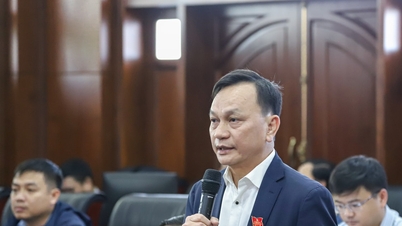
Representative Do Duc Hong Ha ( Hanoi delegation) asked: The National Assembly's interpellation resolution requires the State Bank of Vietnam to move towards removing credit growth limits. How has the State Bank of Vietnam implemented this? What is the roadmap towards eliminating credit growth limits?
Meanwhile, delegate Quàng Thị Nguyệt (from Điện Biên province) questioned: In 2024, the State Bank of Vietnam targeted credit growth of approximately 15%, but in the first nine months, it only reached 8.53%. By October 31, 2024, credit had increased to 10.08%. However, reality shows that although interest rates have fallen sharply, the absorption of credit by businesses and individuals remains low, and there are only two months left to achieve the target set by the State Bank of Vietnam.
Representatives asked the Governor to clarify the feasibility of the 15% credit growth target for 2024, its impact on bad debts and capital absorption capacity, and solutions to ensure 15% credit growth without increasing the bad debt ratio in the future.
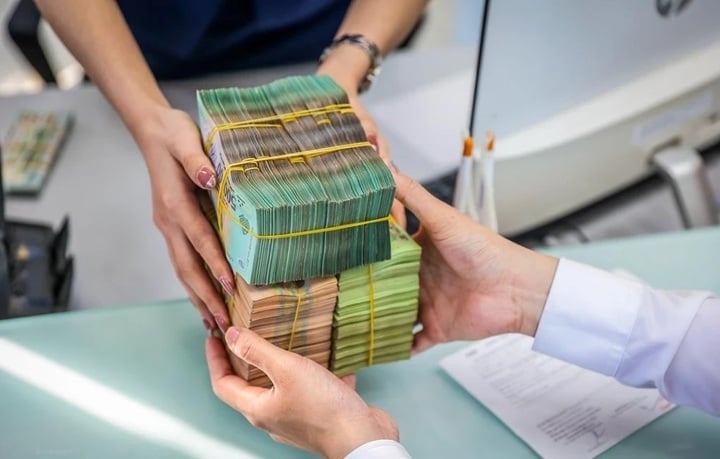
According to the Governor of the State Bank of Vietnam, the current credit limit-based management system cannot be abandoned yet. (Illustrative image)
Governor of the State Bank of Vietnam, Nguyen Thi Hong, stated that following the May 2022 interpellation session, the National Assembly issued Resolution 62/2022/QH15. The State Bank of Vietnam has organized seminars to thoroughly analyze, assess, and review the current state of the Vietnamese economy as well as the situation of credit institutions. " Considering the current context, the State Bank of Vietnam cannot yet abandon the credit limit-based management method ," the Governor emphasized.
The Governor explained that, given the economy's heavy reliance on banking capital, allowing each credit institution to achieve credit growth of several tens of percent, as in previous years, would pose potential risks. Especially since segments of the financial market that meet medium- and long-term needs, such as corporate bonds, equities, and stocks, still lack sufficient long-term capital, abolishing credit limits is not yet feasible.
The Governor also stated that, following the Government's directives, the State Bank of Vietnam has been more flexible in its solutions to meet credit needs, such as: granting credit limits based on assessments and ratings by the State Bank's supervisory and inspection agencies; and considering the Government's priority objectives in each period (agriculture and rural areas, exports, real estate, etc.).
By the end of 2023, the State Bank of Vietnam had announced the credit growth target for the whole year of 2024 for all credit institutions, with a target of approximately 15%.
When the Fed lowers interest rates, it initially seems that pressure on the exchange rate and foreign exchange market is reduced. However, the exchange rate and foreign exchange market are heavily influenced by many factors. It depends not only on the Fed's interest rate but also on the actual needs of the economy. If we improve the business environment, attract investment, and create favorable supply and demand, the exchange rate will be more favorable. In line with its steadfast goal of stabilizing the value of the VND, the State Bank of Vietnam will implement measures to make the VND more attractive and encourage people to convert foreign currency into VND.
According to the Governor, the State Bank of Vietnam aims for a 15% credit growth rate in 2024; however, it needs to monitor developments to adjust the target accordingly. Credit growth typically peaks in the last two months of the year. Therefore, achieving this target is highly feasible.
Regarding bad debts, if the cause of bad debts is due to objective factors, the State Bank of Vietnam will also find it difficult to control. As for the credit institutions themselves, the State Bank of Vietnam has directed them to strengthen measures to control bad debts by carefully appraising loans and borrowers, and cautiously balancing capital sources.
Proposal for a 120 trillion VND housing package to build housing for low-income earners.
During this morning's questioning session, delegate Tran Thi Van (Bac Ninh delegation) requested the Governor to provide solutions to overcome difficulties and promote the development of the current real estate market. In particular, she asked about enabling low-income individuals to purchase social housing.
Regarding this issue, Governor Nguyen Thi Hong stated that the current real estate market is experiencing an imbalance between supply and demand across various segments, especially in the low-income segment, which has not been strongly developed.
The government and the Prime Minister have given decisive direction and issued Resolution No. 33 to remove difficulties for businesses involved in real estate investment.
Accordingly, the State Bank of Vietnam (SBV) has proactively reviewed legal documents to provide solutions to alleviate difficulties for businesses facing debt repayment problems. The SBV has issued circulars to restructure debt repayment terms and maintain the same debt classification, thereby helping real estate businesses access new loan capital.
At the same time, the State Bank of Vietnam also directed credit institutions to reduce and waive interest on projects, including real estate projects. Regarding government lending circulars, these have now been suspended and not implemented.
Regarding the purchase of corporate bonds by organizations, the State Bank of Vietnam has revised regulations to ensure greater convenience for the real estate market.
Regarding resources for low-income housing, Governor Nguyen Thi Hong reaffirmed that the main source of funding is the state budget. The State Bank of Vietnam (SBV) has proposed a package of 120,000 billion VND and will actively implement it in the coming period.
For those eligible for housing and land support loans under national target programs, the State Bank of Vietnam has taken the lead in advising on the issuance of relevant decrees, and once funding is allocated, support solutions will be implemented as part of the program.
Source

![[Photo] Prime Minister Pham Minh Chinh holds a phone call with the CEO of Russia's Rosatom Corporation.](/_next/image?url=https%3A%2F%2Fvphoto.vietnam.vn%2Fthumb%2F1200x675%2Fvietnam%2Fresource%2FIMAGE%2F2025%2F12%2F11%2F1765464552365_dsc-5295-jpg.webp&w=3840&q=75)


![[Photo] Closing Ceremony of the 10th Session of the 15th National Assembly](/_next/image?url=https%3A%2F%2Fvphoto.vietnam.vn%2Fthumb%2F1200x675%2Fvietnam%2Fresource%2FIMAGE%2F2025%2F12%2F11%2F1765448959967_image-1437-jpg.webp&w=3840&q=75)







































![[OFFICIAL] MISA GROUP ANNOUNCES ITS PIONEERING BRAND POSITIONING IN BUILDING AGENTIC AI FOR BUSINESSES, HOUSEHOLDS, AND THE GOVERNMENT](https://vphoto.vietnam.vn/thumb/402x226/vietnam/resource/IMAGE/2025/12/11/1765444754256_agentic-ai_postfb-scaled.png)












































Comment (0)