In the treasure trove of Thanh Hoa's cultural heritage, the Lam Kinh Festival is considered a precious gem with many invaluable and distinctive values. The festival not only preserves many unique values but also provides an opportunity for the Vietnamese people to reflect on and take pride in the tradition of nation-building and national defense of their ancestors.
 The procession of palanquins at the Lam Kinh Festival.
The Lam Kinh Festival is associated with the Lam Kinh Historical Site and the Lam Son region. In 1433, after King Le Thai To passed away, he was buried in Lam Kinh. From here, temples and shrines began to be built.
The book "Vietnamese Historical Chronicle" records the construction of Lam Kinh: In 1433, King Le Thai To died, his body was brought to Lam Kinh and buried in Vinh Lang. In December of the same year, "the officials followed him to Tay Kinh to build the Lam Son Temple." In April 1434, King Le Thai Tong ordered "the Right Minister Le Nhu Lam to go to Lam Kinh to build a temple to worship the Queen Mother." Every few years, the king and officials of the Le dynasty would go to Lam Kinh to perform rituals to commemorate the merits of King Le Thai To in founding the dynasty. The rituals were all performed according to court customs. The sacrificial rituals included: “For the temple offering, four buffaloes were used, bronze drums were beaten, and soldiers cheered in response. For martial music, the dance was "Breaking the Battle of the Wu." For literary music, the dance was "The Vassals Come to Pay Court." Grand Minister Lê Bí performed the ceremony at the temples of Chiêu Hiến Vương (whose name was Học, Lê Lợi's elder brother) and Trung Dũng Vương (whose name was Thạch, Lê Học's son), using three buffaloes. Minister Lê Khang performed the ceremony at the temple of Hoàng Dụ Vương (whose name was Trừ, Lê Lợi's second elder brother), using one buffalo.”
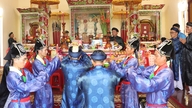

Regarding the festival, the book "Dai Viet History Chronicle" records: Emperor Le Thai Tong "remembered the merits of his predecessors and composed the Binh Ngo dance." The organization of the Binh Ngo dance performance is recorded quite specifically in the book: "In the 7th year of Thai Hoa (1449), in the spring of the first month, the king held a banquet for officials and performed Binh Ngo dances and music. Some dukes and marquises were moved to tears"; "Seven years later (1456), King Nhan Tong, on the occasion of returning to Lam Kinh to pay homage at the royal mausoleum, ordered the bronze drums to be beaten and performed the songs "Binh Ngo Breaking the Battle" and "The Vassals Come to Pay Homage."
 Many spectacular performances take place at the Lam Kinh Festival.
Through many upheavals, the Le Dynasty collapsed, and the Lam Kinh temple complex also declined. Simultaneously, the courtly rituals disappeared from the life of the Lam Kinh region for a long time. It wasn't until the early 20th century that Lam Son village erected a temple right on Lam Kinh land to worship King Le Thai To, Nguyen Trai, Le Lai, and Princess Bach Y. Many rituals were gradually restored and preserved by the people. Perhaps this is what creates the unique and attractive character of the Lam Kinh Festival, which is both courtly and communal in nature.
Today, the Lam Kinh Festival takes place on the 21st and 22nd of August in the lunar calendar each year, commemorating the event: "Twenty-one Le Lai, twenty-two Le Loi." The Lam Kinh Festival is organized with many solemn and sacred rituals. The ceremonial part includes the procession of the palanquins of King Le Thai To and Trung Tuc King Le Lai, the reading of the eulogy, the offering of incense to commemorate King Le Thai To and the Lam Son heroes. In addition to the main rituals, the festival is impressively organized with a theatrical program recreating the Lam Son Uprising with important milestones such as the Lung Nhai Oath, Le Lai saving the king, the liberation of Dong Quan citadel, Le Thai To's coronation, along with many unique games and performances such as the Xuan Pha game, dragon dance, drum performance, and Pon Poong... The combination of these performances demonstrates the vibrant cultural and spiritual life of the people. At the same time, it affirms that Thanh Hoa is a land rich in tradition, a treasure trove of rich, vibrant, colorful, expressive, and artistic intangible cultural heritage of the Thai, Muong, and Kinh ethnic groups.


The Lam Kinh Festival not only enriches the diversity of Thanh Hoa province's culture and Vietnamese national culture, but also affirms its position in the flow of history, culture, and the hearts of the Vietnamese people.
Text and photos: Thùy Linh
Source: https://baothanhhoa.vn/le-hoi-lam-kinh-nam-2024-di-san-van-hoa-phi-vat-the-vo-gia-225632.htm
![[Image] National conference summarizing one year of operation of the overall organizational model of the political system, the three-tiered government model.](https://vphoto.vietnam.vn/thumb/1200x675/vietnam/resource/IMAGE/2026/07/01/1782882811691_ndo_br_1-jpg.webp)