

Training new recruits is the initial step and foundation for shaping the qualities and character of revolutionary soldiers. In 2023, the Party Committee and the Command of Ho Chi Minh City provided close leadership and guidance, implementing numerous policies and measures to improve the quality of new recruit training. Inspection results showed that 100% of training content achieved a "good" rating or higher, with 9 out of 13 areas achieving an "excellent" rating. Discipline was strictly observed, and unit safety was ensured. From practical experience, the City Command has drawn many important lessons to continuously improve the quality of new recruit training.
To improve the quality of training, the City Command has determined that it is necessary to improve the quality of recruitment. In recent years, the Party Committee and the City Command have advised the City Party Committee and the City People's Committee to implement many policies and measures to improve the quality of recruitment and conscription, such as: promoting the role of military agencies at all levels in advising on the management of young people of conscription age; directing localities to plan for the development of Party members; advising on the selection and encouragement of cadres, civil servants, and public employees who are Party members and still of conscription age to participate in military service; directing localities to do a good job of preliminary selection, focusing on young people with university, college, and vocational school degrees; coordinating with local police to manage resources, especially exploiting the national population database. As a result, the quality of young people conscripted into the military has improved every year. In 2023, young people conscripted into the military with university, college, and vocational school degrees accounted for over 44.2%. Health categories I and II account for 79.8%...
 |
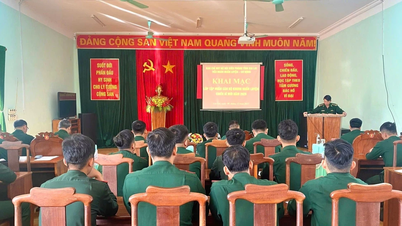
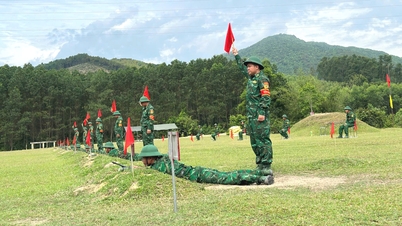
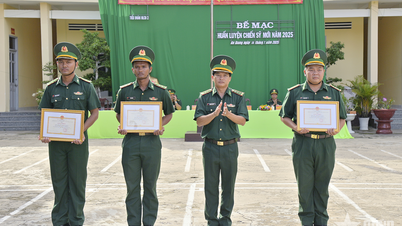
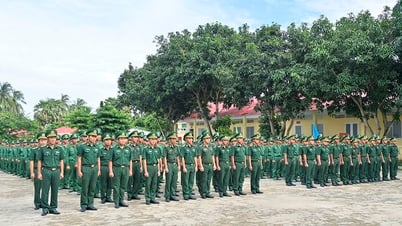
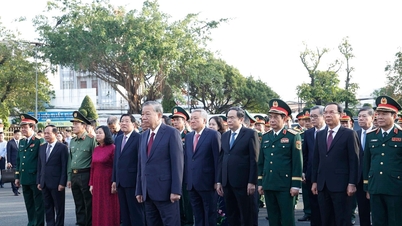
Leaders of the Ho Chi Minh City Command inspect and encourage soldiers of the Gia Dinh Regiment. Photo: DUY HUNG |
 |
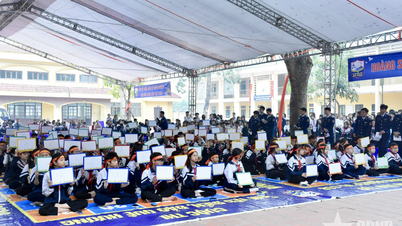
Leaders of the Ho Chi Minh City Command inspect and encourage soldiers of the Gia Dinh Regiment. Photo: DUY HUNG |
Directing units to regularly check, classify, and rigorously evaluate the quality of incoming recruits is one of the crucial steps that helps commanders accurately assess the quality of recruits in order to determine appropriate training methods. Therefore, immediately after receiving recruits and throughout the training process, units organize rigorous checks on their entry level, categorize them into groups, and combine officer training with maximizing the role of teams and groups. The City Command directs units to make thorough preparations in terms of materials and training grounds, ensuring lesson plans and lectures include vivid diagrams, pictures, and illustrations, while actively researching and applying science and technology to training. The organization strictly maintains regular routines and discipline from the very first hour, day, and week, focusing on guiding soldiers to properly adhere to daily and weekly schedules, ceremonial conduct, forms of address, greetings, and maintaining internal order and hygiene. During training, emphasis is placed on innovating training methods, strengthening inspections, focusing on surprise inspections, cross-checking, and training reviews, while decisively addressing shortcomings. In addition, the system of reviewing lesson plans and providing officer training is also strictly and regularly maintained by units, especially for newly graduated officers and officers in the CSM training framework. The establishment of specialized teaching teams, the flexible application of training methods suitable to the CSM's level, the emphasis on promoting the active, proactive, and creative participation of learners, and the role of the three-person team in training are crucial factors determining training results.
From practical experience, the City Command has developed many effective training methods and forms, such as visual training; problem-solving; situational training; and group training with highly skilled soldiers to encourage learners to actively exchange ideas, understand and grasp the overall knowledge, thereby discovering and creatively applying it to the training process, overcoming the passivity of learners. Models such as: "One hour per week to study one legal document," "Applying information technology in testing and evaluating learning outcomes," "Four-Good Unit," "Model for training young officers," "Training team," etc., are maintained and effectively implemented.
 |
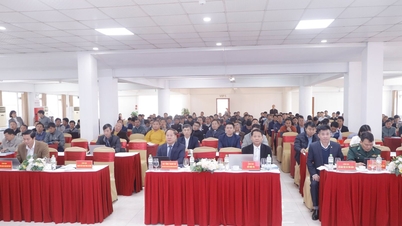
Leaders of the Ho Chi Minh City Command inspect and encourage soldiers of the Gia Dinh Regiment. Photo: DUY HUNG |
The City Command directs the promotion of the role of the staff in managing and conducting training, and the proactiveness of officers in carrying out training tasks. These are important, principled contents and solutions that ensure training is properly oriented, practical, comprehensive, focused, and concentrated, unified, synchronized, and effective. The training motto "basic, practical, and solid" is implemented well, and the role of officers is promoted in innovating the organization and methods of training. Training officers are trained to always maintain a professional demeanor, employ scientific command and training methods, and prioritize the learners, fostering their active participation, initiative, and creativity. The training effectively combines theory and practice, prioritizing practical application, progressing from basic to advanced levels, from simple to complex, from segmented to comprehensive, from rudimentary to proficient movements, and integrating tactics with techniques. It fosters resilience, mental fortitude, and the effective application of knowledge in practice. In disciplinary management, emphasis is placed on combining education and persuasion to inspire the soldiers' active participation and self-awareness; resolute and strict action is taken against violations. Coordination with relevant departments, localities, and families in the management and education of new recruits is also emphasized. During the new recruit training period, the City Command directs the organization of many practical activities such as unit meetings with local Party committees, authorities, and families of new recruits, cultural and artistic exchanges, sports activities, and fraternal activities to strengthen military-civilian solidarity.
Major General LE XUAN THE - Deputy Commander, Chief of Staff of the Ho Chi Minh City Command
Source
































































Comment (0)