

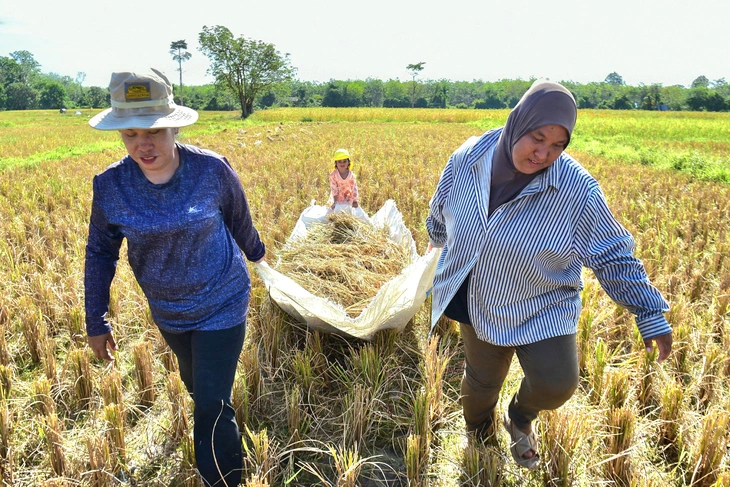
Farmers harvest rice in a field in southern Thailand - Photo: AFP
Some farmers are even switching to growing koshihikari rice - a variety that produces premium Japanese rice - to cater to increasingly diverse tastes, according to Nikkei Asia .
Once a failure in an emergency import in 1993 due to its poor taste, Thai rice is now becoming more popular thanks to the popularity of Asian cuisine in Japan.
Wonnapob Export Company said that the image of “soft and sweet” Thai rice is becoming more known to the Japanese. At the same time, the amount of Thai jasmine rice exported to Japan from the beginning of the year to October 2025 has increased 6 times compared to the whole year of 2024.
While retail rice prices in Japan have risen to more than 4,300 yen per 5kg (about 27.6 USD) - the highest level since 2022, Thai rice sold in Japan is significantly cheaper, about 3,200 yen per 5kg, contributing to stimulating demand.
Japan's Ministry of Agriculture , Forestry and Fisheries also forecasts a 5% cut in staple rice production in the 2026 crop, which could cause rice prices in Japan to remain high.
In contrast to the Japanese market, Thailand's rice export price has dropped to its lowest level since 2007, only 356 USD/ton, due to the impact of the move to restrict and then remove the restriction on white rice exports by India - the leading country in the global rice market.
Although agriculture accounts for less than 10% of GDP, Thailand is the world's third-largest rice exporter, so finding new outlets is crucial.
However, Thai rice exports to Japan still decreased by 15% in the first 9 months of the year, because Thai jasmine rice only accounts for 3% of the total volume and is difficult to replace Japanese rice in terms of stickiness, aroma and grain shape.
In addition, the US-Japan trade negotiations forced Japan to increase its imports of US rice within the “minimum access” framework, forcing it to reduce imports from Thailand from 300,000 tons to 70,000 to 80,000 tons.
Faced with this less positive outlook, some Thai farmers are switching to growing Japanese rice varieties.
In Udon Thani province (northeast of Thailand), Seksan farmers are preparing to export 50 tons of koshihikari to Japan for the first time, despite having to pay a tax of 341 yen/kg because it is not included in the preferential quota.
He believes that thanks to the hot climate and the ability to harvest 2-3 crops per year, Thai rice grown using Japanese varieties can still be sold at half the price of Japanese rice but with the same quality.
After working in Japan and being impressed by the quality of the koshihikari rice variety, Mr. Seksan set up a production group of 50 people on about 50 hectares, mainly selling domestically, before turning to export in the context of a shortage of supply in the Japanese market.
Source: https://tuoitre.vn/gia-gao-nhat-ban-tang-ky-luc-thai-lan-tranh-thu-day-manh-xuat-khau-20251203112210027.htm



























![[Photo] Parade to celebrate the 50th anniversary of Laos' National Day](/_next/image?url=https%3A%2F%2Fvphoto.vietnam.vn%2Fthumb%2F1200x675%2Fvietnam%2Fresource%2FIMAGE%2F2025%2F12%2F02%2F1764691918289_ndo_br_0-jpg.webp&w=3840&q=75)































































Comment (0)