

Domestic fuel prices today, February 10, 2024
In the domestic market, the selling prices of gasoline and oil today, February 10, are applied according to the prices at the management session on the afternoon of February 8 of the Ministry of Finance - Industry and Trade.
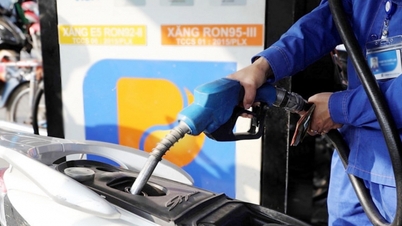
Accordingly, retail gasoline prices have been adjusted downwards across the board. In particular, the price of RON 95 gasoline has dropped sharply to 23,000 VND/liter.
Specifically, the price of E5 gasoline decreased to 22,120 VND/liter. The price of RON 95 gasoline decreased to 23,260 VND/liter.
The price of diesel fuel has fallen to 20,700 VND/liter. Meanwhile, the retail price of kerosene has decreased to 20,580 VND/liter.
Today's retail prices for gasoline and diesel:
| Item | Price from February 8 (unit: VND/liter) | Compared to the previous period |
| RON 95-III gasoline | 23,260 | - 900 |
| E5 RON 92-II gasoline | 22,120 | - 790 |
| Diesel | 20,700 | - 290 |
| Oil | 20,580 | - 340 |
World oil prices today, February 10, 2024
On the world market, oil prices continued to rise today, February 10th, heading towards the $82 per barrel mark.
On February 9, international oil prices increased slightly after increasing by more than 3% in the previous session.
According to data from Oilprice, at 5:03 PM on February 9th (Vietnam time), Brent crude oil was trading at $81.76 per barrel, up $0.13, or 0.16%, from the previous session. WTI crude oil was trading at $76.52 per barrel, up $0.30, or 0.39%, from the previous session.
Gasoline and diesel prices continue to climb, heading towards a sharp increase this week, reversing last week's deep decline.
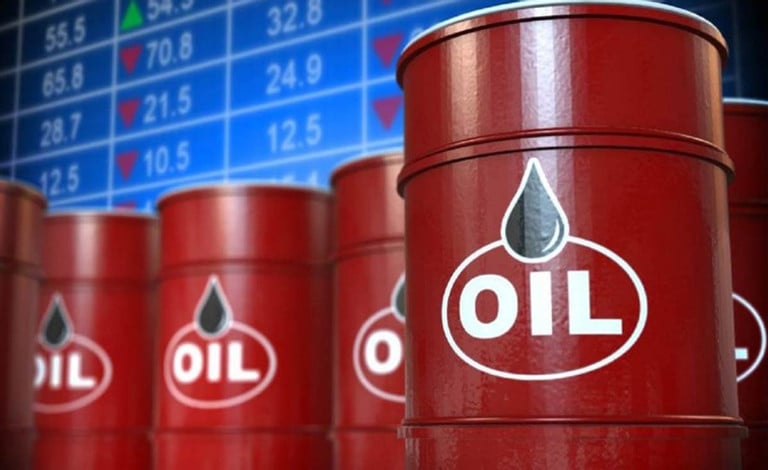
Oil prices continued to rise due to concerns about escalating conflict in the Middle East after Israel rejected Hamas's ceasefire offer.
Israeli Prime Minister Benjamin Netanyahu on February 7 rejected Hamas's proposal for a ceasefire and the release of hostages held in the Gaza Strip. Hamas had previously proposed a four-and-a-half-month ceasefire, which Israel had refused. This highlights the complex nature of the conflict in the Middle East.
Israeli forces even bombed the city of Rafah on the southern border of the Gaza Strip after Prime Minister Benjamin Netanyahu rejected a proposal to end the conflict.
Meanwhile, in the Red Sea, the security situation is deteriorating, despite Western efforts to curb Houthi attacks in Yemen.
Escalating geopolitical tensions have fueled strong buying in the crude oil market, driving oil prices higher.
In addition, a sharper-than-expected drop in US gasoline and distillate inventories also pushed oil prices up.
According to the U.S. Energy Information Agency (EIA), U.S. gasoline inventories fell by 3.15 million barrels last week, contrary to analysts' forecasts of a 140,000-barrel increase. Similarly, U.S. distillate product inventories decreased by 3.2 million barrels, while forecasts predicted a decrease of only 1 million barrels.
Regarding supply, the EIA recently cut its outlook for US oil production growth in 2024 by 120,000 barrels per day to 170,000 barrels per day, a sharp decrease from the 1.02 million barrels per day growth projected for 2023.
Declining fuel inventories, coupled with rising crude oil reserves, are a sign of ongoing maintenance at U.S. refineries.
Maintenance at US refineries, combined with a diesel shortage in Europe, has supported the rise in oil prices.
In addition, concerns about tightening global supplies also pushed oil prices higher.
Source



















































![[OFFICIAL] MISA GROUP ANNOUNCES ITS PIONEERING BRAND POSITIONING IN BUILDING AGENTIC AI FOR BUSINESSES, HOUSEHOLDS, AND THE GOVERNMENT](https://vphoto.vietnam.vn/thumb/402x226/vietnam/resource/IMAGE/2025/12/11/1765444754256_agentic-ai_postfb-scaled.png)

























































Comment (0)