

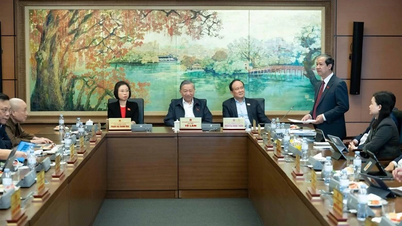
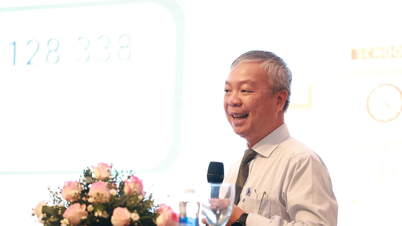
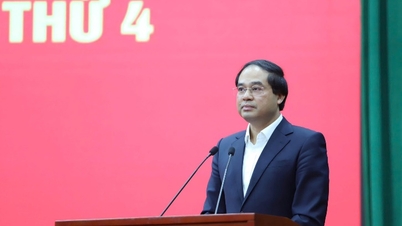
On the morning of December 5, the Vietnam Institute of Educational Sciences in collaboration with the United Nations Children's Fund (UNICEF Vietnam) and the British Council organized the 2025 Educational Science Conference with the theme "Education in the era of national development".
Regarding the question of “What should education do in the new era?”, Professor Le Anh Vinh, Director of the Vietnam Institute of Educational Sciences , said that this cannot be just a slogan but must start with a core question. According to him, to thrive in the new context, education must not simply follow trends or development speed, but must return to essential issues to build a foundation for Vietnamese people.

Mr. Vinh also emphasized the trend of approaching the system and putting people at the center. According to him, no matter how optimal a system is, it is meaningless if it does not serve the development of each student and does not create conditions for teachers to be creative. In the context of the implementation of the two-level local government model, when there is no longer a district/county level and the Department of Education and Training, the roles and responsibilities of the locality are more clearly defined, at the same time the pressure and expectations placed on schools and teachers are also greater.
He believes that the development of education will open up many opportunities for strong innovation. The issue is not just overcoming challenges, but taking advantage of those challenges to accelerate and rise in the new context.
Speaking at the workshop, Dr. Pham Do Nhat Tien (Association of Vietnamese Universities and Colleges) said that the "red thread" running through Resolutions 57 to 71 of the Politburo is breakthrough innovation, shifting from a heavily management-oriented institution to a development-creating institution.
“The resolutions on education reform have put forward a very important idea that old standards should not be imposed on a modern education system. We must move from reform to breakthrough development,” Mr. Tien said.
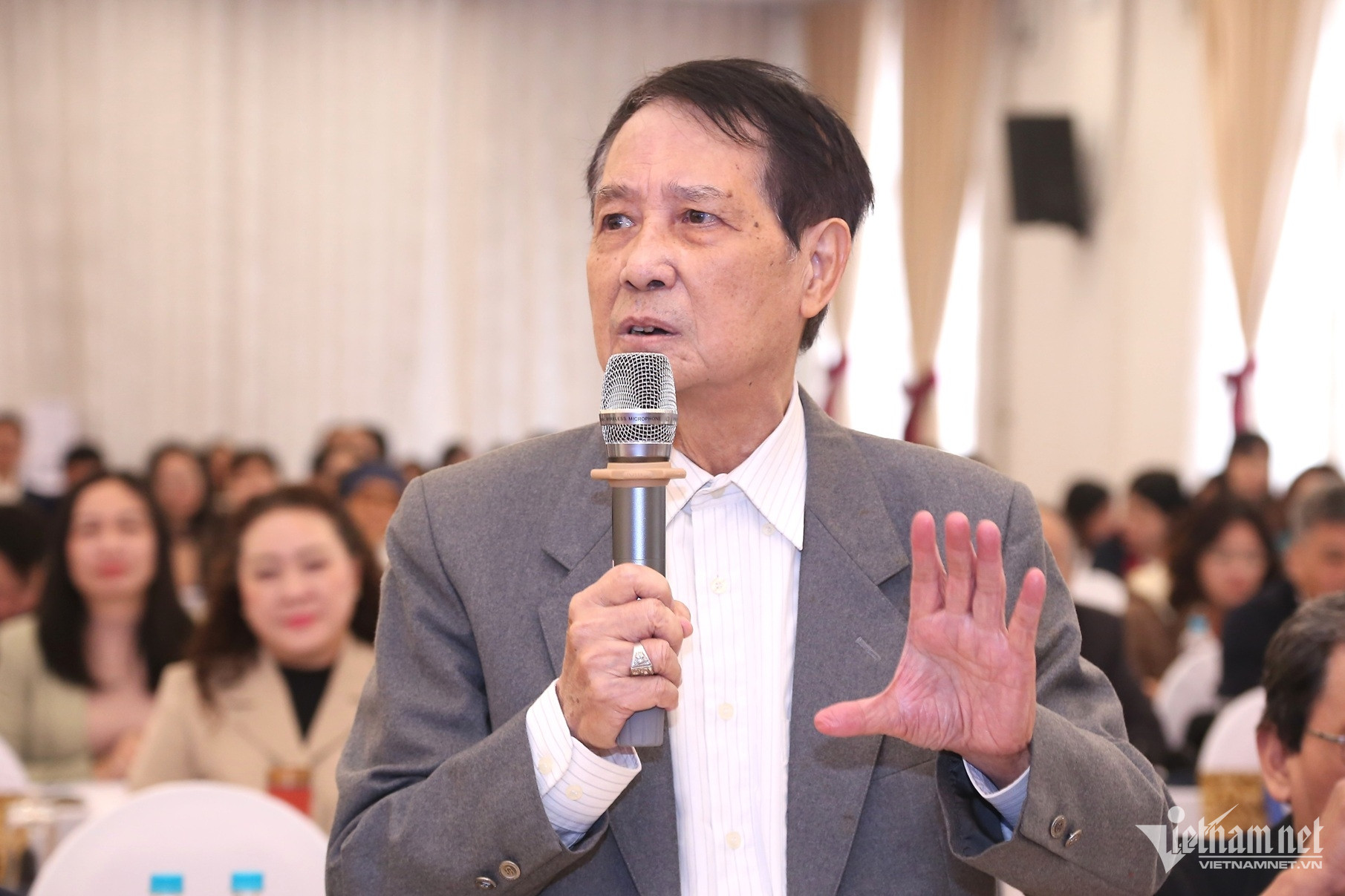
According to him, a very important shift is from traditional management to flexible management in education. Schools, teachers and learners must apply flexible management thinking to innovate management, teaching and learning, ensuring that teaching and learning are always up to date with trends.
However, Mr. Tien also said that there are a series of challenges that need to be clearly recognized in order to innovate.
The first is the conservatism of education. Both teachers and educational administrators at both the system and school levels are hesitant to apply agile management because they are used to traditional management because it is easier, more stable and requires less change.
Second, education also requires additional costs that schools do not always have: costs for training new competencies, costs for new human resources, and costs for the time needed for transformation. All of these costs are not easy to have and overcome.
Third, to apply flexible education management, it must be based on digital technology. “Most fundamentally, it must be based on a developed digital infrastructure; complete and interconnected digital data; and the conditions and digital capacity of teachers to be able to promote all strengths. These are huge challenges for Vietnam,” said Mr. Tien.
He also commented that the current way of designing educational programs is not ready for the future. According to him, the thinking of program development is still heavily based on the traditional approach, considering the program as a finished product, instead of a flexible structure that needs to be continuously adjusted. In addition, the current program development process often follows a fixed path with pre-set goals. Meanwhile, the design of educational programs must be a non-linear process, taking place through many loops, and after each loop, the goals can be adjusted to suit actual fluctuations.
According to Mr. Tien, educational programs must be ready to respond to change and consider change as inevitable, even a competitive advantage.
The expert recommended that the education sector needs to create conditions for schools and teachers to access flexible management thinking so that they can actively participate in innovating educational programs at all levels.
“Currently, if we build programs and organize education with a rigid process, it will not be able to respond to changes and is also not in line with the spirit of Resolution 71,” Mr. Tien said.
Source: https://vietnamnet.vn/giao-duc-can-tro-lai-voi-nhung-van-de-ban-chat-xay-dung-nen-tang-cho-con-nguoi-2469736.html
![[Photo] Cat Ba - Green island paradise](/_next/image?url=https%3A%2F%2Fvphoto.vietnam.vn%2Fthumb%2F1200x675%2Fvietnam%2Fresource%2FIMAGE%2F2025%2F12%2F04%2F1764821844074_ndo_br_1-dcbthienduongxanh638-jpg.webp&w=3840&q=75)








































































Comment (0)