

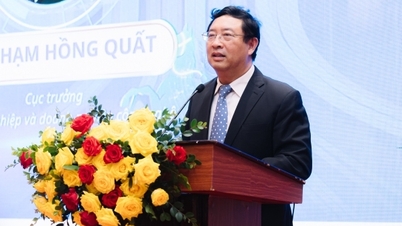
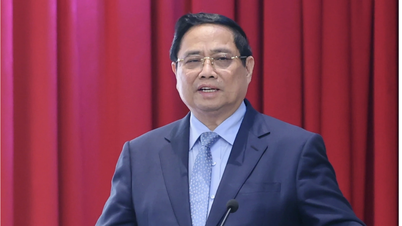
Regarding this matter, a reporter from Thanh Nien newspaper had an interview with Associate Professor Dr. Vu Hai Quan ( pictured ), Director of the Vietnam National University Ho Chi Minh City (VNU-HCM), about the program to develop VNU-HCM into a leading training, research, entrepreneurship, and innovation center in Asia in the field of semiconductor technology for the period 2023-2030, with a vision to 2045 (hereinafter referred to as the program).
DEVELOPING THE MICROCHIP INDUSTRY IS URGENT.
Why did the Vietnam National University Ho Chi Minh City decide to implement this project, sir?

Associate Professor Dr. Vu Hai Quan
Without mastering the technology for manufacturing semiconductor components and integrated circuits, Vietnam cannot create electronic products with high intellectual content and high added value, and even less can it create new products with groundbreaking technological features for various purposes.
International experience shows that the development of the semiconductor industry has benefited significantly from the contributions of universities and research institutes. Domestically, stemming from the Party's policies and the Government 's strategic direction, many centers, laboratories, research groups, and training programs in microchips have been established in recent years.
In 2005, the Vietnam National University Ho Chi Minh City established the Integrated Circuit Design and Training Center (ICDREC) with the mission of training, researching, and mastering several core technologies. The ICDREC Center has researched, designed, and manufactured 8-bit SG8v1 microprocessors, 32-bit VN1632 microprocessors, and several IP cores for data security applications.
In 2018, the Vietnam National University Ho Chi Minh City (VNU-HCM) invested over 60 billion VND to establish a Microchip and High-Frequency Systems Laboratory at the University of Technology. In 2024, VNU-HCM will continue to invest approximately 80 billion VND in two new laboratories focusing on semiconductor microchip technology at the University of Science and Technology and the University of Information Technology. These laboratories will be equipped with modern facilities, creating favorable conditions to attract and gather talented microchip scientists and experts from both within and outside the country, enhancing research capacity and scientific publications, and meeting the needs of the national microchip industry.
Furthermore, within the framework of the Higher Education Innovation Cooperation Project funded by USAID (United States Agency for International Development) with a total budget of 15 million USD, lasting for 5 years from 2022 to 2026, Vietnam National University Ho Chi Minh City is proposing to several leading US universities to support the innovation of its integrated circuit design training program.
Thus, it can be seen that developing Vietnam's microchip industry using domestic resources to increase the added value of domestic electronic products and contribute to boosting the economy and ensuring national security and defense is extremely urgent. This is also the reason why the Vietnam National University Ho Chi Minh City advocates for the implementation of this project.
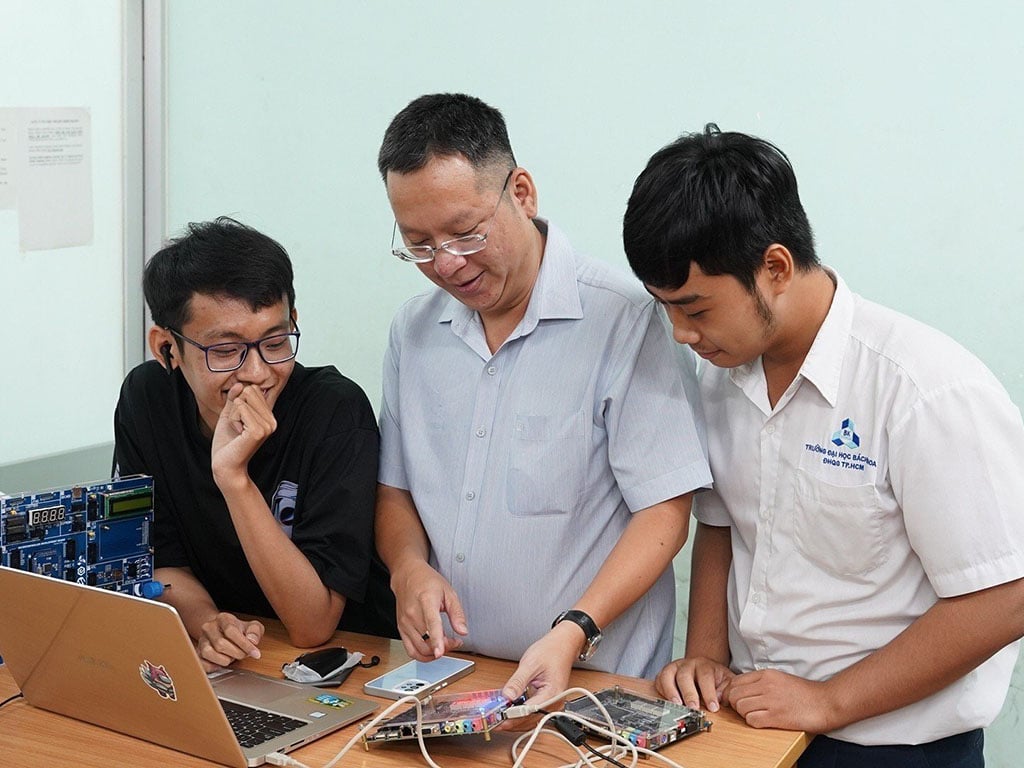
Integrated circuit design training activities at member universities of the Vietnam National University Ho Chi Minh City.
TRAINED OVER 1,500 ENGINEERS AND 500 MASTER'S DEGREE HOLDERS IN MICROCHIP DESIGN
What specific goals does the Vietnam National University Ho Chi Minh City (VNU-HCM) aim to achieve when implementing this project?
Regarding training, the Vietnam National University Ho Chi Minh City (VNU-HCM) aims to provide in-depth training in integrated circuit design to meet the demand for high-quality human resources for the development of Vietnam's and the world's integrated circuit industry. It will develop an advanced undergraduate and postgraduate training framework in integrated circuit design and train over 1,500 engineers and 500 master's degree holders between 2023 and 2030. It will also develop a modern training program leading to industrial and international certifications in integrated circuit design for 15,000 engineers. Furthermore, it will develop a training and research strategy for the period 2030-2045 to ensure a workforce for the successful and sustainable development of Vietnam's integrated circuit industry.
In terms of research, the goal of the Vietnam National University Ho Chi Minh City (VNU-HCM) is to establish a Semiconductor Research Institute as a central hub for developing strong research groups and laboratories serving advanced, in-depth training and research in the field of integrated circuits. This will promote experimental fabrication, scientific research, international publications, and inventions, and master several core technologies. Through this, the university aims to develop a network of lecturers and experts through international cooperation, business collaboration, technology transfer, and the establishment of technology startups in the field of semiconductor integrated circuit design.
Policies to Attract Talented Individuals
Could you please tell us about the strengths and advantages of developing this program?
Firstly, guided by the Government and Ho Chi Minh City's development orientation for the microchip industry, the Vietnam National University Ho Chi Minh City (VNU-HCM) has, over the years, established and developed centers, research groups, and undergraduate, postgraduate, and short-term training programs in microchip design. In particular, in its development strategy for the period 2021-2030, VNU-HCM prioritizes the development of training programs in several key areas, including semiconductor technology.
The Vietnam National University Ho Chi Minh City (VNU-HCM) has also proactively promoted cooperation with major universities with strengths in integrated circuit design training in Asia (South Korea, Taiwan, Japan) to complete the training and research framework in the field of integrated circuit design, while simultaneously investing in the construction and upgrading of modern, specialized laboratories in this field to serve experts and students at VNU-HCM in particular and the southern region in general.
Training institutions under the Vietnam National University Ho Chi Minh City (VNU-HCM) have many years of experience in specialized training and research. In the fields of mathematics, information technology, electronics and telecommunications, and automation, approximately 6,000 bachelors and engineers graduate annually. The faculty and research experts are formally trained and have strong connections with many large enterprises in the field of integrated circuit design in Ho Chi Minh City. Furthermore, many foreign integrated circuit and semiconductor technology companies are currently investing heavily in Vietnam and Ho Chi Minh City, driving up the demand for personnel in the integrated circuit design industry over the next 10-15 years.
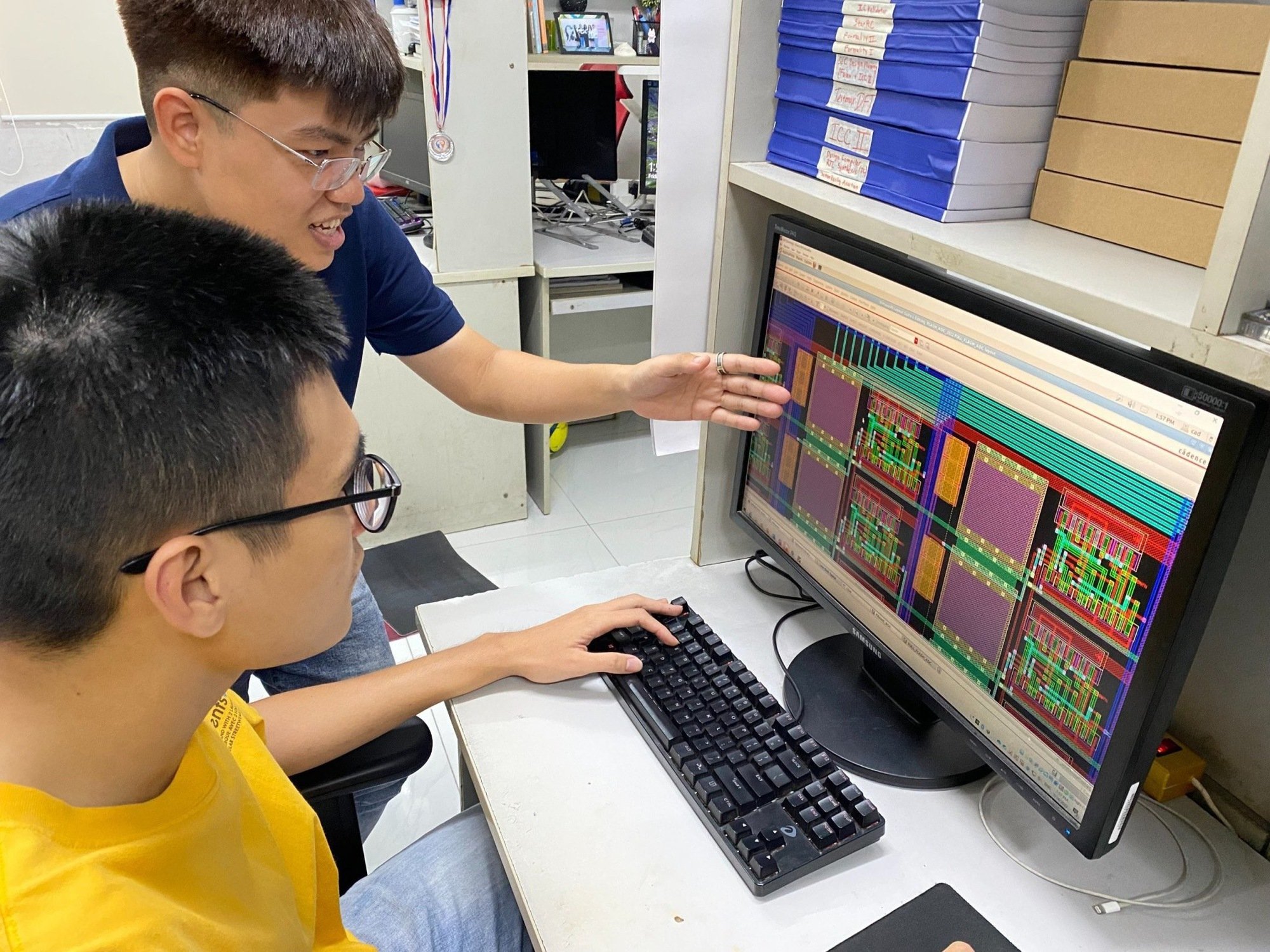
The Vietnam National University Ho Chi Minh City (VNU-HCM) is developing an advanced undergraduate and postgraduate training framework for integrated circuit design and aims to train over 1,500 engineers and 500 masters in the period 2023-2030.
To achieve the above objectives, what specific mechanisms and policies does the Vietnam National University Ho Chi Minh City have in place to attract talented personnel to study and participate in research?
Initially, the Vietnam National University Ho Chi Minh City (VNU-HCM) will facilitate its member universities to pilot integrated circuit design programs (at both undergraduate and postgraduate levels), while also collaborating with large, reputable universities specializing in integrated circuit design to offer master's and doctoral programs. In addition, policies will be implemented to support lecturers and experts in integrated circuit design, particularly attracting domestic and international experts to participate in training in this field. For students, the admissions policy aims to attract talented individuals to the integrated circuit design program. Scholarships for postgraduate students will be especially important, given the long training duration and practical requirements of the field.
In scientific research, priority will be given to allocating funding to support projects on integrated circuit design; supporting the establishment and development of strong research groups, and collaborating with industry and international experts for research and experimental fabrication. In addition, policies will support experimental fabrication through the MPW (Multi-Project Wafer) service, as students need practical experience to enhance their design skills.
The global integrated circuit industry is projected to reach approximately $1,921.42 billion by 2032.
The global semiconductor industry is making strong strides. The global integrated circuit (IC) market was estimated at $562.53 billion in 2022 and is projected to reach approximately $1,921.42 billion by 2032. The Asia-Pacific region is expected to experience the fastest growth.
Source link



![[Photo] Prime Minister Pham Minh Chinh attends the Conference summarizing and implementing tasks of the judicial sector.](/_next/image?url=https%3A%2F%2Fvphoto.vietnam.vn%2Fthumb%2F1200x675%2Fvietnam%2Fresource%2FIMAGE%2F2025%2F12%2F13%2F1765616082148_dsc-5565-jpg.webp&w=3840&q=75)


























































































Comment (0)