

For the country to thrive in the new era, it is essential to have private economic groups that grow to a sufficient level, becoming leading enterprises that drive the economy.
HanoiMoi newspaper is launching a series of articles titled: "The Aspiration to be a 'Leading Crane' - A New Driving Force for Vietnam's Private Economy," identifying bottlenecks, proposing breakthrough policies to develop the private economic sector, and building a generation of Vietnamese entrepreneurs who are courageous and ambitious, contributing to shaping the country's new position in an era of growth, wealth, and prosperity.
Lesson 1: The "Orders" from Leaders
On numerous occasions at high-level forums, leaders of the Party, State, and major localities have mentioned the dream of "Vietnamese private corporations of international stature." However, a challenging gap exists between the reality of the economy and this grand dream. Join HanoiMoi Newspaper in examining the overall role of the private economy today, the major paradoxes that exist, and the new strategic thinking that is making breakthroughs and "giving wings" to this economic sector.
The weight of a national aspiration
From the National Assembly to investment promotion conferences, from strategic speeches to specific policy statements, a common message is resonating increasingly strongly: Vietnam needs "leading cranes" - private corporations with global scale, competitiveness, and the leadership qualities to guide the domestic business ecosystem.
In an article titled "Developing the Private Economy - A Lever for a Prosperous Vietnam" published in March 2025, General Secretary To Lam affirmed: “The private economy needs to strive to become the main force, leading in the application of technology and innovation, to achieve the goal of contributing approximately 70% of GDP by 2030; increasingly more private enterprises will have global competitiveness, master technology, and integrate deeply into international value chains and supply chains; together with the whole country, building a dynamic, independent, self-reliant, strong, and prosperous Vietnam.” This is not just a guideline, it is a strategic mandate for national development.
The image of "leading cranes" has also become a symbol in the messages of Politburo member and Prime Minister Pham Minh Chinh. At many forums, the head of government always emphasizes the need to build Vietnamese businesses that are large-scale, reputable, possess national brands, and are capable of competing fairly in the global market. This aspiration stems from the fierce competition of the world economy. A nation that wants to be self-reliant and have a position on the economic map cannot do without its own pillar businesses, its own "giants."
At a major economic forum in the capital on June 20, 2025, Tran Sy Thanh, Member of the Central Committee of the Communist Party of Vietnam, Deputy Secretary of the Hanoi Party Committee, and Chairman of the Hanoi People's Committee, directly "ordered" that Hanoi needs private corporations that are large enough, strong enough, and capable enough to not only lead the capital's economy but also reach out to the region and the world. This order not only reflects the specific expectations of the city government but also symbolizes a profound shift in development thinking – where the private sector is no longer on the sidelines but is at the center of the aspiration to create a prosperous nation.
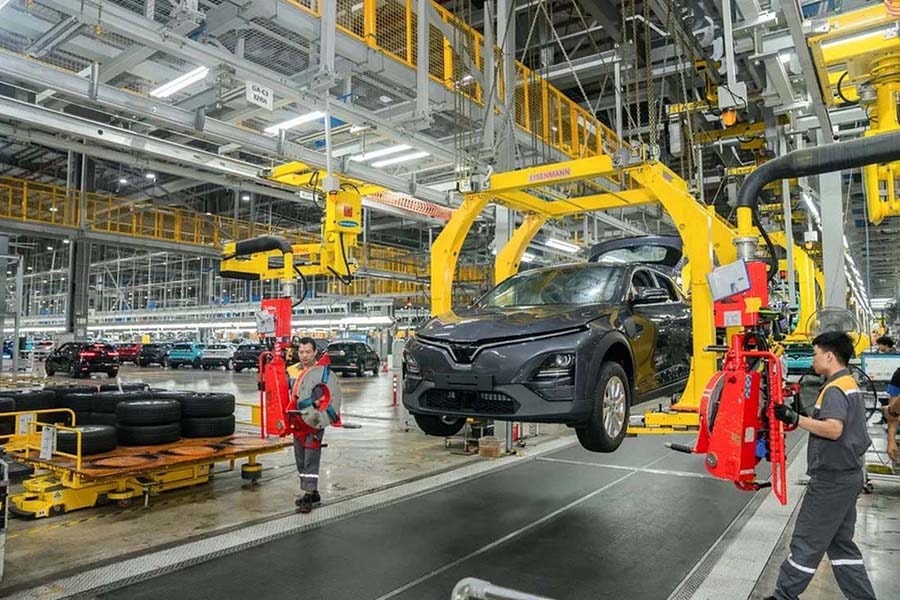
The dream of Vietnamese businesses with international brands is no longer a distant one. In reality, many corporations such as Vingroup, Masan, Thaco... have been and are rising strongly. Vingroup is not only a real estate developer but also a manufacturer of automobiles and high technology with the VinFast brand making a name for itself in the US and European markets. Masan leads the consumer goods and processed food market and is expanding into consumer finance and mining. Thaco is a pioneer in the automotive industry and integrated logistics…
These companies not only create jobs, pay taxes, or increase revenue. More importantly, they have paved the way for tens of thousands of small satellite businesses, standardized value chains, spread a culture of innovation, and laid the foundation for an independent, modern, and self-reliant national economy.
However, behind these bright spots lies a major paradox: Vietnam has a "forest" of private sector businesses with over 940,000 enterprises and 5 million business households, yet the majority still lack capacity, vision, and a supporting ecosystem. By the end of 2024, the private sector contributed approximately 51% of GDP and created 85% of jobs, but 98% of these were small and micro-enterprises. Small businesses typically only participate in the lowest links in the value chain – processing, assembly, or consumer retail. Without these "big players," the business ecosystem will remain fragmented, lacking linkages, and vulnerable to global shocks.
Speaking with a reporter from Hanoi Moi Newspaper, Dr. Le Xuan Sang, Deputy Director of the Vietnam and World Economics Institute, commented that this is a structural challenge for the economy. Dr. Le Xuan Sang analyzed: "The absence of large, powerful private corporations not only reduces national competitiveness but also creates a disruption in industry linkages. Small and medium-sized enterprises (SMEs) find it very difficult to grow on their own without guidance and connection from leading enterprises, especially when state support is ineffective and untimely. The core issue is to create a truly equal, transparent, and predictable business environment. When the environment is good, businesses will find their own way, and outstanding businesses will naturally rise. The state needs to focus on its role in creating an ecosystem, promoting linkages between SMEs and large enterprises and FDI businesses, instead of directly intervening. Only then will businesses have high resilience, increased competitiveness, and make a significant contribution to Vietnam achieving its ambitious economic goals in the new era."

New mindset, new determination.
The question arises: Why, in an economy with high openness, an abundant workforce, and a strong entrepreneurial spirit, is there a lack of private corporations of regional and global stature? The answer lies not only in the internal workings of the businesses themselves, but more importantly in the institutions – how the State designs and operates the development ecosystem. For a long time, the development of the private economy has been affected by a "give-and-take" mentality, outdated prejudices about the role of entrepreneurs, and vague, unstable legal barriers. The business support system has been heavily focused on supervision, failing to shift strongly towards creation.
Change is coming. Resolution No. 68-NQ/TƯ dated May 4, 2025, of the Politburo on the development of the private economy establishes: "The private economy is the most important driving force of the national economy." This is a major turning point, dispelling skepticism and affirming the central role of the private sector in all development policies.
The "requests" from top leaders – the General Secretary, the Prime Minister, and then the Chairman of the Hanoi People's Committee – are a strong indicator. But for these "leading companies" to take off, these expectations need to be transformed into concrete actions. This includes perfecting a modern, safe, and risk-anticipating legal ecosystem; establishing a selective mechanism – prioritizing investment and focused support in areas with significant spillover effects: digital technology, logistics, renewable energy, high-tech agriculture, etc.; and ensuring that the State not only acts as an "arbitrator" but also as a "coach" – supporting human resource training, infrastructure development, venture capital funds, and credit guarantees for businesses with breakthrough potential.
Vietnam is at a major crossroads: either continue to maintain its "truded pyramid" economy – with many small businesses but no leading conglomerates; or boldly choose, invest in, protect, and empower businesses with the ambition to become "leading enterprises." To create a new generation of Vingroups like Masan, Thaco, FPT, Hoa Phat, Sovico, Trung Nguyen, BIM Group, etc., we need to create the conditions for their formation. We must have an institutional "incubator."
Beyond simply focusing on growth or exports, these leading figures carry a larger mission: to inspire a new generation of entrepreneurs, spread the aspiration for nation-building, and affirm Vietnam's strength on the global economic map.
It is time for private enterprises to be not just partners, but pioneers for an independent, self-reliant, and prosperous Vietnam. To achieve this, private enterprises need to be empowered by superior mechanisms.
( To be continued )
Source: https://hanoimoi.vn/khat-vong-seu-dau-dan-dong-luc-moi-cho-kinh-te-tu-nhan-viet-nam-715487.html


















![[Photo] Prime Minister Pham Minh Chinh holds a phone call with the CEO of Russia's Rosatom Corporation.](/_next/image?url=https%3A%2F%2Fvphoto.vietnam.vn%2Fthumb%2F1200x675%2Fvietnam%2Fresource%2FIMAGE%2F2025%2F12%2F11%2F1765464552365_dsc-5295-jpg.webp&w=3840&q=75)











































Comment (0)