

 |
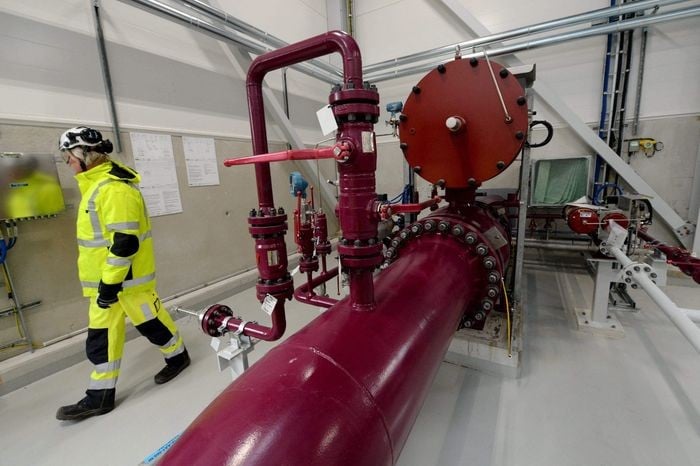
| After more than a difficult year, many believe that the energy crisis in Europe is over. Photo: A compression station of the Balticconnector gas pipeline in Inga, Inkoo, Finland. (Source: Getty Images) |
In an article published on November 28, John Kemp, a market analyst for Reuters (UK), asserted that the energy crisis in Europe is over.
According to the article, from mid-2021 to the end of 2022, Europe and some regions in Asia experienced an energy crisis as the prices of oil, gas, coal, and electricity soared, at times even reaching record highs. This forced households and businesses to quickly reduce their consumption.
Russia's launch of a special military operation in Ukraine (from February 2022) and the sanctions imposed by the US and its allies in retaliation against Moscow have disrupted energy supplies that were already strained due to the recovery of industrial production after the Covid-19 pandemic.
But 18-24 months later, the sharp adjustment period is complete, with energy inventories at comfortable levels and prices returning to multi-year averages (adjusted for inflation).
There will certainly be more shocks in the future, but the energy disruptions related to the end of the pandemic and the Russia-Ukraine conflict have ended. The markets have adapted.
Europe's remaining problem is that it has replaced relatively cheap gas via Russian pipelines with more expensive liquefied natural gas (LNG), putting the continent's industrial competitiveness at risk. However, this is a chronic problem, not a crisis.
Abundant oil supply
In the oil market, US crude oil production continues to rise and has surpassed its pre-pandemic peak in August 2023. Other production sources outside the Organization of Petroleum Exporting Countries (OPEC) are also growing steadily.
Data from the US shows that commercial crude oil inventories were more than 12 million barrels higher than the seasonal average in mid-November over the previous 10 years. This is a sign that market supply is very abundant.
Brent crude oil prices have averaged $82 per barrel since the beginning of November, matching the average since the start of the century after adjusting for inflation.
In late 2022 and early 2023, concerns about overproduction and potential oil stockpiling replaced worries about insufficient supply and rapidly depleting reserves.
In response, Saudi Arabia and its OPEC+ partners have cut production multiple times to prevent inventories from rising, a stark contrast to the pressure they faced a year earlier to increase production to address anticipated shortages.
Gas prices fall
The rapid adjustment was also evident in the natural gas sector, where U.S. inventories have consistently been above the 10-year seasonal average since February 2023 and exports have surged to record levels.
US natural gas futures traded near their lowest levels in 30 years last month, after adjusting for inflation, confirming the market's reaction to oversupply.
In Europe, gas inventories have consistently been at seasonal record levels since the end of the first quarter of 2023 following an unusually warm winter in 2022/23 and a sharp drop in industrial gas consumption.
Output from Germany's energy-intensive industries has fallen by around 17% since the beginning of 2022 and shows no signs of recovery.
Total gas consumption in the seven leading gas-consuming countries of the European Union (EU) – Germany, Italy, France, the Netherlands, Spain, Belgium, and Poland – fell by 13% in the first nine months of 2023 compared to the 10-year average (2012-2021), prior to the outbreak of the Russia-Ukraine conflict.
Inflation-adjusted futures prices for the coming year averaged 48 euros per megawatt-hour as of November 2023, down from 223 euros at the peak of the crisis in August 2022.
In fact, the average price is 53 Euros for 2023 compared to 23 Euros in the five years from 2015-2019 and 32 Euros from 2010-2014. Although prices are still high, they are no longer at crisis levels and are likely to fall further in 2024.
Coal demand has fallen sharply.
An even more profound adjustment has occurred for coal, with demand plummeting due to more abundant gas supplies while production surges.
The actual price of coal delivered to Northwest Europe next year averaged just $112 per ton in November 2023, down from a record high of nearly $300 per ton in September 2022.
In terms of production, China – the world's largest coal producer – increased its output by 425 million tonnes (10%) in 2022 and by another 144 million tonnes (4%) in the first 10 months of 2023.
Flexible adjustment
Each market is undergoing a process of adjustment that is not exactly the same, but they all share the commonality of faster production growth and slower consumption growth.
Regarding oil, consumption growth has slowed due to a slower business cycle, while production in non-OPEC+ countries has increased more rapidly, pushing the market toward a surplus. Russian exports remain high despite US and Western sanctions.
Regarding gas, Europe experienced an unusually warm winter in 2022/23, leading to reduced consumption and also saw a significant drop in industrial demand from the most energy-intensive countries due to temporary factory shutdowns.
The continent was able to replace pipeline gas from Russia with more LNG imports, paying higher prices than other customers in South and East Asia in the winter of 2022/23. This placed some adjustment burdens on poorer countries.
Regarding coal, China's increasing mining output, coupled with the exponential rise of renewable energy from wind and solar power, has eased shortages and allowed power generators to increase their fuel inventories.
Other factors contributing to the adjustment include high hydropower production in Brazil, which reduced demand for LNG imports, and an unusually mild autumn in Northwest Europe in 2023. But the overarching factor is the massive scale of price increases in 2021 and 2022, which accelerated and compressed the adjustment into a relatively short period.
As a result, after a “painful” adjustment in 2021 and 2022, production, consumption, and inventories became much more relaxed by the end of 2023, and by 2024, the crisis period had ended.
Meanwhile, contrary to John Kemp's analysis on Reuters , Bloomberg (USA) reported on the same day, November 28, that German Chancellor Olaf Scholz told lawmakers that Germany's energy crisis "is certainly not over," with high natural gas prices still straining the economy .
Germany was one of the countries hardest hit when Russia restricted gas supplies to Europe via pipeline last year, driving up energy costs and forcing Berlin to spend billions of euros to ease the burden of soaring electricity and gas bills. Germany is the only country in the Group of 7 leading industrial nations (G7) that the International Monetary Fund (IMF) predicts will experience an economic recession this year.
However, according to Chancellor Scholz, although gas prices remain above pre-crisis levels, most are below the government-set price ceiling, and Berlin will allow the gradual elimination of energy subsidies next year.
It has been suggested that Europe is weathering the energy crisis thanks to reduced industrial output. Across Europe, energy-intensive companies have cut or ceased production entirely because they cannot cope with soaring fuel prices. This is truly an unexpected development that perhaps no place wanted.
Source














































































Comment (0)