

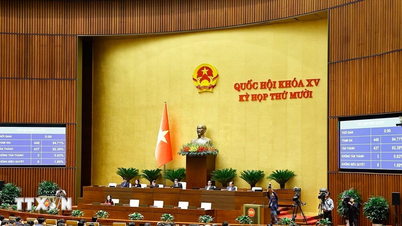
On the afternoon of December 9, the National Assembly discussed in the hall the draft Law amending and supplementing a number of articles of the Law on Value Added Tax.
During the discussion session, delegates gave many insightful opinions, focusing on overcoming bottlenecks in implementation, especially the delayed tax refund mechanism and tax policies for agricultural products, waste products and by-products, in order to create conditions to remove practical difficulties for the business community. Opinions emphasized the need to establish technical tools and a strict and transparent legal framework to both support production and business and protect the state budget.
Establish an automatic tax refund mechanism with clear sanctions
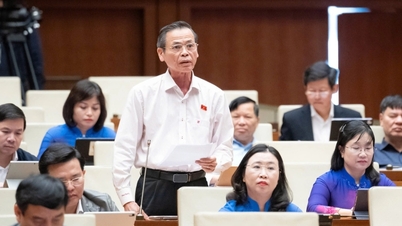
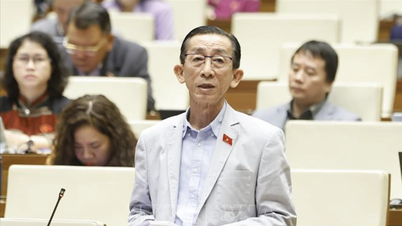
Supporting the amendment of the law, delegate Ha Sy Dong ( Quang Tri ) commented that many current problems do not stem from the provisions of the Law but mainly lie in the implementation stage.
Typical examples include the long tax refund period, lack of transparent search tools and inconsistency in policy application. Delegates believe that amending the law too soon, when the guiding documents are still being finalized, could cause policy deviation and disrupt production and business activities.
To thoroughly resolve the tax refund bottleneck, delegate Ha Sy Dong proposed applying an automatic tax refund mechanism based on the risk level, not just stopping at the general slogan "shorten tax refund time" as in the Government 's report.
Specifically, it is necessary to stipulate a fixed time frame for tax refunds for well-compliant businesses - for example 30 days, while businesses classified in the high-risk group will have to undergo pre-refund audits.
In particular, it is necessary to establish specific sanctions if tax authorities prolong processing time, causing capital stagnation for businesses.
The application of technology, big data and artificial intelligence (AI) also needs to be regulated in detailed documents, not just slogans. This document must clarify what types of data are connected, technical standards, data security measures and specific responsibilities of each related party. All of this content is to supplement technical tools to control risks, ensuring that the law amendment really removes the bottleneck of slow tax refunds.
Analyzing the impact of the tax refund policy on business capital flow, delegate Tran Huu Hau (Tay Ninh) emphasized that adding content to Clause 1, Article 5 of the Law will help Vietnamese export enterprises reduce tens of thousands of billions of VND in capital that must be spent to pay taxes in advance, pay interest, and then receive a refund from the State.
The delegate affirmed that although the final tax amount was refunded, in terms of value, the business had lost a lot, not only the cost of paying interest on the tax loan - often not even being lent by the bank, but also the profit that would have been generated if that money had been put into business.
In the context of Vietnamese agricultural products facing fierce competition in the international market, even a small percentage of profit is meaningful, helping businesses become more stable and develop.
Furthermore, if the old regulations are kept, tens of thousands of businesses and thousands of tax officials will spend a lot of time and effort on administrative procedures, creating a "request-grant" mechanism that can easily lead to negativity.
Tightening management of agricultural products and waste products with technical tools
Regarding tax policies for agricultural products, special goods, waste and by-products, delegate Ha Sy Dong commented that the explanatory report was too lengthy and did not clarify specific operational criteria.
Delegates proposed that the National Assembly request clear regulations in the law or assign the Ministry of Finance to issue a detailed list of goods according to HS codes, along with export ratio criteria to apply the "no declaration but deductible" mechanism, avoiding arbitrary expansion through guiding documents.
At the same time, it is necessary to have a minimum set of mandatory documents, including contracts, collection vouchers, transportation documents, and confirmation from the cooperative; along with unified forms to prevent round-about and fraudulent trading.
Regarding waste and by-products, delegate Ha Sy Dong proposed that the Ministry of Finance develop a system of codes/names and classification criteria according to HS codes, and at the same time require businesses to make a list of production norms.
This measure is aimed at combating the practice of under-declaring values to shift revenue to low-tax brackets, which is a point the report explains loosely and needs to be tightened with technical tools.
Delegate Tran Huu Hau especially emphasized the significance of removing the first paragraph of Clause 5, Article 9, affirming that this will create conditions for tens of thousands of agricultural and aquatic product processing facilities to have more conditions to consume waste such as bran, wine lees, beer lees, cassava residue, pineapple residue, molasses, shrimp shells, etc.
Thereby, it not only helps animal feed processing facilities reduce input costs, reduce animal feed prices and be equal to imported raw materials as explained by the Government, but also helps increase processing efficiency, contribute to solving environmental problems, properly implement the policy of green production and develop a circular economy.
The cassava industry alone discharges more than 4 million tons of cassava residue each year - a major source of pollution for businesses and localities. If cassava residue were not subject to value-added tax, it would have more conditions to become animal feed, bringing great economic value and efficiency in many aspects.
Delegates all agreed with the proposal to remove point c, clause 9, Article 15 on tax refund conditions (requiring "the seller to have declared and paid value added tax according to regulations for invoices issued to the business establishment requesting a tax refund").
Delegate Tran Huu Hau expressed his opinion that the current regulations are unreasonable and pose great risks because they "free" businesses from a responsibility that is often "impossible": checking the tax compliance status of sellers. Buyers and sellers are two independent entities and buyers have no rights or tools to check and intervene in the tax obligations of sellers. Businesses cannot be responsible for the compliance of others and cannot only receive tax refunds when sellers have declared and paid taxes, because the responsibility for tax collection belongs to the tax authority.
Delegate Tran Huu Hau affirmed that although the current regulations have the main purpose of preventing invoice fraud and ensuring budget revenue, it is not possible to prevent fraudulent behavior of a few businesses at the expense of forcing the majority of serious businesses to face difficulties and disadvantages.
Agreeing with the abolition of this condition, delegate Ha Sy Dong requested that a mechanism to protect the budget and businesses must be established at the same time. If the National Assembly considers abolishing the condition "the seller has declared and paid taxes", it is necessary to immediately set up a public lookup portal for the seller's tax compliance status, with an API for banks and businesses to use. Furthermore, it is necessary to include the seller's tax compliance history criteria in the automatic refund mechanism to classify risks.../.
Source: https://www.vietnamplus.vn/ky-hop-thu-10-quoc-hoi-khoa-xv-ap-dung-hoan-thue-tu-dong-theo-muc-do-rui-ro-post1082015.vnp



























![[Photo] Urgently help people soon have a place to live and stabilize their lives](/_next/image?url=https%3A%2F%2Fvphoto.vietnam.vn%2Fthumb%2F1200x675%2Fvietnam%2Fresource%2FIMAGE%2F2025%2F12%2F09%2F1765248230297_c-jpg.webp&w=3840&q=75)
































































Comment (0)