

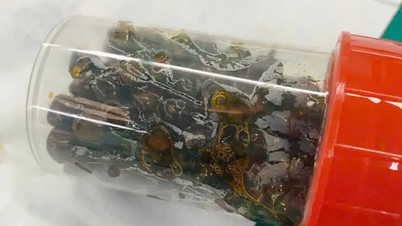
A one-month-old boy from Gia Lai province was brought to Children's Hospital 2 for examination by his family in a critical condition with a severe urinary tract infection, cloudy urine resembling rice water, and green pus.
The medical history revealed that during pregnancy, the mother had a local prenatal check-up which detected abnormalities in the upper urinary tract, specifically hydronephrosis suspected to be a double kidney, but no abnormalities were noted in the ureters below the bladder. The baby was born normal and full-term; however, the family noted that after birth, the baby experienced episodes of difficulty urinating, with urination being interrupted while normal, and the urine was sometimes cloudy. During this examination, the urine was cloudy like rice water with small greenish pus strands, the baby had a high fever, and refused to feed. The baby was admitted to Children's Hospital 2 (Ho Chi Minh City) due to a severe urinary tract infection.
On January 16th, Dr. Pham Ngoc Thach, Deputy Director of Children's Hospital 2, stated that after admission, the child received intensive resuscitation and treatment from the doctors. In addition, a screening examination revealed a congenital urinary tract defect: double kidney and ureter causing hydronephrosis, and a massive prolapsed ureter occupying almost the entire bladder. This was the cause of the hydronephrosis, urinary tract infection, and difficulty urinating.
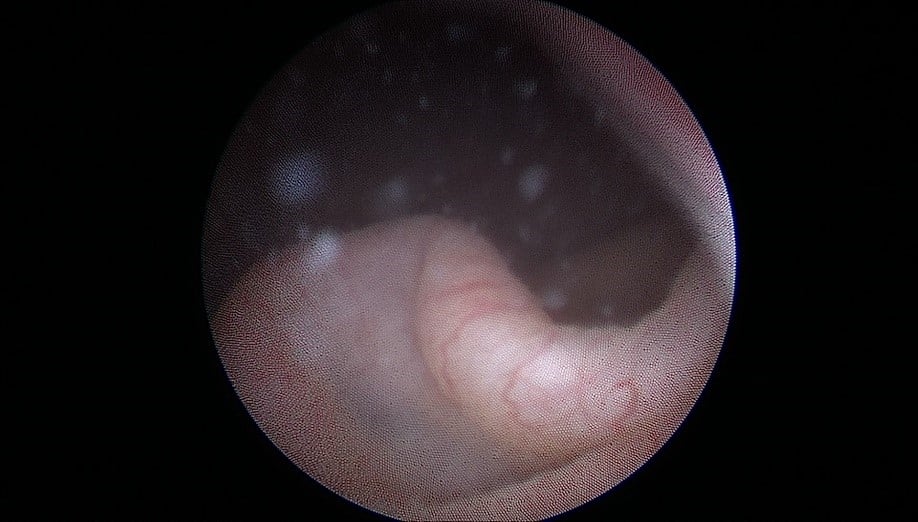
A giant ureteral prolapse forms a fold within the bladder lumen, causing obstruction.
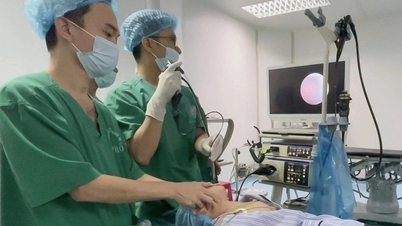
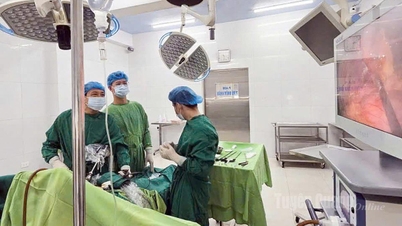
First time performing a suprapubic endoscopy.
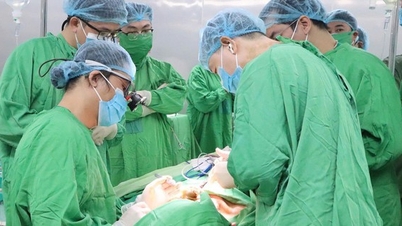
As soon as the urinary tract infection stabilized, the pediatric patient underwent urethrocystoscopy to address the ureteral obstruction caused by the prolapsed sac. However, with the traditional approach through the urethra alone, doctors face many difficulties in treating the obstruction. This is especially true with a large, mobile prolapsed sac, and there may not be much space left for manipulation within the bladder, potentially leading to errors such as damage to the ureteral or bladder wall.
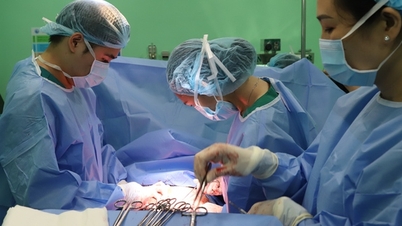
"To address this issue, the hospital has implemented a new technique: after endoscopic examination of the bladder through the urethra to locate the ureteral cyst within the bladder, a small needle is inserted through the skin above the pubic bone into the bladder. Through the needle, a very small clamp is inserted into the bladder to hold the anterior wall of the ureteral cyst in place. This helps to accurately identify the lesion and firmly hold the cyst, making cyst incision much easier," Dr. Thach shared.
This new method offers several advantages over the traditional method. Because the anterior wall of the cyst is kept taut, fixed, and separate from the posterior wall, it allows for precise incisions at desired locations on the cyst wall, avoiding blood vessels and preventing damage to the posterior wall. In contrast, with the traditional method, the doctor only uses a small scalpel from the urethral endoscope to incise the cyst directly without the assistance of a cyst clamp.
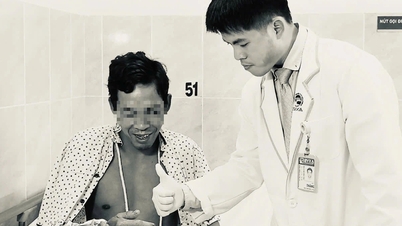
After the procedure, the child was placed in a urinary catheter for monitoring. The infection improved significantly, and kidney function returned to normal. The child was discharged 5 days after surgery, feeding well, and without a surgical scar.
If left untreated, ureteral cysts can cause kidney complications.
According to Dr. Thach, Children's Hospital 2 receives approximately 12-15 cases of ureteral cysts each year. Ureteral cysts are often associated with congenital abnormalities such as double kidney and ureter. The condition manifests as a large dilation of the cystic wall of the segment of the ureter that connects to the bladder. If left undetected and untreated, ureteral cysts can lead to long-term complications in the kidneys and urinary system, such as recurrent urinary tract infections, ureteral stones, and renal scarring, resulting in impaired kidney function.
The method of using small needles inserted through the pubic bone for treatment, currently only implemented at Children's Hospital 2, is a groundbreaking innovation in severe cases and large cysts. The treatment method is highly effective, gentle, and minimally invasive.
Source: https://thanhnien.vn/lan-dau-noi-soi-tren-xuong-mu-cuu-be-trai-tieu-nuoc-duc-nhu-nuoc-vo-gao-185250116153532502.htm

















































































Comment (0)