
Tourists visiting Hon Tranh Island.
In a short period of time, Phu Quy Special Economic Zone has undergone rapid transformation, with hotels, restaurants, and homestays springing up like mushrooms, ranging from budget-friendly to luxury options. From just a few guesthouses in 2019, the entire zone now boasts 19 hotels with 393 rooms, 41 villas and guesthouses with 364 rooms, and over 100 homestays and guesthouses serving tourists. In addition, there are over 30 food establishments and specialty shops, gradually forming a diverse and convenient service chain.

Many restaurants and hotels sprung up like mushrooms in a short period of time.
On average, Phu Quy Island welcomes about 1,000 visitors daily for sightseeing and relaxation. During holidays like April 30th and May 1st, or the Lunar New Year, the number of tourists doubles, sometimes even triples. At those times, accommodations, restaurants, and cafes increase their capacity to serve the large influx of visitors. While everyone is happy with the crowds, inadequate service can lead to negative reactions. Furthermore, if the quality of service and food doesn't match the price paid, it will inevitably result in negative reviews on social media and popular international travel websites, impacting the image of a peaceful and hospitable island that so many people are striving to build.

The Phu Quy Special Economic Zone has implemented several concrete actions to eliminate plastic waste.
According to the leaders of the Phu Quy Special Economic Zone, the biggest challenges facing the island currently are access to clean water and sanitation. The development of tourism also poses significant environmental challenges, particularly the enormous increase in waste. Plastic waste accounts for a large portion of this, posing a potential risk of marine pollution and seriously impacting the ecosystem and natural landscape – a key concern for any special economic zone. Although the zone already has the Da Loc Phu Quy Waste Treatment and Recycling Plant with a capacity of 70 tons of waste per day, the increasing number of tourists and the resulting waste generation are overwhelming the plant, requiring more decisive solutions.
Mr. Nguyen Tung, a resident of Phu Quy Special Economic Zone, said that the island's water supply depends on rainwater reservoirs and drilled wells. Groundwater is only exploited according to "the prescribed limits" to prevent erosion. Meanwhile, hotels and homestays have sprung up rapidly to take advantage of water storage, causing many households to experience water shortages at certain times, especially at night. Therefore, the local authorities regularly educate people about environmental protection and water conservation. However, the government needs a clear plan; otherwise, the water shortage will become increasingly serious.

Whenever Phu Quy Island is mentioned, tourists always remember its pristine beauty, peaceful atmosphere, and warm hospitality.
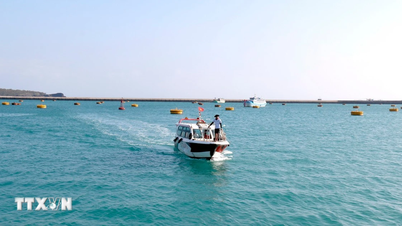
Determined to build an image of a "pearl island" free of plastic waste, the provincial leadership and the Phu Quy Special Economic Zone government have implemented many concrete actions to eliminate plastic waste right from the island's entrance. It is known that since March 2024, Phu Quy has launched a campaign against plastic waste, encouraging tourists not to bring plastic waste onto the island. At the same time, they have mobilized transportation companies, tourism businesses, and tourists to actively participate in preventing plastic waste from being brought onto the island. 100% of boats transporting tourists to Hon Tranh Island and other isolated islands will not use single-use plastic bottles, plastic products, or plastic bags. Currently, Phu Quy is continuing to implement effective models in the collection and transportation of solid household waste. Most interestingly, some young tourists who have fallen in love with the pristine beauty of Phu Quy have quickly called for and formed groups with similar ideas to work together to collect waste along the coast. Thanks to this campaign, places like Lang Co Embankment, Phuot Slope, Small Beach, Phu Beach, etc., have gradually been cleaned up.
The Chairman of the People's Committee of Phu Quy Special Economic Zone, Le Hong Loi, once shared: "Phu Quy identifies tourism development as a comprehensive economic sector, rich in cultural identity, and must be sustainable, green, and in-depth. To achieve this, we will prioritize upgrading infrastructure, systematic planning, applying digital transformation, and strongly attracting investment in services for tourists." To ensure Phu Quy tourism retains its unique identity and is not confused with other special economic zones, the "pearl island" needs its own path, avoiding rapid development and the pursuit of quantity, so that whenever Phu Quy is mentioned, tourists will forever remember its pristine, peaceful, gentle, and hospitable nature.
>> Check out Hotels:
Source: https://baolamdong.vn/loi-di-rieng-cho-du-lich-phu-quy-386968.html







































































Comment (0)