

Contribute to accelerating the industrialization process
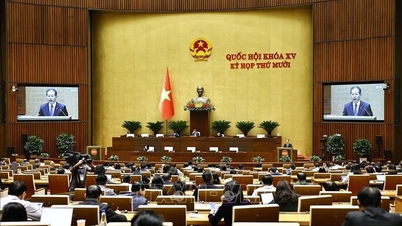
Recently, at the discussion session on socio -economics, the 10th Session of the 15th National Assembly, National Assembly delegate Nguyen Duy Minh (Da Nang) proposed that the Government pay attention to early institutionalization of the Party's policy, direct research and development of the Law on Development of Supporting Industries, in order to form a unified and stable legal framework to ensure production autonomy, sustainable integration and development of Vietnamese enterprises in the global value chain.

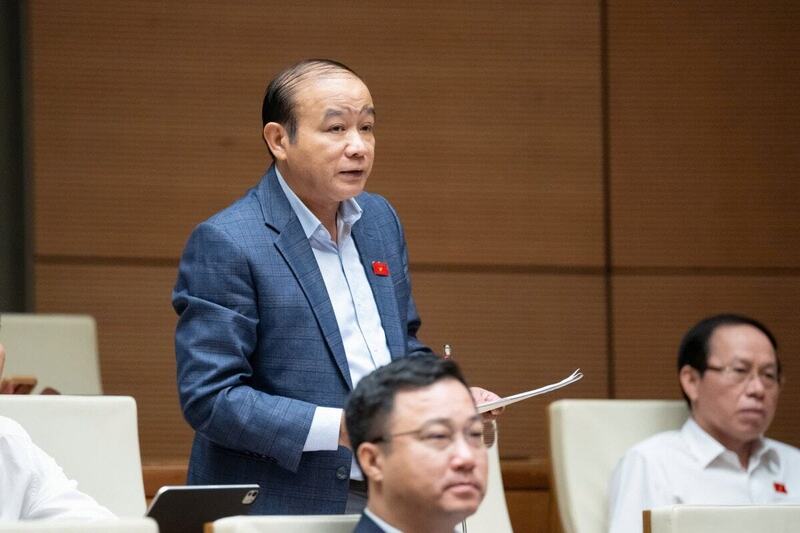
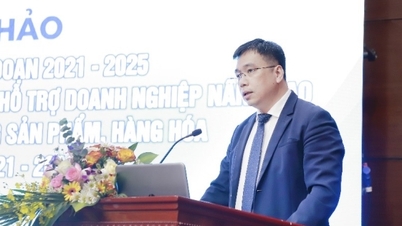
Delegate Nguyen Duy Minh ( Da Nang delegation). Photo: Office of the National Assembly
According to delegate Nguyen Duy Minh, supporting industry plays an important role and is the backbone of the economy. Developing supporting industry enterprises contributes to accelerating the industrialization and modernization of the country, determining Vietnam's capacity to master production and participate in the global value chain.
The delegate emphasized that Vietnam has joined a series of new-generation free trade agreements, opening up great opportunities for preferential tax rates but also placing strict requirements on the principles of origin and localization rates. If domestic enterprises still depend on imported components, many products will not meet the requirements of Vietnamese origin, leading to the loss of tax incentives and the risk of being subject to trade defense measures.
“Resolution 68 of the Politburo on private economic development has affirmed that the private economy is the most important driving force of the economy, in which the processing and manufacturing industry is the priority focus. This is a solid political foundation for the economic sector to become the core, together with the FDI sector and State-owned enterprises to form the three pillars of Vietnam's industry,” delegate Nguyen Duy Minh emphasized.
According to delegate Nguyen Duy Minh, the Government recently issued Decree 205 amending and supplementing a number of articles of Decree 111 on the development of supporting industries, which clearly states the target that by 2035 the localization rate must reach 50-60%, there must be at least 3,000 supporting industry enterprises with sufficient capacity to supply to FDI enterprises and supporting industries must contribute 10% of the value of industrial production. In particular, the Decree has expanded the scope to developing the production, processing and manufacturing ecosystem, considering supporting industries as the pillar of an autonomous and innovative industry.
However, the policy mechanisms to support supporting industries are still scattered in many different laws and decrees, not synchronized, and not strong enough to promote development. Therefore, delegates proposed to soon build the Law on Development of Supporting Industries to form a unified and stable legal framework.
Proposal to implement the industrial support fund
Along with that, he proposed implementing the national industrial support fund in 2026, ensuring preferential loans to enterprises producing components, materials, and precision technology. At the same time, it is necessary to shorten procedures, creating conditions for small and medium enterprises to easily access.
The delegate also proposed selectively attracting FDI investment linked to commitments to localization and technology transfer. He cited the conditional incentive mechanism for FDI enterprises, if they achieve a minimum localization rate of 30% after 5 years or have an annual localization growth roadmap, they will enjoy preferential corporate income tax and priority for land and infrastructure expansion.
According to delegate Nguyen Duy Minh, developing supporting industries is not only an economic development problem but also a pillar of national autonomy, national defense, enhancing competitiveness, ensuring economic security and sustainable development. When supporting industries develop strongly, Vietnam will become a place for design, production and distribution. When Vietnamese enterprises are capable of participating in the global value chain, it will be a success of the country's industrialization and modernization.
According to National Assembly delegate La Thanh Tan (Hai Phong delegation), to promote the localization of supporting industries, there needs to be a link between FDI enterprises and domestic enterprises, aiming to require a localization rate for a number of strategic fields.
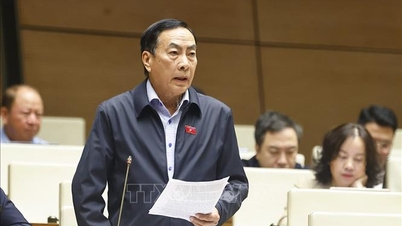
Delegate La Thanh Tan (Hai Phong delegation). Photo: Office of the National Assembly
Specifically, building programs to connect FDI enterprises and domestic enterprises will bring high efficiency, especially in supporting industries, manufacturing, and high technology. At the same time, there should be a mechanism to encourage FDI enterprises to transfer technology and train human resources for Vietnamese enterprises; encourage large enterprises to lead domestic supply chains, develop industry clusters in the fields of supporting industries, agricultural processing, and information technology.
Delegate La Thanh Tan proposed that there should be a mechanism to connect State-owned enterprises, FDI enterprises, and the private economic sector, building a multi-house ecosystem so that enterprises do not swim alone but swim in groups, reduce dependence on imports, increase localization, and promote innovation.
According to delegate Nguyen Duy Minh - Da Nang delegation, developing supporting industries is not only an economic development problem but also a pillar of national autonomy, national defense, enhancing competitiveness, ensuring economic security and sustainable development. When supporting industries develop strongly, Vietnam will become a place for design, production and distribution. When Vietnamese enterprises are capable of participating in the global value chain, it will be a success of industrialization and modernization of the country.
Source: https://congthuong.vn/luat-hoa-cong-nghiep-ho-tro-de-viet-nam-tu-chuoi-gia-tri-433460.html

![[Photo] 60th Anniversary of the Founding of the Vietnam Association of Photographic Artists](/_next/image?url=https%3A%2F%2Fvphoto.vietnam.vn%2Fthumb%2F1200x675%2Fvietnam%2Fresource%2FIMAGE%2F2025%2F12%2F05%2F1764935864512_a1-bnd-0841-9740-jpg.webp&w=3840&q=75)

![[Photo] Cat Ba - Green island paradise](/_next/image?url=https%3A%2F%2Fvphoto.vietnam.vn%2Fthumb%2F1200x675%2Fvietnam%2Fresource%2FIMAGE%2F2025%2F12%2F04%2F1764821844074_ndo_br_1-dcbthienduongxanh638-jpg.webp&w=3840&q=75)
































































Comment (0)