

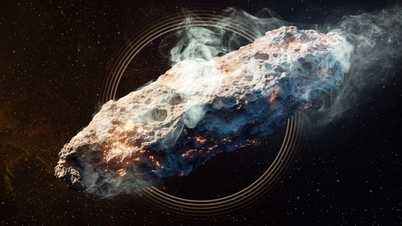
Scientists have just announced a remarkable astronomical discovery: a rare interstellar object is moving through the Solar System.
This object, named 3I/ATLAS, is expected to make its closest approach to Earth on October 30th.
The ATLAS (Atlantic Collision Alert System) telescope, managed by NASA, first recorded the sighting of this object on July 1st at the Rio Hurtado Observatory in Chile – one of the world's best locations for astronomical observation.
Newsweek, citing astronomy experts, reported that Comet 3I/ATLAS is approaching from the constellation Sagittarius and is currently about 420 million miles from Earth.
Scientists assert that this object poses no danger to our planet, because according to its current orbit, the closest distance between it and Earth is still 150 million miles.
This is only the third interstellar object identified by scientists, following 2I/Borisov (discovered in 2019) and 'Oumuamua (discovered in 2017).
Currently, 3I/ATLAS is approximately 416 million miles from the Sun and will make its closest approach to Mars in October, at a distance of 37 million miles.
NASA says ground-based telescopes may be able to track the object throughout September, before it moves too close to the Sun and becomes difficult to observe.
The comet is expected to reappear on the opposite side of the Sun in early December. Scientists determined the object's interstellar origin based on its orbital trajectory.
While objects in the Solar System typically travel in closed elliptical orbits, interstellar objects follow hyperbolic orbits and have velocities high enough to escape gravity.
A study published in the Monthly Notices of the Royal Astronomical Society in 2021 also suggests that interstellar objects may be more common than we previously thought, even more numerous than "inland" objects in the Oort cloud surrounding the Solar System.
Source: https://www.vietnamplus.vn/nasa-phat-hien-vi-khach-la-di-chuyen-xuyen-qua-he-mat-troi-post1048149.vnp

![[Photo] Closing Ceremony of the 10th Session of the 15th National Assembly](/_next/image?url=https%3A%2F%2Fvphoto.vietnam.vn%2Fthumb%2F1200x675%2Fvietnam%2Fresource%2FIMAGE%2F2025%2F12%2F11%2F1765448959967_image-1437-jpg.webp&w=3840&q=75)

















































![[OFFICIAL] MISA GROUP ANNOUNCES ITS PIONEERING BRAND POSITIONING IN BUILDING AGENTIC AI FOR BUSINESSES, HOUSEHOLDS, AND THE GOVERNMENT](https://vphoto.vietnam.vn/thumb/402x226/vietnam/resource/IMAGE/2025/12/11/1765444754256_agentic-ai_postfb-scaled.png)














































Comment (0)