

The Russia-Ukraine conflict, clashes in Kosovo, the situation on the Korean Peninsula, and US-China relations are some of the prominent international events of the past 24 hours.
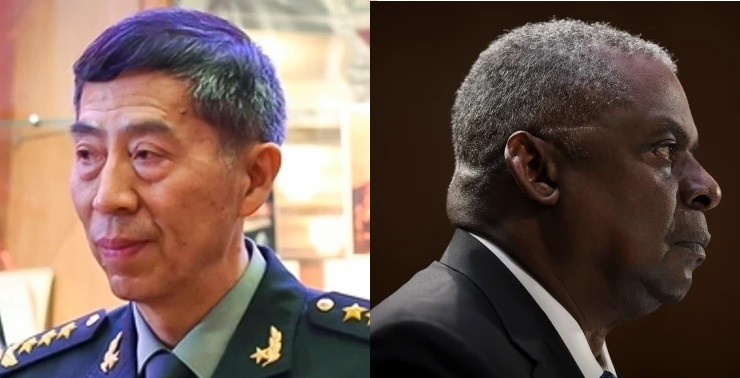 |
| Beijing rejected Washington's offer to hold a meeting between US Defense Secretary Lloyd Austin (right) and his Chinese counterpart Li Shangfu in Singapore. (Source: Getty Images, AP) |
The World & Vietnam newspaper highlights some of the day's most prominent international news:
Russia-Ukraine
* Russian and Ukrainian capitals attacked by drones, Kyiv denies direct involvement: In the early hours of May 30, both Moscow, Russia, and Kyiv, Ukraine, were subjected to drone attacks.
The Russian Ministry of Defense accused Ukraine of launching an attack with eight drones on targets in Moscow, causing damage to several buildings, but all of the devices were shot down.
However, Ukrainian President's advisor Mykhailo Podolyak denied direct involvement in the attack, but stressed that Kyiv "is pleased to see and anticipates an increase in the number of attacks."
Meanwhile, authorities in Kyiv, Ukraine, announced that the country's air defense forces destroyed more than 20 UAVs in an airstrike early on May 30.
Kyiv considers this a large-scale attack launched in multiple waves, in which Russia used only Iranian-made Shahed drones. This was the third attack on Kyiv in the past 24 hours and the 17th airstrike since the beginning of the month. (Reuters, AFP, TASS)
* Kremlin issues statement on Moscow attack: On May 30, Kremlin spokesman Dmitry Peskov stated that the drone attack targeting Moscow and its surroundings confirms the need to continue the special military operation in Ukraine until the stated objectives are achieved.
According to him, this unprecedented attack was Kyiv's "response" to Russia's recent "very effective" offensive in Ukraine.
Meanwhile, Andrey Kartapolov, Chairman of the State Duma's Defense Committee (the lower house of the Russian parliament), stated that the drone attack was a threatening act and that panic among the population should be avoided.
Mr. Kartapolov requested an analysis of all data regarding the incident to determine the launch location of the UAV, as this would allow for the implementation of countermeasures. (TASS)
* Ukrainian President urges South Korea to provide defense systems: In an interview with the Chosun Ilbo newspaper published on May 30, Ukrainian President Volodymyr Zelensky expressed gratitude for South Korea's commitment to providing mine-clearing equipment and humanitarian aid totaling approximately $230 million.
However, the leader emphasized that Kyiv also wants Seoul to provide air defense and early warning systems.
He said, "I know there are limits to supplying weapons, but that principle shouldn't apply to defense systems and equipment to protect our assets. We need a shield to protect the skies to rebuild Ukraine, and I very much hope that South Korea will support us in this area."
President Zelensky asserted that South Korea's early warning system would help protect Ukraine from Russian airstrikes. (Reuters)
According to the European Union's High Representative for Security and Foreign Policy, Josep Borrell, on May 29, Russia will only be willing to negotiate if it wins its campaign in Ukraine.
Expressing "no optimism" about what might happen in the conflict in Ukraine this summer, the diplomat asserted that he clearly saw "Russia's intention to win." (Reuters)
* Ukrainian President's advisor proposes establishing a demilitarized zone in Russian territory: On May 29, Ukrainian President's advisor Mykhailo Podolya suggested that a demilitarized zone 100-120 km long should be established inside Russia, along the border with Ukraine.
Podolya said the demilitarized zone would stretch across the territories of the Belgorod, Bryansk, Kursk, and Rostov regions of Russia.
According to the official, the demilitarized zone would be part of a post-conflict agreement, essential to protect parts of Ukraine from shelling, prevent future clashes, and ensure the safety of residents in some of Ukraine's frontline areas. (Reuters)
| RELATED NEWS | |
 | Ukraine is no longer secretive about a special counterattack; Russia is meticulously defending itself but still reveals weaknesses. |
Serbia-Kosovo
* Tensions escalate in Kosovo: In recent days, Serbs – who make up the majority in some areas of northern Kosovo – clashed with police to protest the new Albanian mayors on May 26, even injuring 25 NATO peacekeepers.
In response to this situation, Serbian President Aleksandar Vucic placed the country's army on full combat alert and ordered units to move closer to the border with Kosovo.
Mr. Vucic also plans to meet with the ambassadors of the United States, Russia, China, the United Kingdom, Finland, and the head of the EU office in Serbia to discuss the incident.
Meanwhile, NATO, the EU, and a number of countries such as Russia, the US, the UK, France, Germany, and Italy have called for restraint from all sides, and criticized the Kosovo government's actions for escalating tensions and affecting the normalization process of Kosovo-Serbia relations.
Most recently, Chinese Foreign Ministry spokesman Mao Ning said that Beijing is very concerned about the developments and affirmed its support for Serbia's efforts to protect its sovereignty and territorial integrity. (Reuters, Sputnik)
* Serbia sets conditions for maintaining peace with Kosovo: On May 30, Serbian President Aleksandar Vucic called on the ambassadors of five Western countries, including the US, UK, Germany, France, and Italy, along with the head of the EU mission in Serbia, to exert influence to get Kosovo to recall its Albanian mayors and withdraw its police.
On his personal page, Vucic stated: "I... note that Pristina's unilateral steps are leading to violence against Serbs, pushing us further away from peace and stability in the region."
According to the leader, "the urgent recall of the misguided mayors and the withdrawal of the so-called Kosovo special police force are conditions for maintaining peace here." (Sputnik)
| RELATED NEWS | |
| Tensions escalate in Kosovo: Serbian army on high alert, US-NATO-EU take urgent action, Russia warns of 'big explosion'. |
US-China
* Advising the US to be "sincere," China rejected Washington's offer to hold a meeting of defense ministers on the sidelines of the Shangri-La Dialogue regional security forum in Singapore, according to information from the Pentagon on May 29.
In early May, the US proposed a meeting between its Defense Secretary Lloyd Austin and his Chinese counterpart Li Shangfu in Singapore, but Washington recently received a rejection.
Pentagon spokesman Brigadier General Pat Ryder said: “China’s unwillingness to engage in meaningful discussions between the two militaries will not diminish the U.S. Department of Defense’s commitment to seeking open lines of communication with the People’s Liberation Army of China.”
Meanwhile, on May 30, Chinese Foreign Ministry spokesperson Mao Ning stated that the US should "show sincerity and take practical steps to create the necessary conditions for dialogue and interaction between the two countries' militaries."
Li Shangfu was sanctioned by the US government in 2018 for purchasing weapons from Russia, but the Pentagon said that did not prevent Austin from conducting official talks with Li Shangfu. (AFP, Straits Times, Sputnik)
China "regrets" the US ban on aerospace cooperation between the two countries, according to AP.
Speaking on the afternoon of May 29th in Jiuquan, China, Li Yingliang, Chief Technology Officer of the China Manned Space Flight Administration, said that Beijing hopes for more international cooperation, including with Washington, in this field.
In addition, AP reported that China's developing space program plans to send astronauts to the moon before 2030 and expand its orbital space station.
* China launched the Shenzhou-16 manned spacecraft on May 30, carrying three astronauts to its space station complex for a five-month mission.
The Long March-2F rocket carrying the spacecraft was launched from the Jiuquan Satellite Launch Center in northwestern China. Astronauts will conduct large-scale orbital tests as well as experiments in various fields as planned. (THX)
| RELATED NEWS | |
| US-China rivalry: Europe's leading power struggles in a 'three-way' between allies and partners. |
Korean Peninsula
North Korea will launch its first military reconnaissance satellite in June to counter "military actions" by the United States, according to the North Korean state news agency ( KCNA ) on May 30.
Prior to this announcement, a US State Department spokesperson affirmed that any satellite launch by North Korea using ballistic missile technology would violate United Nations Security Council resolutions prohibiting Pyongyang from testing long-range missiles.
The U.S. also called on North Korea to "refrain from further unlawful activities and pursue serious and sustained diplomacy."
Meanwhile, South Korean Joint Chiefs of Staff (JCS) spokesman Han Sung-keun said that intelligence officials from both South Korea and the United States are closely monitoring North Korea's actions related to its satellite launch plan.
On Tokyo's side, Foreign Minister Hayashi Yoshimasa stated that Pyongyang's use of a ballistic missile believed to be for launching a satellite was a serious threat to Japan's security and a violation of United Nations Security Council resolutions.
Japan affirmed that it will continue to cooperate closely with the United States and South Korea, as well as other countries, including the Security Council's response, to address this move by Pyongyang.
Tokyo is also working closely with Seoul and Washington to ensure a “unified, strong” response from the international community should Pyongyang carry out the launch.
Also on May 30, South Korea and Japan held their first bilateral consultations on disarmament and nuclear non-proliferation in five years, expressing concern about North Korea's satellite launch plans and urging Pyongyang to cancel them. (Yonhap)
* The US will further increase its strategic military presence on the Korean Peninsula: On May 30, Commander of US Forces Korea (USFK) Paul LaCamera reaffirmed Washington's commitment to defending its ally Seoul.
He also dismissed concerns that Washington might compromise its security commitment to Seoul to protect American cities in an unexpected situation, asserting, "Don't doubt our unwavering commitment."
General LaCamera also added that the US will further increase its strategic military presence on the Korean Peninsula, as stated in the Washington Declaration.
He also emphasized the importance of alliances and cooperation with countries outside of alliances, citing recent efforts at security cooperation between the leaders of South Korea, the United States, and Japan. (Yonhap)
| RELATED NEWS | |
| South Korean President mentions North Korea by name during meeting on 'hot' weapons, South Korea-Japan consultations. |
America
* Venezuela and Brazil usher in a new era in relations: On May 29, Venezuelan President Nicolás Maduro held talks with his Brazilian counterpart Luiz Inácio Lula da Silva in Brasilia.
During the meeting, Mr. Maduro affirmed that relations between the two countries would continue to be strengthened in all areas, thereby ushering in a new era in bilateral relations and jointly building a peaceful and prosperous South America.
According to the Venezuelan president, the two countries need to establish a common mechanism to promote cooperation in areas such as trade, economics, agriculture, and people-to-people exchanges, while also fostering frank and long-term dialogue between Venezuela, Brazil, and the governments of other South American countries.
In addition, the leader said Venezuela wants to become part of the BRICS group of leading emerging economies, which currently includes China, Brazil, Russia, India, and South Africa. (Reuters)
* South American Summit: On May 30th, the heads of state of South American nations gathered in Brasilia, Brazil, to attend the regional summit at the invitation of host President Lula da Silva.
This was the first South American summit in nearly a decade, bringing together leaders from 12 South American nations, excluding Peru, to discuss how to coordinate efforts to combat climate change and rising inflation in the region, where poverty and hunger are on the rise.
President Lula da Silva said that the leaders would not create a new Union of South American Nations (Unasur), but would propose a different format, with the main idea being "a bloc that cooperates on economic, investment and environmental issues."
According to him, countries "need to learn how to talk to each other." (VNA)
| RELATED NEWS | |
| 'After the rain comes sunshine,' Venezuela anticipates a new era with Brazil, declaring its desire to join BRICS. |
Africa
Eight African countries have allowed Ukraine to open embassies , with two more in the process of finalizing the procedures, according to Ukrainian Foreign Minister Dmytro Kuleba on May 30.
Speaking on television, Mr. Kuleba added: "To open all these embassies, we still need to make changes to the Foreign Office's budget and we are working on this with the Prime Minister to achieve the necessary results by the end of this year."
In December 2022, Ukrainian President Volodymyr Zelensky announced that Kyiv would open 10 embassies in Africa. (Sputnik)
Indonesia hopes to strengthen its presence in Africa , according to a source. Indonesian Foreign Ministry spokesman Teuku Faizasyah said on May 29 at the Africa Day celebration in Jakarta.
Mr. Teuku stated that Africa is an important part of Indonesia's foreign policy and that the country wants to contribute to the continent's economic growth and support its efforts towards peace, stability, and development.
The spokesperson stated that both sides need to strengthen cooperation by promoting exchanges between entrepreneurs and state-owned enterprises so that Indonesia's presence in Africa is not only political and socio-cultural, but also economic. (VNA)
Source













































































Comment (0)