

Many people often associate this field of study with a career in the stock market, but in reality, that's not the only path, and to seize those opportunities, students need to prepare many soft skills.
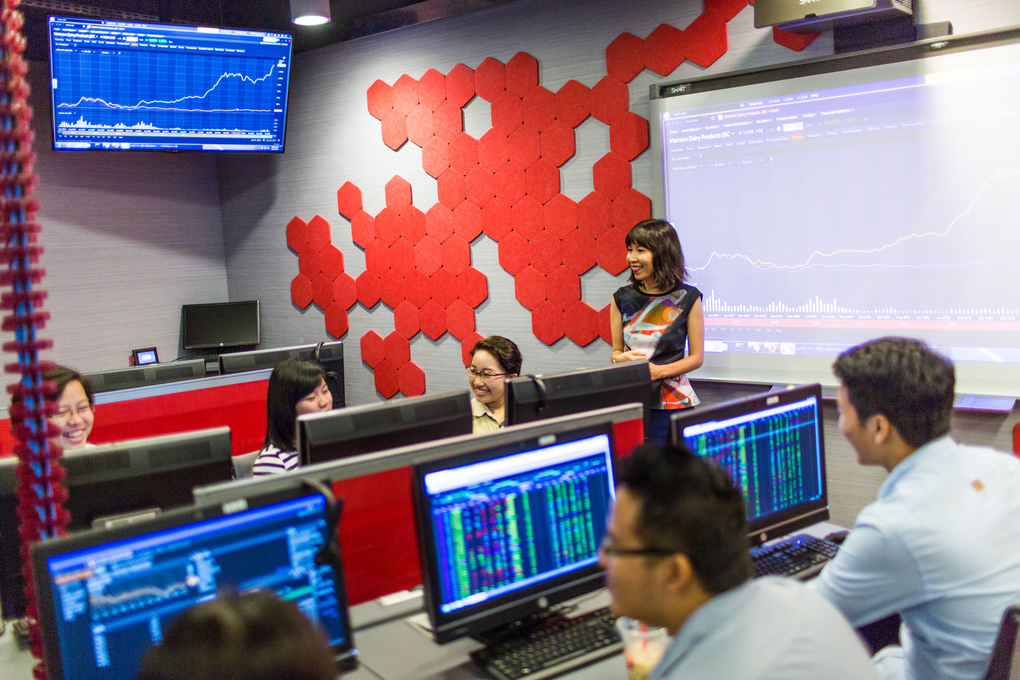
A class session in RMIT's financial trading practice lab (Photo: RMIT).
Does graduating with a finance degree mean you'll only be able to work in the securities industry ?
Many people believe that studying finance means working in the securities industry. However, in reality, the securities industry is just one of many career paths that finance students can choose after graduation.
This field of study encompasses many areas related to cash flow and capital management, such as investment, lending, credit, banking, and capital coordination. As a result, graduates can work in a variety of environments, including banks, securities firms, investment funds, insurance companies, or the finance departments of businesses.
Beyond securities, finance graduates can pursue various career paths such as accounting, auditing, banking, procurement, capital recovery, valuation, or take on consulting and strategic planning positions for individuals or organizations, such as budget analyst, corporate finance manager, risk manager, or personal financial advisor.
Skills that finance students need to acquire
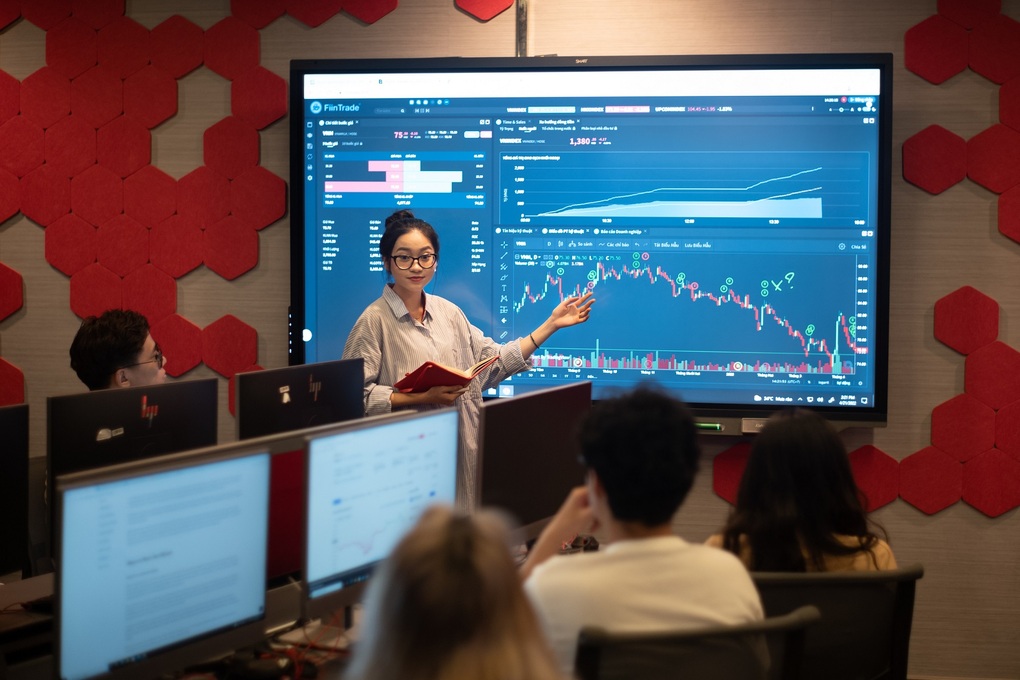
Students practice financial data analysis (Photo: RMIT).
Businesses today tend to prioritize hiring personnel who possess both strong professional knowledge and excellent soft skills, and who can adapt quickly to market changes. To meet this demand, in addition to academic knowledge, finance students need to equip themselves with important skills such as:
Financial data analysis : Financial professionals need to know how to read and understand financial statements, identify and analyze key indicators. Logical thinking and the ability to synthesize data help form a comprehensive picture, supporting accurate forecasting and decision-making based on factual data.
Utilizing Financial Technology (Fintech) : In recent years, Fintech has become a familiar term in the financial and technology sectors. Applications such as digital banking, e-wallets, blockchain, peer-to-peer lending (P2P lending), and insurance technology (InsurTech) are changing the way the financial industry operates. Mastering and knowing how to apply Fintech is crucial for finance students to enhance their competitiveness in the context of digital transformation.
Soft skills and foreign language proficiency : The finance field is often global and fast-paced, requiring soft skills such as communication, cross-cultural teamwork, problem-solving, critical thinking, emotional management, and time management to adapt and work effectively.
Skills training for finance students: A perspective from RMIT Vietnam

RMIT students engage in academic exchange with international lecturers (Photo: RMIT).
At RMIT Vietnam, finance is one of the nine main specializations in the Bachelor of Business program. The program lasts three years and is taught entirely in English.
According to the program structure, students can design a personalized learning path. After completing four foundational business courses, students have many options to combine majors, minors, and electives. For example, students can choose to study two majors: Finance and Blockchain-based Business, combined with three electives from all RMIT programs.
The Work Integrated Learning (WIL) program integrates diverse activities, helping students apply their knowledge to solve real-world business problems and develop interdisciplinary skills. From their first year, students meet with businesses, participate in site visits, or complete exercises based on real-world scenarios. In their final year, all students complete a Graduation Project, a course combining practical application and collaboration with business partners.
RMIT Vietnam also has a Financial Trading Practice Room – a classroom equipped with state-of-the-art technology that simulates a real trading room. Here, students practice with world- leading software for trading and financial analysis such as Thomson Reuters Eikon & Stocktrack.
Beyond an international perspective and multidisciplinary skills such as critical thinking, teamwork, and leadership, RMIT Business students are also equipped with technology skills applicable to business.
Furthermore, RMIT's network of business partners and alumni community is considered a valuable resource for networking and career development after graduation. Therefore, students from RMIT Vietnam's Business program are competitive enough to proactively seize opportunities domestically and internationally, or to freely forge their own career paths.
Read more about what you can do with an economics degree or job opportunities for international business students here.
Source: https://dantri.com.vn/giao-duc/nganh-tai-chinh-trong-thoi-dai-hoi-nhap-ky-nang-nao-giup-sinh-vien-but-pha-20251211094402747.htm
![[Photo] Closing Ceremony of the 10th Session of the 15th National Assembly](/_next/image?url=https%3A%2F%2Fvphoto.vietnam.vn%2Fthumb%2F1200x675%2Fvietnam%2Fresource%2FIMAGE%2F2025%2F12%2F11%2F1765448959967_image-1437-jpg.webp&w=3840&q=75)




![[Photo] Prime Minister Pham Minh Chinh holds a phone call with the CEO of Russia's Rosatom Corporation.](/_next/image?url=https%3A%2F%2Fvphoto.vietnam.vn%2Fthumb%2F1200x675%2Fvietnam%2Fresource%2FIMAGE%2F2025%2F12%2F11%2F1765464552365_dsc-5295-jpg.webp&w=3840&q=75)











































![[OFFICIAL] MISA GROUP ANNOUNCES ITS PIONEERING BRAND POSITIONING IN BUILDING AGENTIC AI FOR BUSINESSES, HOUSEHOLDS, AND THE GOVERNMENT](https://vphoto.vietnam.vn/thumb/402x226/vietnam/resource/IMAGE/2025/12/11/1765444754256_agentic-ai_postfb-scaled.png)




























![[Photo gallery] Long Thanh Airport 'lights up' ready to welcome its first flight](https://vphoto.vietnam.vn/thumb/402x226/vietnam/resource/IMAGE/2025/12/11/1765467251707_bia_20251211222704.jpeg)


















Comment (0)