


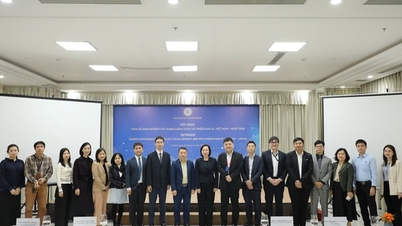
Conference "Reviewing and perfecting tax management procedures and restructuring information technology systems" - Photo: VGP
Risk management is the 'brain', process is the 'backbone'
From December 2 to 5 in Quang Ninh, the Tax Department ( Ministry of Finance ) organized a Conference on "Reviewing and perfecting tax management procedures and restructuring the information technology system", aiming to continue to amend, supplement and perfect the entire business process in the direction of linking management by subject and risk management, ensuring the new tax management model operates effectively.
Speaking at the conference, Deputy Director of the Tax Department Mai Son emphasized the consistent viewpoint: risk management is the "brain", and business processes are the "backbone" of the modern tax management system. Based on the experience of the IMF, WB and models of countries such as the US, UK, Estonia, China, Thailand, etc., the Tax sector determined that reform must be based on data and compliance risk assessment.
According to Mr. Mai Son, the risk-based approach helps tax authorities identify early risks of violations to warn and support before applying strong measures such as inspection or enforcement, thereby improving compliance, reducing costs and administrative pressure.
The Tax Industry is aiming to perfect the entire business process based on data, risk criteria and compliance levels, while closely following the requirement to restructure the information technology system in a synchronous direction, building an integrated database, and real-time connection.
The reform contents aim to concretize the orientation in Resolution 57-NQ/TW on science and technology, innovation and national digital transformation, and Resolution 68-NQ/TW on private economic development. According to Mr. Mai Son, this is an "important political basis" for the Tax sector to proactively redesign processes, apply digital technology, big data and artificial intelligence, create a fundamental shift in the tax management model, contribute to reducing compliance costs and promote a transparent and sustainable business environment.

Deputy Director of the Tax Department Mai Son speaks at the Conference - Photo: VGP
Data as the foundation, strong shift to risk management
A key content of the conference is to review and improve the tax management process system for each group of subjects such as enterprises, organizations, business households and individuals, other individuals, land and other revenues. The review is carried out in close connection with compliance management, risk management, tax audit and taxpayer support processes.
The conference focused on in-depth discussions on procedures by subject, support procedures, compliance management, risk management, data governance and information sharing; and reviewed the tax inspection process and the Inspection Handbook for business households. For households and individuals paying taxes by declaration method, the Tax sector plans to focus on identifying common risky behaviors such as low revenue declaration, concealing revenue, using third-party payment accounts, not issuing invoices, using illegal invoices or accounting in violation of regulations.
According to Ms. Nguyen Thi Thu, Head of the Tax Operations Department, the new tax management process is built on four core principles. First, focusing on taxpayers, improving experience and increasing support, limiting direct contact. Second, applying risk management and compliance throughout each operation and in the entire system. Third, considering data as the foundation, aiming for a centralized, integrated, clean, standardized and continuously updated database. Fourth, promoting automation of the entire process, from receiving, processing, accounting to notification and decision making.
Process standardization will be designed according to the taxpayer lifecycle, from registration, declaration, tax payment, tax refund to obligation management and termination of operations, moving from passive management to proactive support based on risk assessment.
Sharing international experience, Mr. Nguyen Viet Anh, Senior Public Sector Specialist of the World Bank, emphasized that tax management must be oriented towards output results instead of revenue collection targets. Tax authorities need to classify taxpayers according to their compliance level in the context of a rapidly increasing number of taxpayers while staff resources are limited. He also noted the need to improve analytical capacity in the face of the explosion of data from electronic invoices, requiring powerful enough analytical tools to process live data and real-time data.
Mr. Rick Fisher, Senior Tax Advisor of the World Bank, said that process redesign must be accompanied by a system of specific criteria and measures, with the goal of improving compliance, increasing the number of registered taxpayers, and reducing late or missing declarations. More importantly, redesign is not just about digitizing the old process but redesigning from the root, in which the business block plays a central role and is not just an IT problem.
Mr. Minh
Source: https://baochinhphu.vn/nganh-thue-ra-soat-quy-trinh-lay-quan-ly-rui-ro-lam-trung-tam-102251205203219335.htm
![[Photo] 60th Anniversary of the Founding of the Vietnam Association of Photographic Artists](/_next/image?url=https%3A%2F%2Fvphoto.vietnam.vn%2Fthumb%2F1200x675%2Fvietnam%2Fresource%2FIMAGE%2F2025%2F12%2F05%2F1764935864512_a1-bnd-0841-9740-jpg.webp&w=3840&q=75)


![[Photo] Cat Ba - Green island paradise](/_next/image?url=https%3A%2F%2Fvphoto.vietnam.vn%2Fthumb%2F1200x675%2Fvietnam%2Fresource%2FIMAGE%2F2025%2F12%2F04%2F1764821844074_ndo_br_1-dcbthienduongxanh638-jpg.webp&w=3840&q=75)





![[Infographic] Cross-calculated exchange rates to determine taxable value from December 4-10](https://vphoto.vietnam.vn/thumb/402x226/vietnam/resource/IMAGE/2025/12/04/1764832340841_infographic-ty-gia-tinh-cheo-de-xac-dinh-tri-gia-tinh-thue-tu-4-1012-20251204120447.jpeg)























































































Comment (0)