

Establish a department for purchasing goods on e-commerce platforms.
In response to Thanh Nien newspaper, Mr. Au Anh Tuan, Director of the Customs Supervision and Management Department, General Department of Customs ( Ministry of Finance ), stated that in reality, the management agency is currently facing a number of obstacles regarding customs documents, specialized management policies, as well as difficulties in preventing and combating smuggling and illegal transportation of goods across the border.
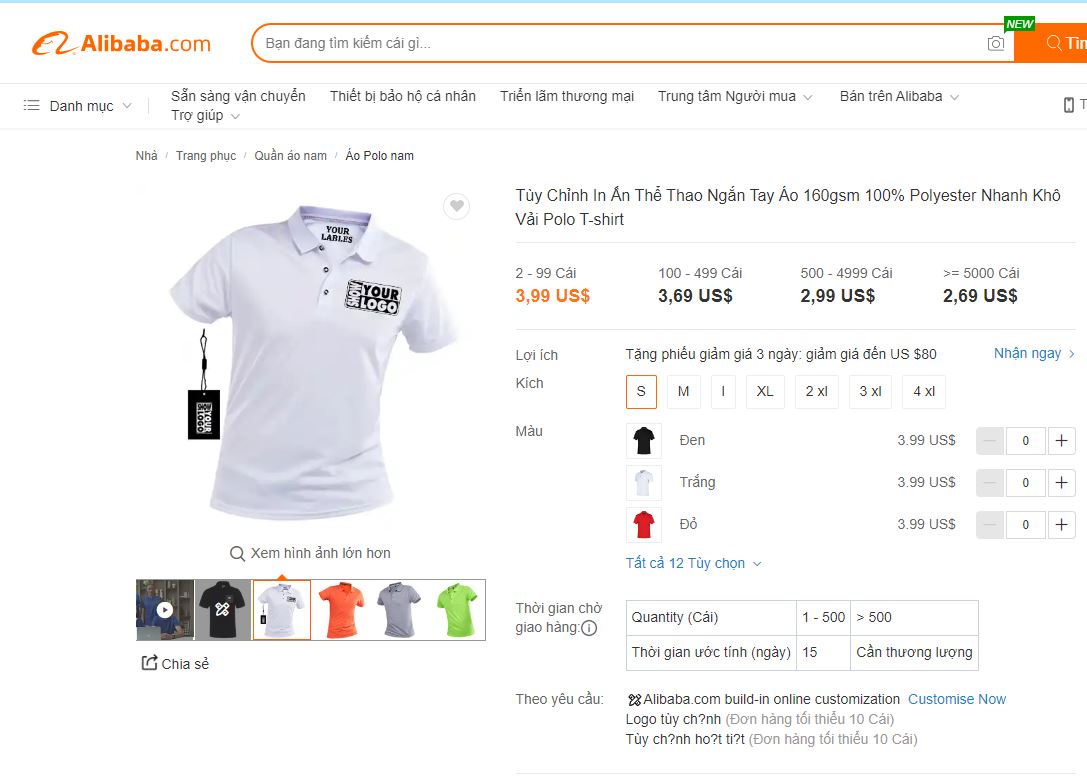
Alibaba's website also has a Vietnamese interface.
Typically, buyers fail to submit or present documents related to the value of exported or imported goods to customs authorities when carrying out customs procedures to determine the customs value according to the actual purchase price and calculate taxes on exported or imported goods (because buyers often pay via debit cards, e-wallets, etc.).
In addition, the Director of the Customs Supervision and Management Department also mentioned that the number of low-value shipments is increasing rapidly, but the customs agency lacks a basis for classifying goods into groups, and does not have prior information about goods to apply modern technical solutions in customs procedures, inspection, and supervision according to the risk management principle.
"This situation has led to the formation of a group that purchases goods on behalf of others on e-commerce platforms and websites, and then transports these goods to Vietnam through unofficial channels. This makes it difficult to combat commercial fraud," said Mr. Au Anh Tuan.
From the perspective of market management authorities, Mr. Nguyen Duc Le, Deputy Director of the Market Management Operations Department (General Department of Market Management - Ministry of Industry and Trade ), shared that there are still many instances of manufacturing, trading, and selling counterfeit goods, substandard goods, goods infringing on copyrights, as well as goods of unclear origin on e-commerce platforms.
The e-commerce environment brings buyers and sellers closer together, regardless of geographical distance or time. This ease of access has led to a surge in the number of organizations and individuals with ulterior motives seeking to profit from the production and sale of counterfeit, substandard, and unverified goods on e-commerce platforms in recent times.
"Over the past two years, we have handled nearly 5,000 violations on e-commerce platforms and social networks, with fines totaling nearly 50 billion VND in confiscated goods. Of that amount, nearly 30 billion VND worth of goods were confiscated and over 20 billion VND worth of goods were ordered to be destroyed," Mr. Le informed, adding that although the authorities have made many efforts, the results have not yet met expectations.
Increase coordination in tax administration.
Mr. Le further informed that recently, the Prime Minister approved the Project on combating counterfeit goods and protecting consumers in e-commerce until 2025. The Ministry of Industry and Trade, in its leading role and in coordination with relevant ministries and agencies, will contribute to making the e-commerce environment cleaner, gradually eliminating and eventually completely eradicating the business of counterfeit goods, substandard goods, goods infringing intellectual property rights, as well as goods of unknown origin on e-commerce platforms.
In the landscape of e-commerce, besides issues related to product quality and origin, one of the concerns that receives much attention is the worry about tax revenue loss. Ms. Nguyen Thi Minh Huyen, Deputy Director of the Department of E-commerce and Digital Economy (Ministry of Industry and Trade), stated that the Ministry of Finance is the agency assigned by the Government to manage the tax sector in general, including tax management in e-commerce.
Affirming that "there is indeed tax revenue loss in e-commerce," the head of the Department of E-commerce and Digital Economy pointed out that the first reason is that the legal regulations on tax collection in e-commerce are still in the process of being perfected. In addition, "current e-commerce transactions are mainly COD (cash on delivery) transactions using cash; there is no timely mechanism for data sharing or information sharing between relevant management agencies" were also mentioned by Ms. Huyen as reasons for the difficulties in combating tax revenue loss in e-commerce.
In her role as the industry manager in e-commerce, Ms. Huyen stated that the Ministry of Industry and Trade has closely coordinated with the General Department of Taxation (Ministry of Finance) in strengthening tax management for e-commerce. Specifically, this includes developing and improving legislation in the field of e-commerce; and establishing a mechanism for sharing data and information through agreements signed between the two ministries.
"In the coming time, we will continue to proactively build a database on e-commerce and will also have discussions to continue exchanging databases and information between the two sides in the management of e-commerce taxes. In addition, we propose that the Ministry of Finance continue to apply digital technology in tax management for e-commerce, as well as promote the role of the e-commerce portal and provide e-commerce services abroad," Ms. Huyen said.
Source link

![[Photo] Prime Minister Pham Minh Chinh holds a phone call with the CEO of Russia's Rosatom Corporation.](/_next/image?url=https%3A%2F%2Fvphoto.vietnam.vn%2Fthumb%2F1200x675%2Fvietnam%2Fresource%2FIMAGE%2F2025%2F12%2F11%2F1765464552365_dsc-5295-jpg.webp&w=3840&q=75)

![[Photo] Closing Ceremony of the 10th Session of the 15th National Assembly](/_next/image?url=https%3A%2F%2Fvphoto.vietnam.vn%2Fthumb%2F1200x675%2Fvietnam%2Fresource%2FIMAGE%2F2025%2F12%2F11%2F1765448959967_image-1437-jpg.webp&w=3840&q=75)




















































![[OFFICIAL] MISA GROUP ANNOUNCES ITS PIONEERING BRAND POSITIONING IN BUILDING AGENTIC AI FOR BUSINESSES, HOUSEHOLDS, AND THE GOVERNMENT](https://vphoto.vietnam.vn/thumb/402x226/vietnam/resource/IMAGE/2025/12/11/1765444754256_agentic-ai_postfb-scaled.png)







































Comment (0)