


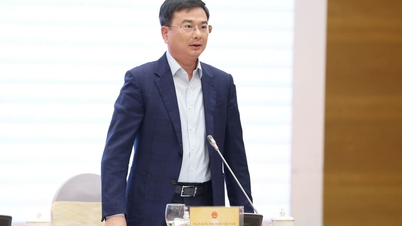
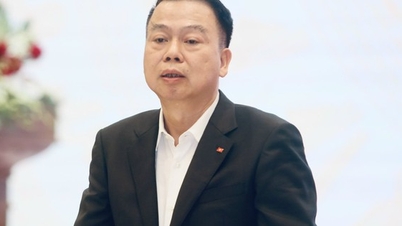
Deputy Governor of the State Bank of Vietnam Pham Thanh Ha answers questions at a press conference - Photo: VGP
Maintaining monetary stability in a highly open economy
On the afternoon of December 6, at the regular Government press conference for November 2025, Deputy Governor of the State Bank of Vietnam (SBV) Pham Thanh Ha said that the global economy is recovering slowly, and although inflation has decreased compared to the previous period, there are still potential risks. In the context of Vietnam's highly open economy, monetary policy management is under a lot of pressure.
Following the direction of the Government and the Prime Minister , the State Bank of Vietnam (SBV) has operated monetary policy proactively and flexibly to control inflation, stabilize the macro-economy and support growth. Exchange rates have been managed according to market signals; lending interest rates have continued to decrease; credit has maintained its growth momentum, ensuring capital supply for the economy.
As of November 27, total outstanding credit reached over VND18.2 trillion, up 16.56% compared to the end of 2024, higher than the increase in the same period and the previous year. Macroeconomic indicators were kept within the limits set by the National Assembly and the Government: the average CPI in the first 11 months increased by 3.29%, core inflation by 3.21%; growth in the first 9 months reached about 7.85%.
According to the Deputy Governor, in the coming time, the world economy will continue to develop unpredictably, trade protection measures will increase, while the management orientation of major central banks, especially the Fed, is difficult to predict, which can have a strong impact on the international financial market.
"The State Bank will continue to closely monitor domestic and international developments to promptly adjust appropriate monetary policies; support liquidity for credit institutions in the final period of the year; and closely coordinate with fiscal policies to stabilize the monetary and foreign exchange markets," said the Deputy Governor.
Accelerating support for people and businesses after storms and floods
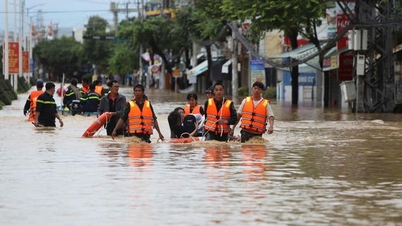
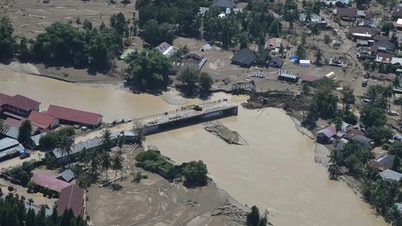
In addition to macro management tasks, the banking industry in 2025 will face great pressure from natural disasters. Since July, consecutive storms and floods have caused damage, affecting about 250,000 borrowers with outstanding loans of nearly VND60,000 billion.
Implementing the Government's direction, the State Bank of Vietnam requested credit institutions to review the extent of damage, assess debt repayment capacity and apply support measures. The key solution is to restructure debt repayment terms and reduce interest rates by 0.5-2% for 3-6 months. To date, nearly 24,000 customers have had their interest rates reduced with a total outstanding debt of about VND14,000 billion.
At the same time, banks have deployed a loan package to restore production and business worth about VND70,000 billion; disbursed nearly VND1,500 billion to 6,500 customers, of which the agriculture, forestry and fishery sector received VND600 billion for 4,000 customers.
Regarding policy credit, the Vietnam Bank for Social Policies (VBSP) continues to play a pivotal role. On December 4, the Prime Minister issued Decision 2654 reducing interest rates by 2%/year in the last 3 months of the year for about 3 million customers in 22 flood-affected provinces, with total expected support of more than 1,100 billion VND.
Regarding the damage caused by storm No. 13 in Gia Lai, Dak Lak, Lam Dong and Khanh Hoa, the Social Policy Bank is submitting to the Prime Minister for consideration to continue reducing interest rates by 2% in the last 3 months of 2025 for about 1 million customers, with total support of nearly 300 billion VND.
Huy Thang
Source: https://baochinhphu.vn/nhnn-no-luc-kiem-soat-lam-phat-truoc-bien-dong-toan-cau-102251206173005133.htm


![[Photo] 60th Anniversary of the Founding of the Vietnam Association of Photographic Artists](/_next/image?url=https%3A%2F%2Fvphoto.vietnam.vn%2Fthumb%2F1200x675%2Fvietnam%2Fresource%2FIMAGE%2F2025%2F12%2F05%2F1764935864512_a1-bnd-0841-9740-jpg.webp&w=3840&q=75)
![[Photo] National Assembly Chairman Tran Thanh Man attends the VinFuture 2025 Award Ceremony](/_next/image?url=https%3A%2F%2Fvphoto.vietnam.vn%2Fthumb%2F1200x675%2Fvietnam%2Fresource%2FIMAGE%2F2025%2F12%2F05%2F1764951162416_2628509768338816493-6995-jpg.webp&w=3840&q=75)















































































Comment (0)