

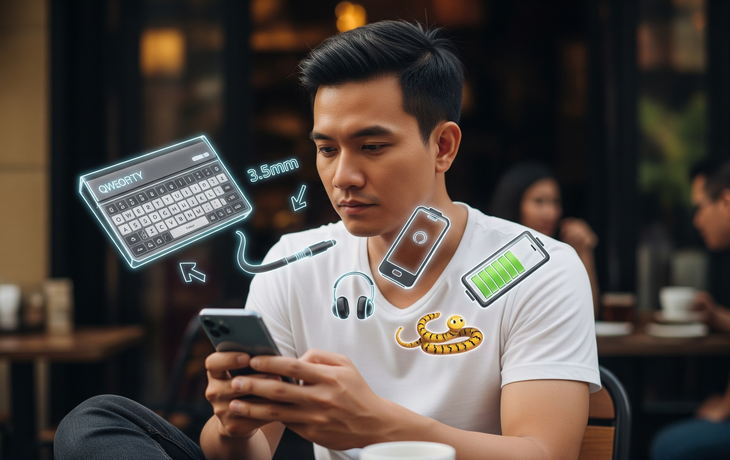
Users sometimes feel nostalgic for old experiences on smartphones from "the old days".
New experiences gradually make people forget the familiar feeling of old conveniences until one day, they look back at the smartphone in their hand and suddenly realize that something that was once so convenient and familiar is no longer there...
When old habits are gradually replaced
One of the most notable changes is the removal of the 3.5mm headphone jack, a connector that had been ubiquitous on almost every mobile device for over a decade.
The reasons given by manufacturers are to optimize design, increase battery capacity, or steer users towards the wireless headphone ecosystem. However, many people still miss the convenient "plug-and-play" feel of wired headphones, especially since wireless products require frequent charging and sometimes still experience audio latency.
Similarly, LED notification lights are gradually becoming obsolete. Previously, a small blinking light on the side of the device helped users easily recognize missed messages or calls without turning on the screen. But with OLED screens and Always-On Display features becoming increasingly common, LEDs are becoming redundant in the eyes of manufacturers.
Infrared remotes, once a lifesaver when users couldn't find their TV or air conditioner remotes, are gradually fading into obscurity. With the rise of IoT devices and the smart home ecosystem, manufacturers are shifting to WiFi, Bluetooth, and app-based control – which many users consider more modern but sometimes less intuitive.
Sharing the same "fate" are the convenient removable battery – which can be quickly replaced, especially for heavy users; the physical home button – which once provided a familiar "realistic" tactile feel that many still remember even after the switch to full touch operation; and the microSD card slot...
As technology reshapes smartphone user habits.
According to Tuoi Tre Online's research, the disappearance of these features is not entirely due to the designers, but reflects how technology companies are reshaping the entire mobile device ecosystem.
Instead of simply providing hardware functionality, today's smartphones are central hubs connecting wireless headphones, smartwatches, TVs, portable speakers, and even smart homes, all operating seamlessly through AI and cloud platforms.
Removing the headphone jack not only frees up internal space for a larger battery or a more complex camera module, but also forces users to embrace wireless headphones and integrated virtual assistants.
Replacing LED lights with Always-On Display also represents a shift from a passive notification experience to an active and customizable display.
Even users themselves are changing. Charging headphones wirelessly has become a habit, controlling the home from a smartphone via WiFi is now more common than using infrared ports...
Source: https://tuoitre.vn/nhung-dac-san-mot-thoi-cua-smartphone-20250707101846302.htm

![[Photo] National Assembly Chairman Tran Thanh Man successfully concludes his participation in IPU-152](https://vphoto.vietnam.vn/thumb/1200x675/vietnam/resource/IMAGE/2026/04/18/1776502638199_vna-potal-chu-tich-quoc-hoi-ket-thuc-tot-dep-chuong-trinh-tham-du-ipu-152-8709975-jpg.webp)




























































































Comment (0)