

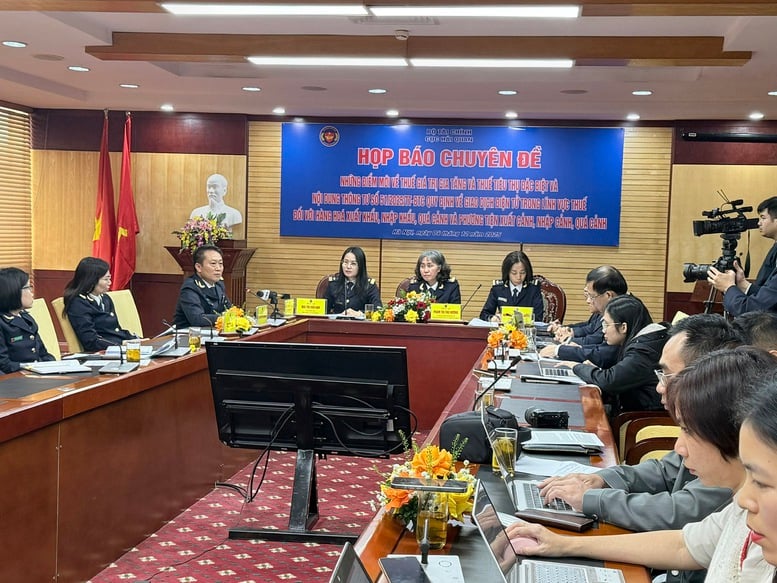
The Customs Department held a thematic press conference to inform about new points of the Law on Value Added Tax, the Law on Special Consumption Tax and Circular 51/2025/TT-BTC on electronic transactions - Photo: VGP
Towards a transparent and synchronous legal framework
According to the Customs Department, these documents are considered an important step to standardize and make tax procedures transparent and consistent with the current import-export tax law system.
Ms. Nguyen Thi Khanh Huyen, Customs Tax Department, said that the VAT Law No. 48/2024/QH15 and its guiding decree have supplemented many regulations that were previously only guided by official dispatch.
A notable content is the expansion of the list of goods not subject to VAT, thereby helping businesses reduce legal risks and compliance costs.
Specifically, imported goods for financial leasing are allowed to be transported directly into duty-free zones without being subject to VAT. Exported products belonging to the group of resources and exploited minerals (raw or processed according to the Government 's List) are clearly identified as not subject to tax, in line with the policy of restricting the export of raw resources.
The Law also codifies tax exemption cases such as: movable assets within the import tax exemption limit; goods exchanged by border residents in the prescribed list; relics and antiques imported by competent authorities.
Along with the expansion of some tax-free cases, some incentives were adjusted. Previously tax-free items such as fertilizers, fishing vessels, and specialized agricultural machinery and equipment were transferred to a 5% tax rate.
The previous 5% tax incentives have also been adjusted to 10% for groups of goods such as sugar and sugar production by-products, specialized equipment for teaching - research - experimentation, semi-processed rosin, and unprocessed forest products.
The law clearly stipulates the principles of tax rate application: business establishments with many types of goods and services must declare according to each corresponding tax rate; if they cannot be distinguished, they must pay the highest rate. This provision aims to limit the situation of false declaration or under-declaration due to mistakes or abuse.
The principles applied to unprocessed agricultural, forestry and fishery products, waste, by-products, scrap, etc. are also specifically regulated to unify the calculation method.
According to the Customs Department, the legalization and synchronization of regulations from July 1, 2025 will help businesses be more proactive in production and import-export planning; at the same time, create conditions for management agencies to strengthen supervision, apply technology in exchanging tax data and reduce administrative procedures.
Regarding tax collection on low-value goods sent via express delivery service, the Customs Department said that before February 18, this group of goods was not subject to VAT.
However, after referring to the practices of some countries, many countries have abolished the VAT exemption for small value goods. From February 18, implementing the Government's policy, small value goods imported via express delivery must pay VAT.
The Customs Department has built software for businesses to declare through the data system, serving the implementation of this policy.
As of September 15, in a short period of implementation, tax collection reached 1,082 billion VND for low-value goods. This contributes to preventing the situation of dividing goods to avoid taxes, while ensuring fairness with domestically produced goods.
Balancing development and protecting public health
According to the customs authority, the amended Law on Special Consumption Tax (SCT), which takes effect at the same time as the Law on Value Added Tax (VAT), brings about changes in both the group of policies supporting businesses and management measures for groups of goods affecting public health.
On the facilitation side, a change that businesses are interested in is the abolition of the special consumption tax on air conditioners with a capacity of 24,000 BTU or less. The new regulation helps reduce the cost burden for businesses that manufacture and import air conditioners.
The Law also expands the cases not subject to special consumption tax under Article 3, including: goods produced and processed for export; exported goods for which tax has been paid but returned by foreign parties; certain types of vehicles used in relic sites, hospitals, and schools; helicopters and gliders used for rescue and pilot training.
The Law allows the Government to submit to the National Assembly Standing Committee amendments and supplements to taxable or non-taxable subjects when necessary, creating a flexible mechanism in the application process.
Another content is to expand the conditions for deduction and refund of special consumption tax, applicable to imported raw materials for production of export goods; in case of dissolution or bankruptcy of enterprises with remaining tax amount not deducted; or tax refund according to international treaties.
In terms of tightening management, the Law on Special Consumption adds regulations for sensitive goods. Soft drinks with sugar content over 5g/100ml are subject to tax; tobacco and alcohol continue to be adjusted according to the roadmap of increasing tax rates, combining absolute tax and proportional tax to reduce consumption of products harmful to health.
For temporarily imported and re-exported goods, regulations are tightened: overdue re-export or change of purpose of use will be subject to special consumption tax, ensuring consistency with customs law. The time for calculating tax on imported goods is determined as the time of registration of customs declaration.
The synchronous adjustments in both VAT and special consumption tax reflect a two-way policy trend: both creating favorable conditions to promote production and export and improve the business environment; and strengthening management in areas that are prone to risks and affect public health.
Actual implementation will require coordination between businesses, customs authorities and relevant ministries and branches to ensure effectiveness, efficiency and transparency in tax management.
A representative of the customs sector said that every year there is a plan to control and combat smuggling in conjunction with tax control. In particular, before, during and after the Lunar New Year, the Ministry of Finance and the customs sector issue a peak plan to control smuggling.
The period before Tet is the time when consumer goods such as alcohol, beer, and cigarettes – which have high tax rates – are prone to smuggling due to profit margins.
These items are always identified as high-risk items and customs authorities apply synchronous measures in customs procedures and customs control measures to prevent smuggling, trade fraud, avoid tax losses and protect the interests of legitimate businesses.
During the peak period before Lunar New Year, under the direction of the Ministry of Finance and the General Department of Customs, local customs departments deploy procedures and arrange forces to coordinate with professional units to control smuggling along all routes and customs operation areas.
To ensure smooth electronic transaction processes and avoid congestion, customs authorities use technological tools, including artificial intelligence (AI), to promptly detect bottlenecks during the implementation process.
Ms. Pham Thi Thu Huong, Chief of Office of the Customs Department, said that the policy mechanism and legal documents of the customs agency will be amended and supplemented to meet the new organizational model, serve the goal of building a digital customs sector and implementing the four pillar resolutions of the Politburo.
"When there is a new policy, the Customs Department will organize information seminars for the press because this is an important channel to disseminate and propagate the new policy of the state management agency to the business community, helping businesses understand and comply with regulations, while supporting the customs agency in the process of performing its duties," Ms. Pham Thi Thu Huong emphasized.
Mr. Minh
Source: https://baochinhphu.vn/nhung-diem-moi-ve-thue-gia-tri-gia-tang-thue-tieu-thu-dac-biet-va-tac-dong-toi-doanh-nghiep-102251204132038935.htm


![[Photo] Cat Ba - Green island paradise](/_next/image?url=https%3A%2F%2Fvphoto.vietnam.vn%2Fthumb%2F1200x675%2Fvietnam%2Fresource%2FIMAGE%2F2025%2F12%2F04%2F1764821844074_ndo_br_1-dcbthienduongxanh638-jpg.webp&w=3840&q=75)













































![[VIMC 40 days of lightning speed] Da Nang Port: Unity - Lightning speed - Breakthrough to the finish line](https://vphoto.vietnam.vn/thumb/402x226/vietnam/resource/IMAGE/2025/12/04/1764833540882_cdn_4-12-25.jpeg)






































Comment (0)