

Seafood exports generated over $4.4 billion.
According to the Vietnam Association of Seafood Processing and Export (VASEP), in June 2024, the country's seafood exports were estimated at US$875 million, a 14% increase compared to the same period last year. This was also the month with the highest export value so far this year. Accordingly, cumulative seafood exports in the first half of this year brought in over US$4.4 billion, an increase of nearly 7% compared to the same period in 2023.
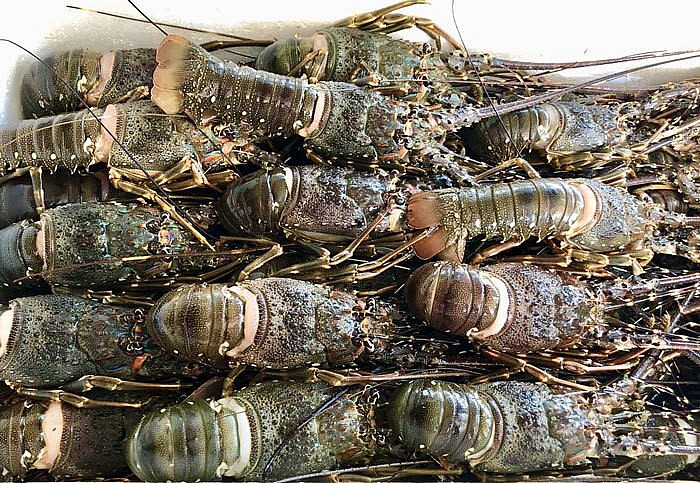 |
| In the first half of 2024, lobster exports increased 57 times. |
Exports of most key commodities showed high growth in June, with pangasius exports increasing by 22%, tuna by 40%, and crabs by 59%. Shrimp exports saw a slight increase of 7%. Squid and octopus were the only products that experienced a slight decrease compared to the same period last year.
In the first half of this year, shrimp exports brought in over $1.6 billion, 7% higher than the same period last year. Of this, whiteleg shrimp accounted for nearly $1.2 billion, a slight increase of 3%, while tiger shrimp reached over $200 million, a decrease of 10%. Lobster exports, however, surged 57 times compared to the same period, reaching over $130 million.
Pangasius exports in the first half of this year reached $922 million, an increase of nearly 6% compared to the same period last year. Although demand has improved, export prices to markets such as China, the EU, and the UK remain low. Only the US market shows more positive signs in terms of both price and import volume.
Tuna exports in the first half of this year increased by nearly 25% to $477 million, mainly due to a strong increase in the canned and packaged tuna segment. Meanwhile, squid and octopus exports decreased slightly by 1% to $289 million, with a decline in squid exports, while octopus exports continued to increase.
Besides tuna, many other marine fish products saw strong demand and sales growth in the first half of this year. These included sea bass, with a 27% increase in exports reaching over $36 million; yellowfin tuna, with a 14% increase reaching over $29 million; mackerel, with a 6% increase; pollock, with an 8% increase reaching $38 million; and snapper, with a 96% increase. Several freshwater fish species also saw increased import demand, including red snapper (up 32%), tilapia (up 18%), and eel (up 93%).
The EU market recorded the highest export growth rate of 40%.
Seafood exports to the top two largest markets, the US and China-Hong Kong (China), both recorded high growth in June. Specifically, seafood exports to the US increased by 14%, and to China-Hong Kong (China) increased by 18%.
The US economy is showing optimistic signs this year. Inflation in the US has fallen rapidly from 9% to 3% this year, and the US is expected to cut interest rates soon to stimulate consumer demand, thus creating good opportunities for exporters. In the first half of the year, seafood exports to the US market reached $733 million, an increase of 9%. Meanwhile, exports to China and Hong Kong (China) in the first half of the year increased by 7% to $766 million.
Exports to Japan in June increased only slightly by 2% year-on-year. By the end of June 2024, seafood exports to Japan reached US$705 million, a slight decrease of 1% compared to the first half of 2023. The 12% depreciation of the Japanese Yen against the US Dollar, the largest depreciation among major currencies, was a factor contributing to the decline in imports. Furthermore, the disadvantages caused by China's ban on imports of Japanese seafood also contributed to the slowdown in Japan's imports.
Exports to the EU market saw the highest growth (+40%) in June. For the first half of 2024, seafood exports to the EU totaled US$513 million, a 12% increase compared to the same period last year. The EU market is showing signs of gradual stabilization. Market and consumer prices are stable, and seafood inflation continued to fall to 2.1% in May. Since March, inflation has decreased even more significantly for frozen seafood, with a negative inflation rate of 0.9% in May. EU demand and seafood imports are forecast to rebound after the European summer holidays.
VASEP expects that this year's export situation will stabilize according to the normal cycle, accelerating in the third and fourth quarters. Accordingly, export turnover will be about 15% higher than the same period in 2023, reaching over 5.5 billion USD, bringing the total export results for 2024 to nearly 10 billion USD, an increase of 12% compared to 2023.
China increases lobster imports, leading to a sharp rise in lobster exports.
Regarding lobster specifically, China is currently the largest importer of this product from Vietnam, accounting for 98-99%. According to experts, China's massive purchase of Vietnamese lobsters has led to a 57-fold increase in lobster exports in the first half of 2024 compared to the same period last year.
Previously, in October 2023, China stopped importing spiny lobsters from Vietnam due to regulations related to its Wildlife Protection Law. To export spiny lobsters to China, businesses had to prove that the lobster larvae were not caught directly from the sea, provide clear evidence of the farming process, and not use larvae harvested from the wild, meaning the larvae had to be F2 generation; the importing unit had to have a license...
On January 20, 2024, Deputy Minister of Agriculture and Rural Development Tran Thanh Nam led a delegation from the Ministry to work with the People's Government of Guangdong Province (China) on cooperation in agricultural development and trade. During the working sessions, both sides agreed to coordinate in resolving obstacles in the import and export of sturgeon and spiny lobster under a special mechanism, which will be included in the Protocol between the two countries. While awaiting the signing of the Protocol, China will consider creating a special mechanism for businesses to register to export spiny lobster to the country.
In Vietnam, many localities currently have strong potential for lobster farming, with an estimated production of about 4,000 tons per year. Spiny lobsters, in particular, have high economic value, generating revenue of approximately 2 trillion VND.
Regarding the Chinese market, Vietnam currently has 46 packaging facilities exporting lobster to this market. Currently, lobster exports to China are trending favorably, but in the long term, it is necessary to move towards official export channels. To achieve this, it is essential to build integrated supply chains from production and procurement to export, linked with transparent traceability.
Source: https://congthuong.vn/nua-dau-nam-2024-xuat-khau-tom-hum-tang-57-lan-329302.html






















![[Photo] Prime Minister Pham Minh Chinh holds a phone call with the CEO of Russia's Rosatom Corporation.](/_next/image?url=https%3A%2F%2Fvphoto.vietnam.vn%2Fthumb%2F1200x675%2Fvietnam%2Fresource%2FIMAGE%2F2025%2F12%2F11%2F1765464552365_dsc-5295-jpg.webp&w=3840&q=75)












































Comment (0)