

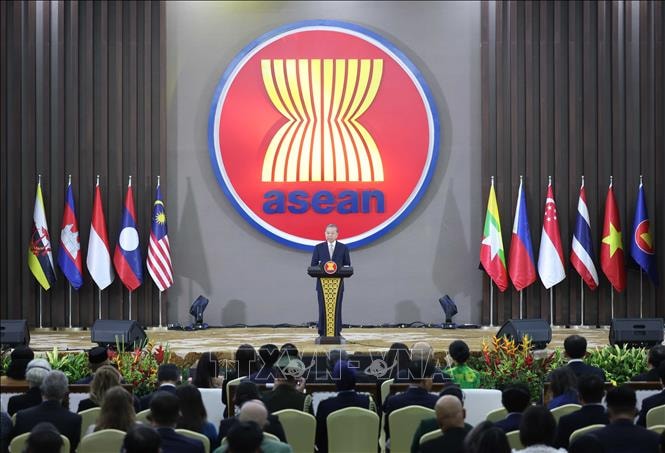
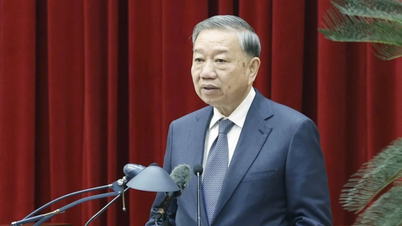
The Vietnam News Agency (VNA) respectfully presents the content of General Secretary To Lam's Policy Statement: "Vietnam's Vision on the ASEAN Region, Vietnam's Foreign Policy and International Integration Guidelines in the Era of National Advancement."
" Mr. Secretary-General of ASEAN Kao Kim Hourn,
Ladies and gentlemen,
1. I am pleased that during my State visit to Indonesia I had the opportunity to officially visit and speak at the ASEAN Secretariat – the permanent body of ASEAN, where meetings and conferences at the ASEAN summit and other levels take place, as well as between ASEAN and its partners. It is also where ASEAN leaders adopt many important decisions that contribute to the development and future of Southeast Asia and the world .
I sincerely thank the Secretary-General, the leaders and staff of the ASEAN Secretariat, and the ambassadors and representatives of diplomatic missions here for the warm welcome extended to me and the Vietnamese delegation. In this hall today, I have learned of many reputable scholars and researchers, many of whom have made and continue to make significant contributions to the development of ASEAN and Vietnam-Indonesia relations. I respectfully extend my best wishes and greetings to all of you.
Ladies and gentlemen,
2. As soon as we set foot in the beautiful "land of a thousand islands," everywhere we went we saw radiant eyes and very friendly and affectionate smiles from the Indonesian people, making us feel like we were visiting a close relative with many similarities and a sense of intimacy. Indonesia is famous for its rich and diverse culture, a crossroads of many major civilizations and religions in the region stretching from the Indian Ocean to the Pacific Ocean. Its majestic nature, combined with ancient architectural structures steeped in spiritual and cultural values, and unique and impressive modern architecture, has made it an attractive destination for tourists from all over the world and Vietnam.
Indonesia is also known for its transcendental ideology, in which independence, self-reliance, self-strength, and non-alignment have become its foreign policy philosophy. Inspired by my visit to this country and the warm, friendly, and united atmosphere at the ASEAN Secretariat, I would like to share with you some thoughts on the important role of ASEAN in the current context of the Asia-Pacific and Indian Ocean regions; and on Vietnam's foreign policy and international integration in this era of national progress, striving to contribute to peace, stability, and development in ASEAN, the region, and the world.
Ladies and gentlemen,
3. In recent decades, particularly since the COVID-19 pandemic, the world and the region have witnessed rapid shifts, creating epochal changes with three major trends shaping the future:
Firstly, the reshaping of the world's landscape towards a multipolar, multi-centered system, in which strategic competition and fragmentation among major powers are becoming increasingly intense, presents unprecedented opportunities and challenges for the post-war international order and ASEAN.
Secondly, the explosive development of science and technology, especially emerging technologies such as artificial intelligence, quantum technology, blockchain, synthetic biology, etc., has led to fundamental changes in the cultural, economic, political, and social life of all humanity, each nation, and every individual.
Thirdly, the increasingly profound impact of non-traditional security challenges such as climate change, resource depletion, epidemics, cybersecurity, and population aging requires countries to adjust their development and cooperation approaches in global governance.
These trends are profoundly impacting all aspects of global political, security, economic, and social life, presenting both opportunities and challenges for all countries and international organizations, including ASEAN and Vietnam. More than ever, we clearly feel the difficulties, challenges, and risks to peace, security, and stability. Escalating tensions and conflicts between nations have reached their highest levels in 75 years. Global security is increasingly unstable, with nearly 15% of the world's population now living in conflict-affected areas. International cooperation and multilateral institutions face unprecedented challenges as trust between nations is gradually being replaced by confrontation and suspicion. The open multilateralism promoted by the strong globalization process over the past three decades is being eroded. The intertwining of traditional and non-traditional security challenges is becoming increasingly complex, making the security and development environment of the Asia-Pacific region, including Southeast Asia and ASEAN member states, more complicated and unpredictable than ever before. As ASEAN Secretary-General Kao Kim Hourn noted at the Second ASEAN Future Forum in Hanoi at the end of February: the world today is characterized by "competition, confrontation, mutual challenges, and fragmentation."
However, I believe that challenges and difficulties always contain or present opportunities. Difficulties drive nations closer together to address common challenges. At the same time, difficulties also open up rare opportunities for ASEAN to rise and assert a new position, based on shared principles, values, and achievements after nearly 60 years of development. Most importantly, difficulties and challenges are the driving force for innovation. From the historical lesson of Vietnam, if it weren't for the difficulties and challenges of the 1980s, we might not have had the reform process and Vietnam as it is today. Our beloved President Ho Chi Minh once advised: "Nothing is difficult, only the lack of perseverance is to be feared; with determination, one can move mountains and fill seas." This is precisely the opportunity and the time for us to continue to innovate and innovate even more strongly. Therefore, what we need to do is be determined, united in facing the difficulties and challenges head-on, continue to promote cooperation, stimulate innovation, and create new, sustainable growth drivers for the entire ASEAN Community, for each ASEAN member state, and for ASEAN's partners.
Ladies and gentlemen,
4. Looking back at ASEAN's nearly 60-year history provides us with many valuable lessons, especially regarding the spirit of self-reliance, self-strength, and strategic autonomy. I would like to share with you three typical stories about ASEAN's historic decisions that created turning points in the region's development.
The first was the period of the regional financial crisis in the late 90s of the last century. The widespread impact of the crisis at that time raised questions about the real effectiveness and prospects of regional economic integration; even many hasty assessments said that ASEAN would withdraw and build a protectionist "wall". But ASEAN's decision at that time was completely the opposite. It was during the crisis that ASEAN became more aware of the interdependence and connection between economies. From the decision to accelerate the integration roadmap in the ASEAN Free Trade Area, to the efforts to promote the free flow of goods, services, investment... it was those correct decisions that contributed significantly to helping ASEAN overcome difficulties, today becoming a center of free trade agreement networks accounting for 30% of the world's population and 32% of global GDP.
The second story is ASEAN's decision to accelerate the formation of the Community in 2015, shortening the timeline by 5 years compared to the original roadmap. This was a strong and timely decision, made in 2007 in the context of the urgent need to enhance ASEAN's integration to keep pace with the trend of globalization and increasingly deep integration. The ASEAN Charter, which came into effect in 2008, established a comprehensive legal and institutional framework for ASEAN integration. The establishment of the ASEAN Community on December 31, 2015, was a qualitative leap for ASEAN across all three pillars: (1) Political-security; (2) Economic and (3) Socio-cultural. ASEAN today has become a Community of 10 nations united in diversity; the 5th largest economy in the world with a leading growth rate; and the center of regional and global integration processes; It serves as a bridge for dialogue and cooperation for peace and development in the region, making a positive contribution to shaping a new world order.
Finally, there is the story of ASEAN's extraordinary efforts to overcome the COVID-19 pandemic. Faced with unprecedented challenges from the outbreak, ASEAN mobilized its collective strength, transforming the need for cooperative response into a common denominator of interests among nations, jointly maintaining the stability of ASEAN's operations and sustaining the momentum of community building. Amidst the gloomy global economic landscape, ASEAN continues to emerge as a positive bright spot, with a projected growth rate of 4.7% in 2025. To capitalize on these new growth drivers, a series of cooperation frameworks are being urgently developed to enhance ASEAN's competitiveness, shaping and leading new cooperation trends in the region.
5. The stories above are evidence of the core values that have shaped ASEAN's success and identity over the past nearly six decades. Solidarity, self-reliance, cooperation, and unity in diversity continue to be key to ASEAN's success in today's volatile environment. The emergence of increasingly numerous challenges with multifaceted and far-reaching impacts demands that ASEAN adopt a creative, flexible, and innovative approach, including in the decision-making process. Consensus and solidarity do not mean always staying within a safe zone for all parties. On the contrary, members of the ASEAN family must dare to think, dare to act, and dare to act for the common good. That is the true meaning and value of consensus and solidarity.
6. Entering a new phase of development, ASEAN is sure to grow strongly and will become the world's fourth largest economy by 2030. With a consumer market of over 800 million people, it will also be a hub for technology, the digital economy, and innovation, with ASEAN's digital economy growing rapidly and projected to reach US$1 trillion by 2030.
In the face of current complex changes, to maintain and build upon achievements effectively and sustainably, and to affirm its stature and central position, ASEAN needs not only unity, consensus, and solidarity, but also breakthrough thinking, sharp strategies, a feasible roadmap, concentrated resources, and decisive action. I have some thoughts on creating breakthroughs in promoting ASEAN's strategic values and enhancing ASEAN's prestige and role in the future.
Firstly, ensuring strategic autonomy and flexibility is crucial to enhancing adaptability and responsiveness to challenges and rapid changes in the context of strategic competition. ASEAN needs to coordinate with greater responsibility in strengthening internal solidarity. This is a decisive factor in responding to external pressures, maintaining an independent and balanced voice in the context of increasingly fierce great power strategic competition. Accordingly, ASEAN needs to increase consensus through consultation, dialogue, and the intertwining of interests among members; enhance community awareness and greater proactiveness from each member state in seeking common ground on ASEAN interests, identity, and values.
Secondly, ASEAN needs to become more economically self-reliant, leveraging and maximizing its advantages as a vast and potentially rich economic development space, rising in the global supply chain to become a strategic manufacturing hub of the world. ASEAN needs to be more innovative in its development solutions, adopting new approaches to promote new growth drivers, especially in innovation, science and technology, digital transformation, green economy development, circular economy, renewable energy, and the development of high-quality human resources; ensuring harmony between economic growth and green, inclusive, and sustainable development. ASEAN needs to become a center of breakthrough technological initiatives, transforming scientific research into practical and effective applications in socio-economic development.
Third, further promote the identity and values of ASEAN. Strengthen cultural connectivity and people-to-people exchanges, promoting ASEAN's distinctive values such as consensus, harmony, and respect for diversity. Preserve and promote the "ASEAN Way"—a precious cultural heritage in the Association's decision-making process, especially with people-centered approaches as the goal and driving force of sustainable development. In the context of food security, energy security, and climate change seriously impacting people's lives, ASEAN's task is to be prepared in all aspects to proactively adapt to any circumstances, ensuring stable and prosperous lives for its people.
Fourth, enhance the effectiveness of establishing norms of conduct to regulate and guide relations among countries in the region based on the principles of balance, inclusiveness, and mutually beneficial cooperation. Simultaneously, ensure the substantive implementation of initiatives and cooperation commitments. Given the increasing strategic friction between major powers, ASEAN needs to demonstrate solidarity in both its conduct and actions, maintain its central role, promote its connecting and bridging function, encourage all parties to participate in ASEAN-led mechanisms, create a foundation for dialogue and goodwill cooperation, and foster cooperation and maintain stability and peace for the region and the world, while ensuring adherence to the principles and guidelines set forth by ASEAN mechanisms. In particular, ASEAN needs to be more proactive in using the "ASEAN Way" to find long-term, sustainable solutions to issues both within and outside Southeast Asia.
Fifth, focus on jointly resolving internal issues to help Myanmar achieve stability and development; and help Timor Leste become a full member of ASEAN as soon as possible.
Ladies and gentlemen,
7. Vietnam is proud of its international integration process implemented over the past 30 years, with ASEAN serving as the starting point and foundation for Vietnam's increasingly deep integration into the region and the world. From a country that was isolated and embargoed, Vietnam today has diplomatic relations with 194 countries and is a member of more than 70 regional and global forums and organizations. The network of free trade agreements (FTAs) that Vietnam has signed and implemented with more than 60 countries and economies has contributed to making Vietnam one of the 40 largest economies in the world and one of the top 20 economies in the world in terms of attracting foreign investment and trade volume.
To date, Vietnam has established comprehensive partnerships, strategic partnerships, and comprehensive strategic partnerships with 35 countries, including all ASEAN members and key ASEAN partners. It can be affirmed that cooperation with ASEAN members and with the ASEAN network of partners has significantly contributed to ensuring a peaceful, stable, and favorable environment for Vietnam's development and increasing prosperity, opening up a space full of potential for Vietnam's development and helping Vietnam enhance its prestige, role, and international standing.
As a reliable, active, and responsible member of the region and the world, Vietnam has been striving to contribute resources and intellect to leading regional and global cooperation mechanisms. Vietnam's contributions as a non-permanent member of the United Nations Security Council, a member of the United Nations Human Rights Council, and to important regional cooperation mechanisms such as the ASEAN Regional Forum (ARF), the East Asia Summit (EAS), the Asia-Pacific Economic Cooperation (APEC) Forum, and its three terms as ASEAN Chair (1998, 2010, 2020)... have been recognized and highly appreciated by the international community. Vietnam understands that alongside its increasing standing comes increased responsibility – to the ASEAN family, to its regional friends, and to the common concerns of the international community.
These tremendous, historically significant achievements form a crucial foundation for Vietnam to enter a new era, an era of national progress. Vietnam is determined to pursue a breakthrough growth target of 8% in 2025 and above double digits in the following years; to transform the country into a modern industrialized nation by 2030 and a developed, high-income country by 2045. We link rapid and sustainable economic development with the transformation of the growth model towards improving quality, efficiency, and competitiveness, with science, technology, innovation, and digital transformation as key drivers; at the same time, we continue to place people at the center and as the driving force of development; building a rule of law state, of the people, by the people, and for the people.
In this new era of development, Vietnam continues to steadfastly pursue its independent, self-reliant, peaceful, friendly, cooperative, and developmental foreign policy, multilateralizing and diversifying its relations, being a friend, a reliable partner, and an active and responsible member of the international community; proactively and comprehensively integrating into the international community. Vietnam is ready to contribute even more actively and proactively to world politics, the global economy, and human civilization.
With the aspirations of a peace-loving nation, we also believe that peace is the foundation for development. Inheriting the heroic and humane traditions of the nation, "Connecting two countries in friendship; extinguishing the flames of war for all eternity," "Using righteousness to overcome brutality; using humanity to replace tyranny," Vietnam adheres to the "four no's" national defense policy: (1) Not participating in military alliances; (2) Not aligning with one country against another; (3) Not allowing foreign countries to establish military bases or use territory to fight against other countries; (4) Not using force or threatening to use force in international relations. Vietnam always firmly supports respect for the principles of the United Nations Charter and international law; strongly supports the peaceful resolution of disputes, opposes unilateral actions, power politics, and the use or threat of using force in international relations.
8. Since opening up and integrating into the global economy, we have always considered ASEAN as a multilateral cooperation mechanism that is directly and most importantly relevant to Vietnam. For more than three decades since joining ASEAN in 1995, Vietnam has prioritized strengthening relations with neighboring countries and the region, striving to contribute its utmost to building a united, strong, and self-reliant ASEAN Community, thereby affirming its international standing as a member of the ASEAN family. Vietnam's foreign policy priority in the coming period is to continue working with ASEAN to build a strong and united community, contributing to peace, stability, and prosperity in the region.
Standing at a new historical starting point, Vietnam and ASEAN are together striving towards ambitious goals. In the next stage of development, with new expectations placed upon ASEAN, Vietnam is more aware of its responsibility to actively participate and contribute more to the common good, guided by the principles of creative thinking, innovative approaches, flexible implementation, effective methods, and decisive action. Vietnam will closely coordinate with ASEAN members to help realize potential and overcome challenges, including efforts to build an inclusive, sustainable, and interconnected regional structure in terms of politics, security, economics, trade, culture, society, and people-to-people exchanges; while upholding conduct based on the United Nations Charter and international law as the best and most fundamental way to ensure peace, stability, and prosperity in the region and the world.
Vietnam will continue to join hands with ASEAN countries to realize ASEAN's historical mission and spread ASEAN's success stories. For member states, this is a story of solidarity, close ties, mutual support, self-reliance, self-strength, strategic autonomy, and the successful implementation of the ASEAN Community Vision 2045, for the practical benefit of member states and the Community. For the region, it is a story of comprehensive and deep partnerships between ASEAN and its partners in a spirit of goodwill, responsibility, mutual respect, and mutual benefit, striving for peace, security, stability, prosperity, and sustainable development. To the world, ASEAN is a story of hope and inspiration, a successful model of integration, bringing confidence and motivation for solidarity and cooperative development in many parts of the world, connecting regional concerns with global concerns, creating synergistic strength to effectively address global issues, and realizing the shared aspiration for peace and development.
Wishing the Secretary-General, and all of you good health, happiness, and success.
Thank you for your attention .
Source: https://baotainguyenmoitruong.vn/phat-bieu-chinh-sach-cua-tong-bi-thu-to-lam-tai-le-ky-niem-30-nam-viet-nam-gia-nhap-asean-387422.html

![[Photo] Prime Minister Pham Minh Chinh holds a phone call with the CEO of Russia's Rosatom Corporation.](/_next/image?url=https%3A%2F%2Fvphoto.vietnam.vn%2Fthumb%2F1200x675%2Fvietnam%2Fresource%2FIMAGE%2F2025%2F12%2F11%2F1765464552365_dsc-5295-jpg.webp&w=3840&q=75)


![[Photo] Closing Ceremony of the 10th Session of the 15th National Assembly](/_next/image?url=https%3A%2F%2Fvphoto.vietnam.vn%2Fthumb%2F1200x675%2Fvietnam%2Fresource%2FIMAGE%2F2025%2F12%2F11%2F1765448959967_image-1437-jpg.webp&w=3840&q=75)

































![[OFFICIAL] MISA GROUP ANNOUNCES ITS PIONEERING BRAND POSITIONING IN BUILDING AGENTIC AI FOR BUSINESSES, HOUSEHOLDS, AND THE GOVERNMENT](https://vphoto.vietnam.vn/thumb/402x226/vietnam/resource/IMAGE/2025/12/11/1765444754256_agentic-ai_postfb-scaled.png)



































Comment (0)