

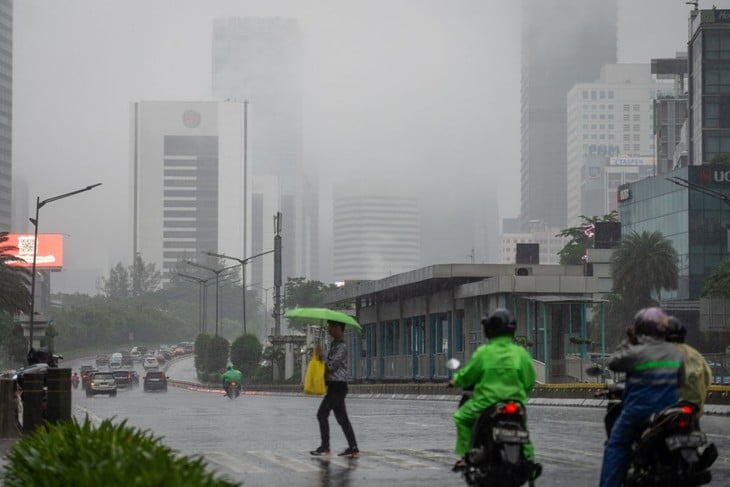
Indonesia's National Research and Innovation Agency has discovered that rainwater in the capital Jakarta contains microplastic particles, warning that they could cause tissue damage and endocrine disruption. - Photo: IANS
Indonesia's National Research and Innovation Agency (BRIN) has reported the detection of dangerous microplastic particles in rainwater in the country's capital, Jakarta. This information was released following a multi-year study based on rainwater samples collected since 2022.
"Microplastics were found in every rainwater sample collected from different areas in Jakarta. They come from synthetic fibers in clothing, vehicle dust and tires, residue from burned plastic, and plastic that has broken down outdoors," said researcher Muhammad Reza Cordova of BRIN.
He also noted that these rainwater samples mainly contained polyester, nylon, polyethylene, polypropylene, and polybutadiene, appearing as synthetic fibers or plastic fragments.
In samples collected from the coastal area of Jakarta, researchers found an average of 15 microplastic particles per square meter per day.
Mr. Cordova explained that microplastics are the result of atmospheric deposition, in which plastic particles suspended in the air enter the water cycle and fall to the ground with rain. This rainwater containing microplastics can contaminate surface water and enter the food chain.
This finding raises concerns about air pollution levels in Jakarta, as plastic particles not only exist in water but can also enter the human body through the respiratory and digestive systems.
Mr. Cordova stated that rainwater itself is not harmful; the concern lies in the microplastic particles in rainwater, which may contain chemical additives or absorb other pollutants. He cited international studies showing that microplastics can cause oxidative stress, hormonal disruption, and tissue damage in humans.
To address this issue, he called for increased inter-sectoral cooperation, including improving plastic waste management systems, expanding recycling facilities, limiting the use of single-use plastics, and installing microfiber filters in washing machines to prevent synthetic fibers from entering the environment.
He also urged the community to reduce plastic use, sort waste at source, and avoid burning plastic waste.
Source: https://tuoitre.vn/phat-hien-vi-nhua-trong-nuoc-mua-canh-bao-hiem-hoa-suc-khoe-nghiem-trong-20251018141206001.htm


![[Photo] Prime Minister Pham Minh Chinh holds a phone call with the CEO of Russia's Rosatom Corporation.](/_next/image?url=https%3A%2F%2Fvphoto.vietnam.vn%2Fthumb%2F1200x675%2Fvietnam%2Fresource%2FIMAGE%2F2025%2F12%2F11%2F1765464552365_dsc-5295-jpg.webp&w=3840&q=75)






































































Comment (0)