

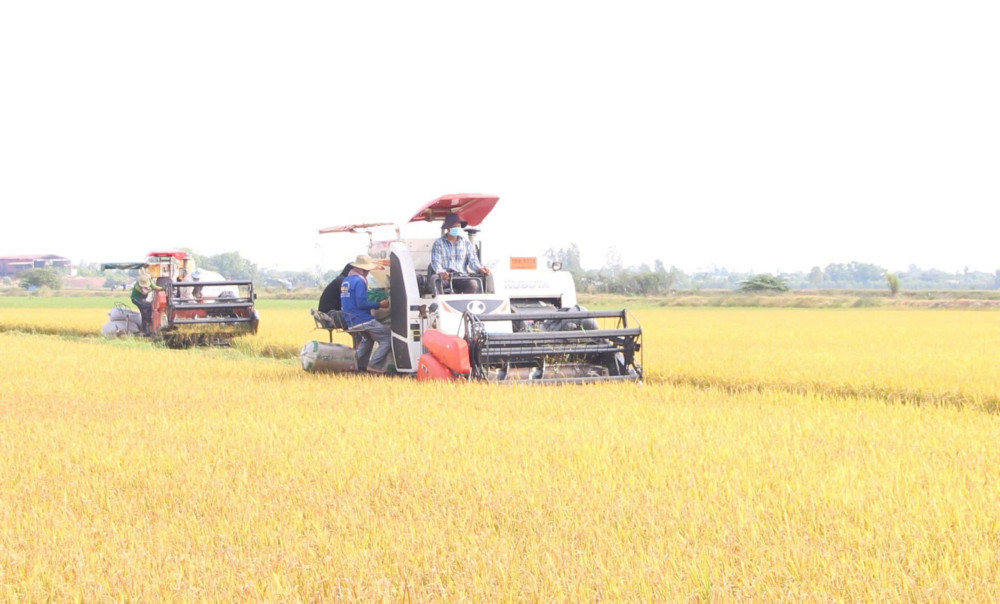
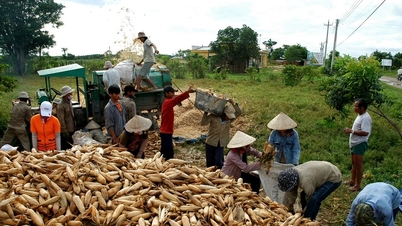
The application of mechanization helps farmers reduce costs and increase the efficiency of rice production.
Many positive results
According to the report of the Department of Agriculture and Environment, the Program for the Development of High-Tech Agriculture associated with the restructuring of the provincial agricultural sector in the 2021-2025 period has achieved and exceeded many important targets. A prime example is rice cultivation, with 63,988 hectares of high-tech rice grown within the project area, reaching 106.6% of the plan for the 2016-2025 period. This is a very commendable achievement, demonstrating the decisive involvement of relevant agencies and the strong shift in mindset of farmers.
Mr. Tran Van Tam, a farmer from Binh Hoa commune, shared: “Previously, we were accustomed to the old way of farming, sowing densely, applying a lot of chemical fertilizers, and spraying pesticides frequently. Since participating in the high-tech rice cultivation model, I have received technical training, used certified seeds, reduced the amount of seeds sown by 20-30 kg/ha, and applied more organic fertilizer. In particular, using drones to spray pesticides and fertilizers has significantly reduced labor costs. As a result, profits have increased by about 15% compared to before.”
These technological advancements not only help farmers save 5-15% on costs and increase profits by 5-20%, but also reduce the use of chemical pesticides, protecting the ecological environment. This is a key factor enabling the province to participate in the Government 's project to cultivate 1 million hectares of high-quality rice and reduce emissions.
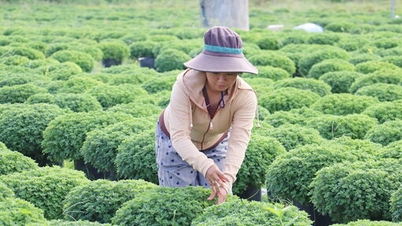
Not only rice, but other crops have also achieved outstanding results. Specifically, the area of vegetable crops using high-tech methods is currently over 2,148 hectares, exceeding the plan by 7.4%. Most farmers in traditional vegetable growing areas have switched to using organic fertilizers combined with biological products, water-saving irrigation systems, and growing in greenhouses and polytunnels. As a result, productivity and product quality are superior, production costs are significantly reduced, and food safety is ensured.

Growing vegetables in greenhouses yields high productivity and ensures food safety.
Despite facing numerous challenges regarding market access and shrinking planting areas, the province still has over 5,840 hectares of dragon fruit grown using high-tech methods, achieving 97.5% of the plan. Many farmers have changed their farming methods, no longer using untreated fertilizers, and instead using organic and microbial fertilizers. The amount of chemical fertilizer has decreased by 10-15%, investment costs have decreased by 10-20%, and profits have increased by 15-25%. Notably, many households have adopted VietGAP standards, contributing to enhancing the brand image of the province's dragon fruit.
Lemon cultivation also exceeded targets, reaching 4,114/3,000 hectares, equivalent to 137%. The seedless lemon cultivation model in localities such as Ben Luc and Duc Hue has proven effective, with initial investment costs reduced by 3-5 million VND/ha and profits increased by 21-50 million VND/ha. Thanks to this, the "Ben Luc Seedless Lemon" brand is gradually establishing its position in the market.
The livestock and aquaculture sectors also achieved outstanding results. The province implemented pilot models of high-tech shrimp farming on an area of 98.84 hectares, reaching 98.84% of the plan. Based on this model, people boldly expanded it to an area of over 1,172 hectares. Many farmers adopted multi-stage farming methods and increased use of biological products to reduce chemical use, protect the environment, and enhance product value.
In beef cattle farming, artificial insemination models, improved feed rations, and waste treatment methods help improve the quality of the herd, shorten the time between calving periods, and increase the value of calves by more than 30%. Some households also apply techniques such as silage and mineral ice production, thereby reducing costs and increasing economic efficiency.
Strategic direction for the new phase
The achievements made in the past period serve as an important foundation for the province to continue implementing the High-Tech Agriculture Program associated with the restructuring of the agricultural sector in 2025 and the coming period. Based on production practices and the requirements of integration, the province's agricultural sector has developed orientations with many specific solutions, closely adhering to actual needs.
For rice cultivation, the province continues to maintain and expand high-tech application models; implementing the Sustainable Development Project for 1 million hectares of high-quality, low-emission rice monoculture linked to green growth in the Mekong Delta region by 2030. This will be an important driving force for the province's rice products to have a firm foothold in demanding markets.
In addition, the province continues to consolidate and maintain over 2,000 hectares of high-tech vegetable cultivation in the lower-lying communes; and supports dragon fruit production according to VietGAP standards in Tam Vu, An Luc Long, Thuan My, and Vinh Cong communes.
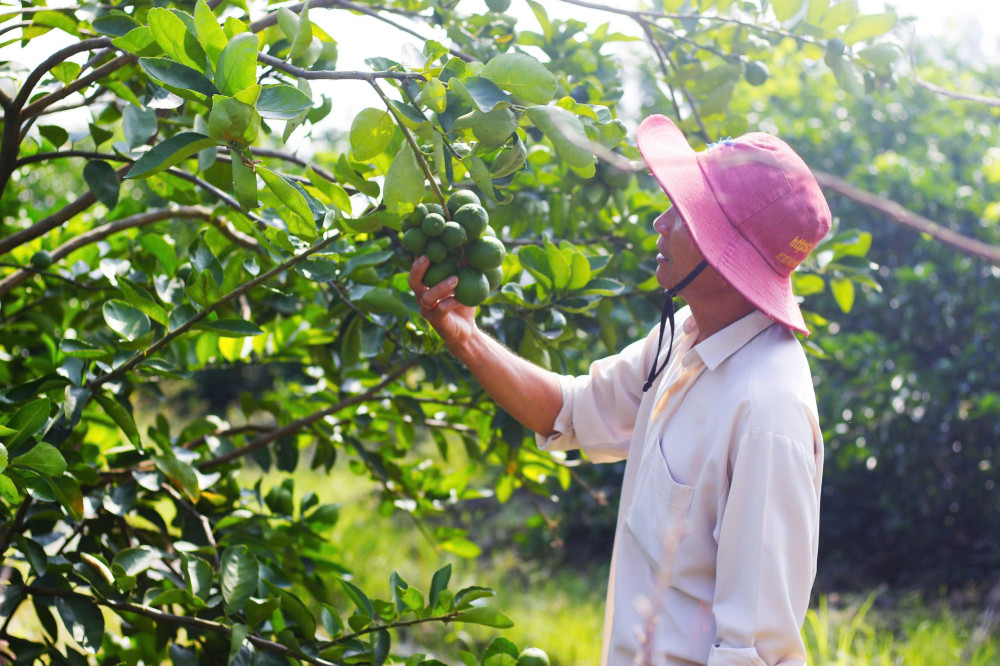
Ben Luc seedless lemons have established their brand and brought stable profits to farmers.
For lemon trees, in addition to maintaining two model orchards for improvement, the province is strengthening the management of the geographical indication "Ben Luc, Long An " for seedless lemons and opening 10 training courses to replicate the model.
Meanwhile, shrimp farming will be expanded to an additional 1.16 hectares using high-tech methods, and five model farms will be established for replication in Tan Tru, Vam Co, and Can Duoc communes.

High-tech shrimp farming reduces risks, increases productivity, and improves economic efficiency.
For beef cattle farming, the province continues to support the conversion of 15 high-quality breeding cows, artificial insemination for more than 1,800 cows in Duc Hue and Tan Tru communes; and provides vaccines and necessary equipment for farmers.
According to Deputy Director of the Department of Agriculture and Environment, Dinh Thi Phuong Khanh: “In addition to key crops and livestock, the province also focuses on supporting cooperatives and businesses in applying high technology and building safe agricultural supply chains linked to traceability. Simultaneously, the province will review and strengthen the operations of agricultural cooperatives, addressing the issue of inactive cooperatives. In particular, digital transformation in agriculture is considered a breakthrough solution, applied to 4 crops and 2 livestock according to the approved plan. The application of digitalization will help manage production data, trace origins, and ensure transparency in the value chain, thereby enhancing the reputation of the province's agricultural products.”
Kieu Anh Dung, Director of Phuoc Hoa Safe Vegetable Cooperative (Long Cang commune), shared: “We expect that with support in technology, technical training, and digital transformation, the cooperative can expand its scale, connect with businesses, and bring our products closer to supermarkets and collective kitchens. This is a long-term path for farmers to get rich from clean agriculture.”
It can be affirmed that, with systematic steps, Tay Ninh is leveraging its advantages and elevating high-tech agriculture, making a significant contribution to the goal of developing green, safe, and sustainable agriculture.
Thanh Tung
Source: https://baolongan.vn/phat-huy-loi-the-nang-tam-nong-nghiep-cong-nghe-cao-a202162.html


![[Image] Vietnam's colorful journey of innovation](/_next/image?url=https%3A%2F%2Fvphoto.vietnam.vn%2Fthumb%2F1200x675%2Fvietnam%2Fresource%2FIMAGE%2F2025%2F12%2F14%2F1765703036409_image-1.jpeg&w=3840&q=75)




















































![[Image] Vietnam's colorful journey of innovation](https://vphoto.vietnam.vn/thumb/402x226/vietnam/resource/IMAGE/2025/12/14/1765703036409_image-1.jpeg)
























Comment (0)