

Identifying bottlenecks in the law is already difficult, but amending it under time pressure and the demands of pressing practical needs is even more challenging. However, in response to urgent demands from daily life, the Government is currently striving to finalize several draft laws in time for submission to the National Assembly for consideration at the 8th session in October 2024. On this occasion, Thoi Dai newspaper had an interview with Deputy Prime Minister and Minister of Finance Ho Duc Phoc on this matter.
-Sir, what are the reasons behind the urgent need to amend certain economic laws?
As we all know, economic activity is governed by a number of laws, among which there are specific areas that are directly regulated by law at each stage, process, and aspect of work related to all parties involved. Generally, having laws is good; however, this concept of "good" only exists when the laws are truly appropriate to the dynamics of life. Conversely, if there is a gap between the law and practice, and it does not meet the requirements in different contexts, it will only create obstacles and have undesirable impacts on certain sectors of the economy.
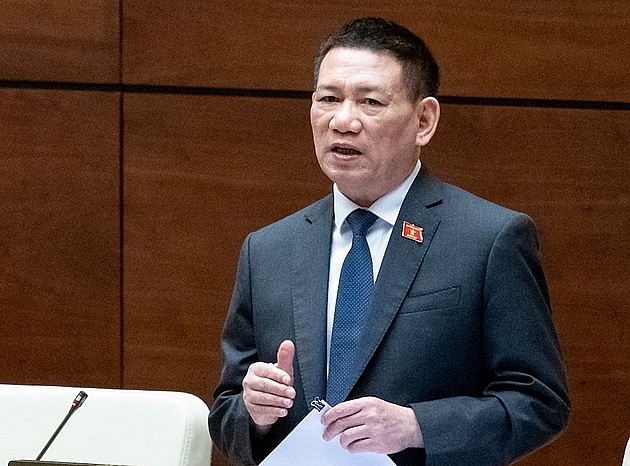 |
| Deputy Prime Minister Ho Duc Phoc believes that once bottlenecks in the law are removed, conditions will be created to unleash resources to promote sustainable economic development. |
Given the specific challenges of the current situation and feedback from practical management, some areas require adjustments to relevant laws. Otherwise, bottlenecks will create obstacles to investment activities in particular, and consequently affect the economy and society in general. Therefore, to promote development and achieve breakthroughs in this period, these bottlenecks must be removed.
Which laws will the government focus on, sir?
-First, regarding the Law on Public Investment. This revision of the Law on Public Investment will include the following specific reforms: Firstly, Group A projects will be assigned to the Minister and the Chairman of the Provincial People's Committee. Secondly, the land compensation and resettlement portion of all types of projects will be separated into an independent project. Thirdly, it will allow the use of recurrent expenditure funds to prepare and adjust project plans. Fourthly, the medium-term public investment plan will balance the fiscal year for the entire term, while the management of the budget and finances within the year, if there are other sources for recurrent expenditure, will follow the current procedures. If the funds are used for investment, a project, budget estimate, and bidding process must be established. Furthermore, decentralization will be strengthened, and with Official Development Assistance (ODA) funds, disbursement will be made as long as there is money and work completed, not according to the limits in the plan.
-That's the case with the Law on Public Investment, but what about other sectors, sir?
-With the State Budget Law, the first important adjustment is the use of budget funds from one level to fund another. Secondly, if a central government project runs through a locality, the locality can use its own budget to carry out the task. Thirdly, it allows the use of recurrent expenditures for the repair, upgrading, and construction of necessary projects. Fourthly, it decentralizes the management of aid and grant funds for targeted investment and development investment. Fifthly, localities can use local budgets or foreign aid to support border units. Another aspect is that budget levels can support businesses, organizations, and individuals through off-budget financial funds, for example, supporting businesses affected by the global minimum tax, or supplementing charter capital for state-owned enterprises…
-Sir, there have been many conflicting assessments recently regarding the effectiveness of the bidding process. So, will there be any amendments to the Bidding Law this time?
-Yes, the same applies to the Bidding Law. This revision will aim to increase the level of direct contracting, strengthen decentralization, minimize administrative procedures, and promote online bidding to enhance transparency…
-Sir, a major concern now is whether, given such a short timeframe, the quality of the draft laws can be guaranteed when they are presented to the National Assembly at the October session?
-It's true that time is limited, but that's precisely why the quality of the draft laws must be prepared to the highest possible standard. We must be open to listening to feedback and suggestions in order to leverage the wisdom of the community and relevant agencies. Along with that, we must ensure strict adherence to the law-making process, clearly define the timeline for submitting draft laws, and ensure they meet the requirements of the National Assembly and the Government.
The overarching goal here is to amend the law to promptly and accurately address obstacles, thereby freeing up resources to achieve high growth targets, solve employment problems, increase budget revenue, and thus build a foundation to ensure sustainable economic development.
Thank you very much, sir!
Source: https://thoidai.com.vn/pho-thu-tuong-ho-duc-phoc-phai-sua-luat-de-thao-go-nhung-vuong-mac-204435.html













































































![[Infographic] Many activities at the 96th anniversary commemoration of the death of Deputy Scholar Nguyen Sinh Sac](https://vphoto.vietnam.vn/thumb/402x226/vietnam/resource/IMAGE/2025/12/11/1765441454787_infographic-nhieu-hoat-dong-tai-le-gio-lan-thu-96-cua-cu-pho-bang-nguyen-sinh-sac20251211010322.webp)















Comment (0)