

(NLĐO) - Scientists have successfully recreated the 6.3-meter-long beast from fragmented fossilized skeletons unearthed in Coahuila state, Mexico.
A study led by Dr. Héctor Rivera-Sylva from the Desert Museum (Mexico) and Dr. Nicholas Longrich from the University of Bath (UK) has identified a new species of beast that roamed North America 72.5 million years ago.
Previously, a portion of this creature's skeleton had been found in rocks belonging to the Campanian Formation in the state of Coahuila, Mexico.
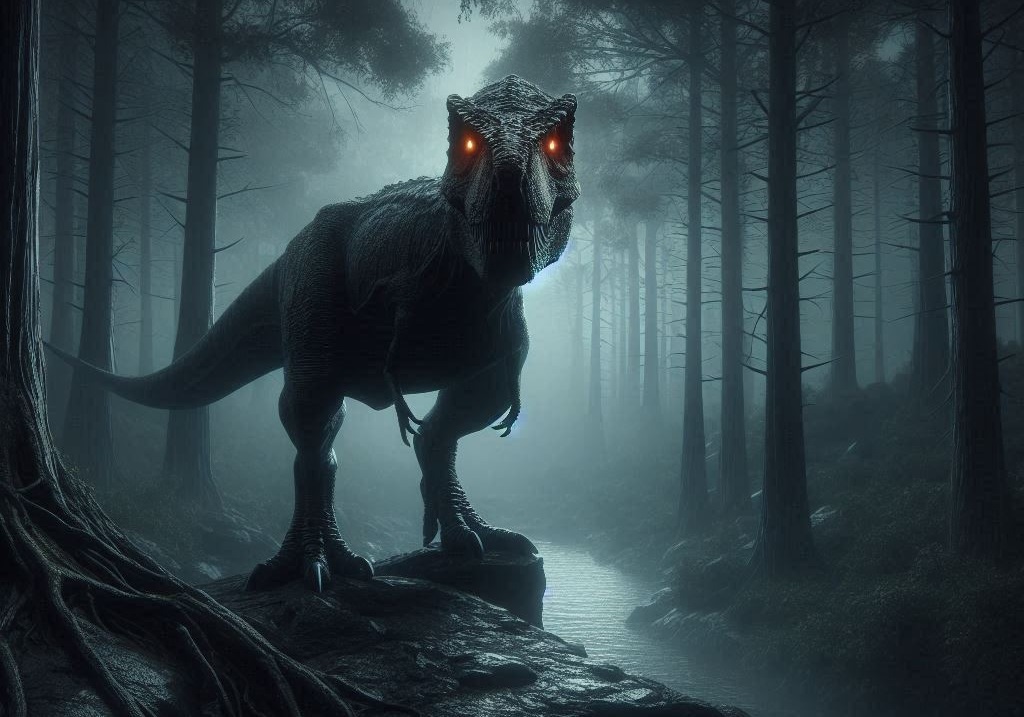
A monster skeleton in Mexico has revealed a previously unknown "meat grinder" - AI illustration: ANH THU
The Campanian is a geological stratum near the end of the Late Cretaceous period, also the period of the dinosaur boom.
Named Labocania aguillonae, this beast was an ancient predator with the characteristic physique of a theropod dinosaur and was a relative of the Tyrannosaurus Rex.
According to a paper published in the scientific journal Fossil Studies, this beast was approximately 6.3 meters long when alive, which is relatively smaller than the T-rex.
Some anatomical features helped scientists identify this beast as a previously unrecorded species. However, other features indicated it was a close relative of several Tyrannosaurus species in the region, such as Labocania anomala, Bistahieversor sealeyi, and Teratophoneus curriei.
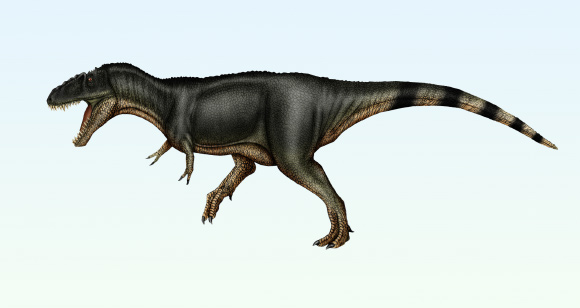
A portrait of the new monster species recreated by the research team - Graphic image: Karkemish
This skeleton helped demonstrate that in what is now Mexico, the Tyrannosaurus Rex family dominated the food chain by evolving into numerous distinct species and subspecies.
This new discovery has led scientists to believe even more undiscovered species of Tyrannosaurus Rex may exist in the southern regions of North America.
Furthermore, this helps demonstrate just how rapidly this fearsome dinosaur family evolved during the late Cretaceous period.
Between approximately 100 and 89 million years ago, Tyrannosaurus Rex dinosaurs were relatively small, unspecialized, and not very diverse.
However, by the Campanian stage—beginning 83 million years ago—they had undergone a major process of decay, diversification, and the creation of larger, more specialized forms.
Perhaps this group of dinosaurs would have been even more formidable if it weren't for the Chicxulub asteroid catastrophe 66 million years ago, which abruptly ended the age of dinosaurs just as they were at the peak of their evolution.
Source: https://nld.com.vn/quai-thu-may-nghien-725trieu-tuoi-la-loai-chua-tung-biet-196240928092631555.htm




![[Photo] Closing Ceremony of the 10th Session of the 15th National Assembly](/_next/image?url=https%3A%2F%2Fvphoto.vietnam.vn%2Fthumb%2F1200x675%2Fvietnam%2Fresource%2FIMAGE%2F2025%2F12%2F11%2F1765448959967_image-1437-jpg.webp&w=3840&q=75)











































![[OFFICIAL] MISA GROUP ANNOUNCES ITS PIONEERING BRAND POSITIONING IN BUILDING AGENTIC AI FOR BUSINESSES, HOUSEHOLDS, AND THE GOVERNMENT](https://vphoto.vietnam.vn/thumb/402x226/vietnam/resource/IMAGE/2025/12/11/1765444754256_agentic-ai_postfb-scaled.png)
















































Comment (0)