

The International Monetary Fund (IMF) warns that Asian economies will face numerous risks amid trade tensions and slowing growth in China.
The International Monetary Fund (IMF) said that risks to the Asian economy have increased due to escalating trade tensions, difficulties in China's real estate sector, and the potential for further market volatility.
According to the IMF, prolonged downward price pressure in China could strain trade relations due to its impact on industries with similar export structures in neighboring countries. The IMF also urged Beijing to implement measures to revive the economy based on increased consumer demand.
The IMF stated in its Asia economic outlook report that: "A longer-than-expected slowdown in China would harm both the region and the global economy ."
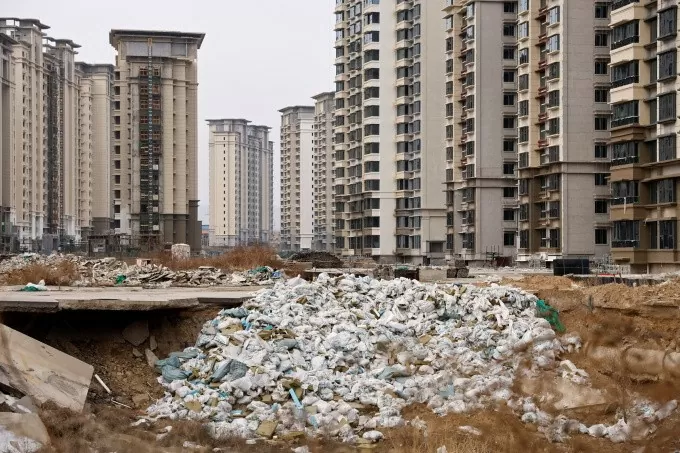 |
| An unfinished apartment project by China Evergrande Group in Hebei province, China. Photo: Reuters |
" China's policy response is crucial in this context ," the IMF said, while calling for measures to support the adjustment of the real estate sector and boost private consumption.
In its latest forecast, the IMF projects Asian economies to grow by 4.6% in 2024 and 4.4% in 2025, with loose monetary policy globally expected to boost private demand next year.
The IMF's forecasts for 2024 and 2025 have both been revised upwards by 0.1 percentage points compared to the forecasts made in April, but are still lower than the 5.0% growth rate of 2023.
The IMF stated that risks could negatively impact the economy because monetary tightening measures and geopolitical tensions could reduce global demand, increase trade costs, and cause market volatility.
According to the IMF, “a serious risk is the escalation of retaliatory tariff measures between major trading partners,” which would exacerbate trade fragmentation and harm growth in the region.
Although low growth, high debt, and escalating war were official issues on the agenda at last week's annual meetings of the International Monetary Fund and the World Bank, financial leaders paid close attention to the potential impact of Donald Trump's return to power in the US presidential election on November 5th.
Analysts say Trump has pledged to impose a 10% tariff on imports from all countries and a 60% tariff on imports from China, which would significantly impact supply chains worldwide.
Krishna Srinivasan, Director of the IMF's Asia-Pacific Department, stated at a recent press conference that: " Tariffs, non-tariff barriers, and domestic content requirements are not the right solutions, as they distort the flow of trade and investment and undermine the multilateral trading system ."
He said, " Ultimately, such measures will lead to consumers and investors paying higher prices ."
The IMF said that recent market volatility could be a harbinger of future instability, as investors adjust prices based on expectations that the US Federal Reserve will implement larger interest rate cuts and the Bank of Japan will gradually implement interest rate hikes.
The report stated: “Sudden shifts in expectations regarding these policies could trigger sharp adjustments in exchange rates, with ripple effects across other segments of the financial market .”
The IMF projects that the Chinese economy will grow by 4.8% in 2024, up 0.2 percentage points from its April forecast, but still slower than last year's 5.2%. Growth is expected to slow further, reaching 4.5% in 2025, according to the IMF.
Source: https://congthuong.vn/quy-tien-te-quoc-te-imf-canh-bao-rui-ro-doi-voi-nen-kinh-te-chau-a-se-gia-tang-356565.html
















































































Comment (0)