

Faced with the impacts of climate change, shifting consumer trends, and a focus on exports, the agricultural sector has innovated its thinking and methods of organizing rice production in a sustainable direction to ensure food security and increase farmers' income.
The area where drones are used for spraying pesticides is expanding, thereby reducing greenhouse gas emissions.
As a riverside commune in Kien Xuong district with over 3km of alluvial plain along the Tra Ly River, Tra Giang commune has planned nearly 60 hectares of land for organic rice cultivation combined with the exploitation of mudworms to build a rice brand and increase the value per unit area.
Mr. Bui Huu Tuong, Vice Chairman of the Commune People's Committee, said: "Cultivating rice on land used for harvesting mudworms doubles production efficiency, not only increasing mudworm yields but also creating a clean environment for the alluvial land and producing clean rice, building a strong brand, and certainly improving economic efficiency."
In recent years, sustainable agricultural development has been a priority for the province, setting directions and implementing appropriate solutions to achieve the overall goals in the plan for restructuring the agricultural sector of Thai Binh province for the period 2021-2025, as stipulated in Decision No. 2840/QD-UBND dated November 18, 2021, of the Provincial People's Committee. As the province with the second largest rice cultivation area in the Red River Delta region, at 140,000 hectares per year, Thai Binh has consistently been at the forefront of applying scientific and technological advancements. Rice yields have consistently exceeded 130 quintals/hectare/year in recent years, with an estimated annual output of approximately 1 million tons, contributing to national food security and meeting both domestic consumption and export demands. The concentration of land for large-scale rice production along the value chain has been a focus of many organizations and individuals, contributing to increased value in rice production. Rice production in the province has undergone significant changes in recent years due to a shift in the variety structure. High-quality rice varieties are gradually expanding, accounting for over 40% of the total rice varieties. This direction helps improve production efficiency, meet diverse consumer demands, and contribute to the formation of many high-quality rice production areas.
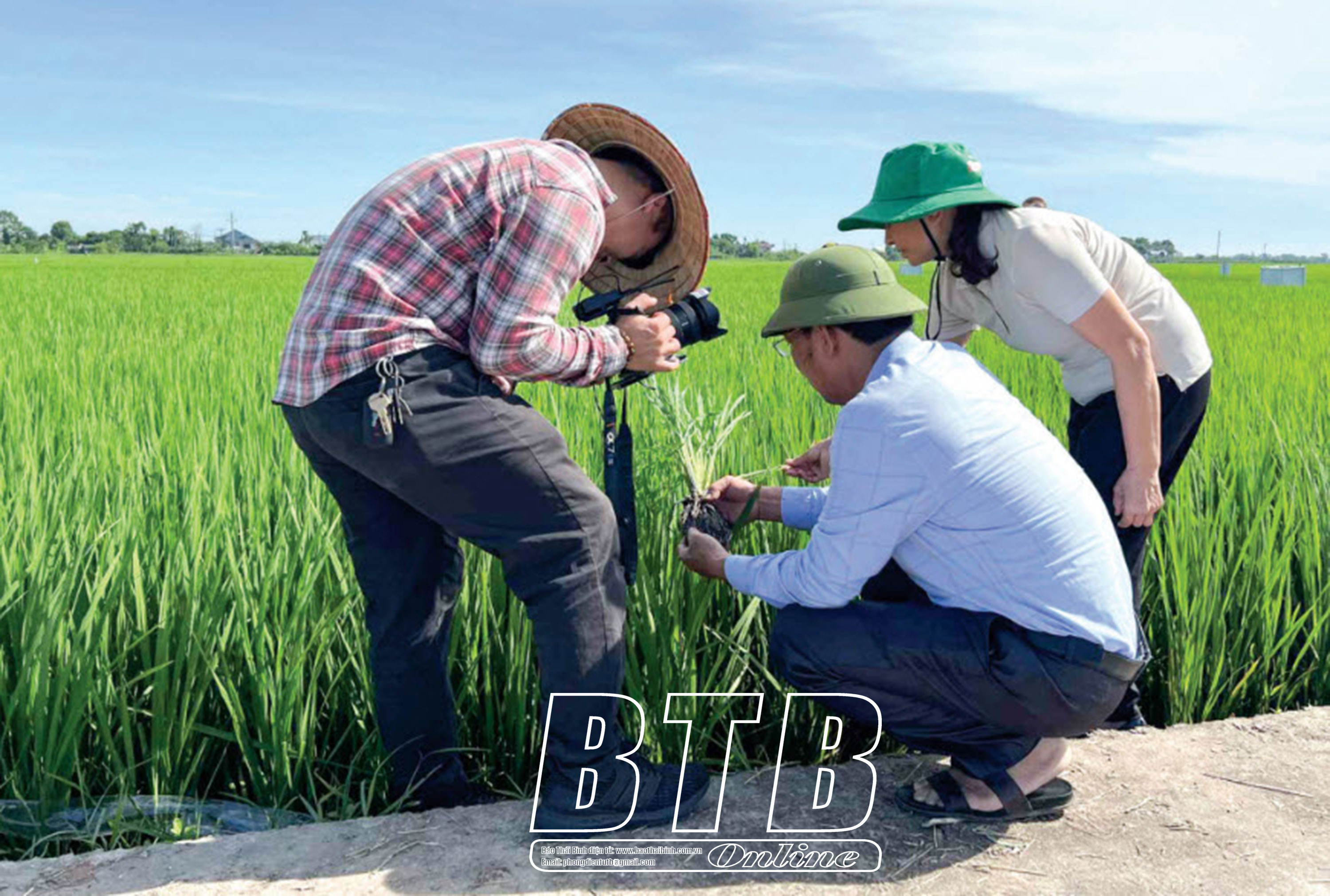
In the 2024 crop season, Phu Luong commune (Dong Hung district) participated in a model to enhance smart rice production with a climate-oriented approach, aiming for sustainable rice production and regional food security through the application of nuclear technology.
Recognizing that a low-carbon economy is a new direction and an opportunity to enhance the competitiveness of the agricultural sector in the global sustainable agricultural value chain, many localities in the province have focused on implementing and developing models that apply science and technology, and technical processes for fuel-efficient agricultural machinery operation, limiting the use of chemical fertilizers and pesticides, reducing greenhouse gas emissions, and protecting the environment.
Phu Luong commune (Dong Hung district) is a leading locality in applying advanced techniques to rice production such as: SRI (System of Rice Intensification), wide-row and narrow-row planting, and greenhouse gas emission reduction. Recently, in the spring of 2024, the locality participated in a pilot model of alternating wet and dry rice cultivation, calibrated and validated a satellite image interpretation model to determine water levels in rice fields for calculating and inventorying greenhouse gases, aiming towards carbon credit trading, on a scale of over 60 hectares with 800 participating farmers. In the autumn crop, the cooperative continued to participate in the model "Demonstration of enhanced climate-smart rice production towards sustainable rice production and regional food security, through the application of nuclear techniques" implemented by the Institute of Agricultural Environment.
Mr. Nguyen Trong Thanh, Director of the Phu Luong Commune Agricultural Production and Service Cooperative, said: Besides economic benefits, participating in projects and models has helped farmers receive training, significantly raising their awareness and encouraging them to "say no" to plastic waste in the fields, while also producing more responsibly towards the environment and the market.
With the goal of minimizing the harm caused by the overuse of chemicals, especially pesticides, to public health, the environment, and food safety, more and more models are using biological preparations to treat rice straw, using fertilizers containing effective microorganisms, multi-element NPK fertilizers, and supporting substances... in the direction of integrated intensive farming, sustainable rice production, and not using single nitrogen fertilizers for rice.
Ms. Nguyen Thi Nga, Deputy Director of the Department of Agriculture and Rural Development, said: Thai Binh is proud to be the first locality where 100% of cooperatives were guided to apply integrated pest management (IPM) since the 2000s. The province has adopted a "farm-open-drying" approach to managing water levels suitable for each growth stage of the rice plant. This approach has become a guiding principle throughout many years.
To leverage advantages and aim for sustainable and efficient development of the rice industry, and to increase income for rice farmers in the new context, in the coming time, the Department of Agriculture and Rural Development will continue to pilot rice production models in the direction of circular, sustainable, multi-layered ecological agriculture and apply high technology and digital technology to rice production for areas cultivating specialty rice varieties, high-quality rice, and export rice.
Ngan Huyen
Source: https://baothaibinh.com.vn/tin-tuc/4/207029/san-xuat-lua-gao-theo-huong-ben-vung













![[Photo] Prime Minister Pham Minh Chinh holds a phone call with the CEO of Russia's Rosatom Corporation.](/_next/image?url=https%3A%2F%2Fvphoto.vietnam.vn%2Fthumb%2F1200x675%2Fvietnam%2Fresource%2FIMAGE%2F2025%2F12%2F11%2F1765464552365_dsc-5295-jpg.webp&w=3840&q=75)













































Comment (0)