

Since the beginning of 2024, Hanoi's real estate market has been experiencing a continuous boom across most segments, constantly setting new price benchmarks. This "boom" is not limited to the central area; even suburban districts and counties are seeing significant increases. Land auctions in these suburban districts are consistently setting new records for winning bids, driving up land prices in surrounding areas.
Mr. Le Dinh Chung, General Director of SGO Homes Investment and Real Estate Development Joint Stock Company, believes that while Hanoi's real estate prices are rising, investment demand will not increase significantly in the near future.
Currently, customers with 5-10 billion VND in hand have almost no opportunity to invest in the Hanoi market.
According to his observations, from May onwards, the trend is for money to flow into provinces surrounding Hanoi such as Bac Ninh, Bac Giang , Hung Yen, Hai Duong... Regarding the provincial market, Mr. Chung believes that land prices will recover because, ultimately, this still falls within the general market's preference.
With the shift towards suburban areas, the supply of real estate in these regions will become more diverse, ranging from land plots and apartments to townhouses and villas. This gives investors more choices and caters to the diverse needs of the market.
Despite the shift in investment, real estate prices in suburban areas are expected to rise but remain at reasonable levels compared to central areas. This stability will attract more investors.
" The shift of investment to suburban areas in the second half of 2024 is an inevitable trend due to factors such as prices, legal regulations and infrastructure development. Suburban areas have the potential for more sustainable development thanks to synchronous planning and infrastructure development. This not only helps increase real estate value but also improves the quality of life of residents, " Mr. Chung shared.
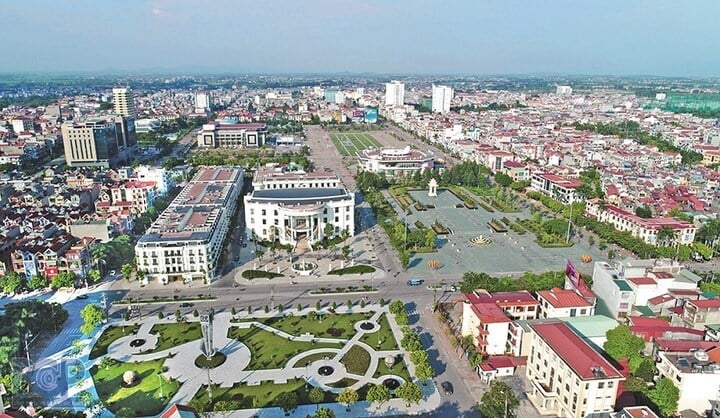
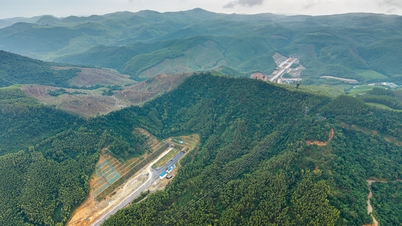
Real estate in the provinces is predicted to attract investment capital. (Illustrative image).
Sharing the same view, Mr. Le Xuan Nga, General Director of BHS Real Estate Company, also said that recently, real estate prices in Hanoi have increased too strongly because the cash flow is too concentrated in the inner city, not flowing out.
According to Mr. Nga, the real estate market in Hanoi will be fiercely competitive, targeting only large investors with budgets of 15 billion VND or more. Investors with smaller budgets will seek to relocate to other provinces and regions sooner rather than later. Therefore, sooner or later, capital will flow out of Hanoi, possibly by the end of 2024 or early 2025. This is similar to what has happened in previous real estate cycles.
Mr. Nga also recognized that the shift in capital flow would help real estate projects in other localities to be constructed and completed, creating infrastructure for new areas, thereby helping the local economy develop.
Mr. Nguyen Quang Huy - CEO of the Finance and Banking Faculty at Nguyen Trai University (NTU) also believes that the escalating real estate prices in Hanoi have caused many investors and buyers to shift their focus to seeking opportunities in neighboring provinces such as Ha Nam, Ninh Binh, Bac Ninh, Bac Giang, Hung Yen, Hai Duong, Hai Phong, Thai Nguyen, and Vinh Phuc.
These areas are experiencing strong growth in industry, services, and tourism, along with a comprehensively and modernly developed transportation infrastructure. With reasonable prices, these neighboring provinces not only attract investors but also provide opportunities for residents to settle down and work locally, instead of facing the high cost of living in Hanoi.
This also contributes to the formation of satellite cities, creating a new trend in living and working: People are no longer overly dependent on Hanoi, but can settle down and build careers in places with comparable living conditions and career development potential.
However, according to Mr. Huy, despite its potential, investors should carefully research the local infrastructure, planning, and legal aspects when investing in this area. Synchronized infrastructure and stable planning will help ensure sustainable growth in real estate value.
In addition, avoid speculating in areas showing signs of excessively rapid price increases. This will not only help minimize liquidity risks but also ensure financial security.
Investors also need to choose the right time to invest, avoiding unpredictable market fluctuations.
" It's advisable to choose projects with transparent legal procedures, reputable developers, and complete infrastructure and amenities such as parks, shopping centers, healthcare facilities, and educational institutions. These will be crucial factors in enhancing profit potential and long-term residential value. If using borrowed capital, ensure the loan-to-income ratio does not exceed 50% of income to avoid financial pressure and risks in case of economic fluctuations ," Mr. Huy advised.
Source
![[Photo] Prime Minister Pham Minh Chinh holds a phone call with the CEO of Russia's Rosatom Corporation.](/_next/image?url=https%3A%2F%2Fvphoto.vietnam.vn%2Fthumb%2F1200x675%2Fvietnam%2Fresource%2FIMAGE%2F2025%2F12%2F11%2F1765464552365_dsc-5295-jpg.webp&w=3840&q=75)
![[Photo] Closing Ceremony of the 10th Session of the 15th National Assembly](/_next/image?url=https%3A%2F%2Fvphoto.vietnam.vn%2Fthumb%2F1200x675%2Fvietnam%2Fresource%2FIMAGE%2F2025%2F12%2F11%2F1765448959967_image-1437-jpg.webp&w=3840&q=75)
















































![[OFFICIAL] MISA GROUP ANNOUNCES ITS PIONEERING BRAND POSITIONING IN BUILDING AGENTIC AI FOR BUSINESSES, HOUSEHOLDS, AND THE GOVERNMENT](https://vphoto.vietnam.vn/thumb/402x226/vietnam/resource/IMAGE/2025/12/11/1765444754256_agentic-ai_postfb-scaled.png)









































Comment (0)