

Over the years, solid waste management in general, and household solid waste management in particular, has received attention from all levels of government in the province. To date, the province has built 8 solid waste landfills and 3 centralized incinerators; and the means and equipment for collecting, transporting, and processing solid waste have been invested in and upgraded. As a result, the rate of household solid waste collection has increased significantly, reaching approximately 98% in urban areas and about 77.3% in rural areas.
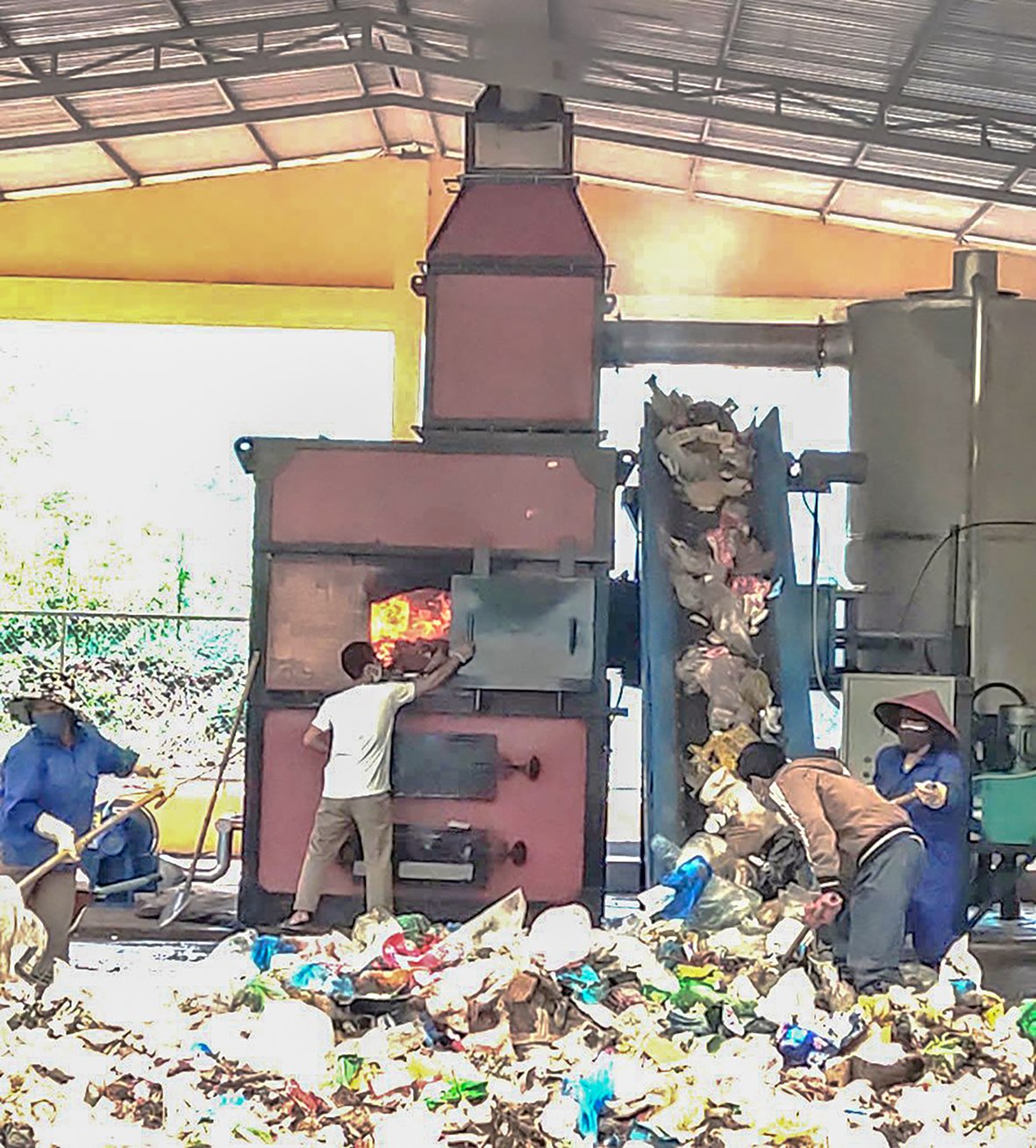
Centralized solid waste incinerator in Ta Rut commune, Dakrong district - Photo: TN
However, according to current statistics, the province generates approximately 345 tons of household waste per day, and this amount is expected to increase in the coming years. The processing capacity of existing landfills cannot meet the demand for household solid waste treatment.
The construction of landfills requires a large amount of land and faces difficulties in raising the necessary capital for their construction.
According to Plan No. 530/KH-UBND dated February 11, 2019, of the Provincial People's Committee on implementing the national strategy on integrated solid waste management until 2025, with a vision to 2050, the goal is that by 2025, 85% of remaining urban areas will have solid waste recycling facilities suitable for household sorting, and the percentage of household solid waste treated by direct landfilling will be below 30% of the total collected waste.
Over the years, the Department of Natural Resources and Environment has implemented pilot models for sorting and processing household waste at source in rural areas for 840 households in the communes of Hai Hung (Hai Lang), Trieu Hoa (Trieu Phong), Hai Thai (Gio Linh), Vinh Thai (Vinh Linh), and Trieu Nguyen (Dakrong).
Based on the pilot model, several localities in Hai Lang and Cam Lo districts have also expanded the implementation throughout their areas, initially recording an annual rate of over 11% of waste being sorted at source in these localities.
Given the current situation where the infrastructure for waste sorting at source, collection, and centralized processing is not yet fully developed, the implementation of pilot models has brought practical benefits to rural areas.
These models have raised people's awareness of environmental protection, sorting, collecting, and processing household waste; reduced the amount of waste transported to centralized landfills, reduced collection and transportation costs; and contributed to fulfilling the environmental criteria in building new rural areas.
Sorting waste at source is considered a sustainable waste management and environmental protection solution. Good sorting will significantly reduce the amount of organic waste in household waste (estimated at around 50-70%) that ends up in landfills, equivalent to a 50% reduction in collection and processing costs.
To achieve this, the active participation of households in implementing the household waste sorting model plays a crucial role in replicating the model in residential areas.
To achieve the objectives set forth in Prime Minister 's Directive No. 41/CT-TTg dated December 1, 2020, on some urgent solutions in strengthening solid waste management, the 2020 Environmental Protection Law, and related regulations, a great effort is needed from functional agencies, local authorities, and the people.
To address pressing issues regarding current and future waste management, given the local context and the difficulties in investing in waste treatment and technology for transitioning from landfill to advanced treatment technologies, it is necessary to create mechanisms and conditions for social mobilization and investment in waste treatment. Furthermore, a roadmap for implementing waste sorting for each type of solid waste should be established, ensuring the principle of "the polluter pays," gradually building environmental awareness, and reducing waste disposal among citizens and businesses.
Integrated solid waste management involves managing the entire waste lifecycle from generation to final treatment, including prevention, reduction, sorting, collection, recycling, and final treatment, with the aim of protecting human health, protecting the environment, conserving resources, adapting to climate change, and moving towards sustainable development.
The requirement is that household solid waste must be managed and sorted at the source to minimize the amount of solid waste generated at centralized treatment facilities. The sorting of household solid waste at the source must be linked to models for collecting, processing, recycling, and reusing the components of sorted solid waste.
Investment in the collection, transportation, recycling, and treatment of household solid waste must be carried out using advanced, modern, environmentally friendly technologies that are suitable to the local conditions, minimizing the amount of household solid waste that needs to be landfilled, and moving towards circular development.
Therefore, on January 25, 2024, the People's Committee of Quang Tri province issued a plan for sorting household solid waste at source in the province until 2025, with a vision to 2030. This is an important solution to promote waste sorting at source in general, solid waste treatment at households in particular, and strengthen environmental protection management in Quang Tri province.
Tan Nguyen
Source: https://baoquangtri.vn/tang-cuong-phan-loai-chat-thai-ran-tai-nguon-189147.htm


![[Photo] Explore the US Navy's USS Robert Smalls warship](/_next/image?url=https%3A%2F%2Fvphoto.vietnam.vn%2Fthumb%2F1200x675%2Fvietnam%2Fresource%2FIMAGE%2F2025%2F12%2F10%2F1765341533272_11212121-8303-jpg.webp&w=3840&q=75)
![[Photo] The captivating scenery of the fragrant maple forest in Quang Tri](/_next/image?url=https%3A%2F%2Fvphoto.vietnam.vn%2Fthumb%2F1200x675%2Fvietnam%2Fresource%2FIMAGE%2F2025%2F12%2F10%2F1765353233198_lan09046-jpg.webp&w=3840&q=75)




















![[Video] The craft of making Dong Ho folk paintings has been inscribed by UNESCO on the List of Crafts in Need of Urgent Safeguarding.](https://vphoto.vietnam.vn/thumb/402x226/vietnam/resource/IMAGE/2025/12/10/1765350246533_tranh-dong-ho-734-jpg.webp)




























































Comment (0)