

During the beginning of the new school year 2025 - 2026, digital transformation in education has become an urgent requirement, including the application of artificial intelligence (AI) in schools. However, according to experts, the implementation of AI at each level of education and level of use needs a clear roadmap and specific program.
Misconceptions about AI
AI can be applied in schools, even in kindergartens and nurseries. However, applying AI does not mean forcing students to learn AI early, even in elementary school. Two concepts that need to be clearly distinguished are: "learning AI" and "getting acquainted with AI".
Educators believe that primary school is the golden time for children to train their brains and develop skills related to thinking. That is the consistent goal of primary school programs, planned and maintained for many years. The good thing for the present and the future is not to let AI dominate or affect the process of perfecting children's brains at this stage. During this stage, AI is applied to support children, helping to promote the process of perfecting and developing brain functions more effectively.
As AI becomes more and more embedded in life, experts recommend integrating AI into IT and STEM lessons, helping children become familiar with the concept of AI and know how to use basic AI applications in daily life. Electronic devices in the home are increasingly integrated with AI and children need to know how to "command" and interact to use them effectively. For example, holding the TV remote, pressing the microphone button and asking to find a song on YouTube - that is also a form of AI application in daily life.
When asked "At what age should students be taught AI?", AI Gemini replied that the appropriate age for children to approach AI applications is 12 years and older. Before delving into AI, children should be trained in basic skills such as logical thinking and problem solving. At the same time, AI training needs to be combined with an educational program on technology ethics.
Google is very clear: Users aged 13 and over (or depending on the age set by the state in each country) are allowed to log in and use Gemini applications. Later, Google allowed children under 13 to access some Gemini features through their parents' Family Link accounts, which means they must have parental permission and supervision. Even if they want to use a Google account issued by their school, the user must be 13 years old (or according to the age set by each country) and the school administrator must activate this service.
Hour of Code Vietnam, a programming training unit for children in Vietnam known for Scratch programming, has proposed an AI approach roadmap for children. Accordingly, from 7 to 8 years old: children can start to get acquainted with simple AI concepts through games and interactive activities. From 9 to 12 years old: children can start to learn visual programming languages to build simple AI projects. From 13 years old and up: children can start to learn more complex programming languages such as Python and take in-depth AI courses.
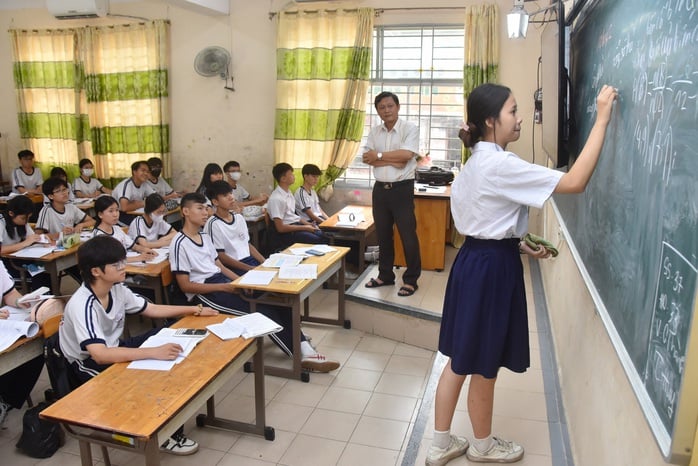
Applying AI in education will significantly change the way of teaching and learning. Photo: TAN THANH
Increased monitoring
Mr. Nguyen Minh Hai, editor at VNPT AI, shared: "AI helps create personalized learning paths, provide virtual tutors, analyze learning data to optimize content and support disabled students to better integrate. Over the years, AI applications have significantly changed the way of teaching and learning globally, making lectures more vivid, automating basic tasks and personalizing content to suit each student. Thanks to that, lessons become more interesting and effective for both teachers and students."
According to a report by market intelligence firm Mordor Intelligence, educational institutions now see AI as the fastest way to personalize learning, reduce administrative costs, and expand access to underserved learners. Meg Harms, a STEM educator at Brownell Talbot School in Nebraska, offers three warnings when applying AI in schools. First, the bias of AI applications. Each AI application reflects the developer's own views and biases. Teachers need to check and edit content, especially on topics with potentially biased data.
Second, concerns about privacy and personal information. Educators need to be careful with the information and data that families entrust. Third, the misuse of AI by students. Students' use of ChatGPT or other AI tools can negatively impact their learning outcomes if not properly monitored.
According to Microsoft research, the majority of students use AI to support their learning. About 54% of students use AI once a week, for tasks such as answering questions, checking grammar, summarizing documents or drafting assignments. This is a concern for school administrators, because students use AI without guidance and safety limits.
AI is a compulsory subject
China requires primary school students to study 8 hours of AI every year as part of a $3.3 billion national strategy. The United Arab Emirates (UAE) has introduced AI into its curriculum from kindergarten, with a specialized teacher training program. In the UAE, AI is applied from kindergarten and teachers are properly trained. From the 2025-2026 school year, AI will become a compulsory subject in all public schools in the UAE.
Source: https://nld.com.vn/than-trong-khi-dua-ai-vao-truong-hoc-196251011190621266.htm


![[Photo] 60th Anniversary of the Founding of the Vietnam Association of Photographic Artists](/_next/image?url=https%3A%2F%2Fvphoto.vietnam.vn%2Fthumb%2F1200x675%2Fvietnam%2Fresource%2FIMAGE%2F2025%2F12%2F05%2F1764935864512_a1-bnd-0841-9740-jpg.webp&w=3840&q=75)


![[Photo] National Assembly Chairman Tran Thanh Man attends the VinFuture 2025 Award Ceremony](/_next/image?url=https%3A%2F%2Fvphoto.vietnam.vn%2Fthumb%2F1200x675%2Fvietnam%2Fresource%2FIMAGE%2F2025%2F12%2F05%2F1764951162416_2628509768338816493-6995-jpg.webp&w=3840&q=75)




















































































Comment (0)