

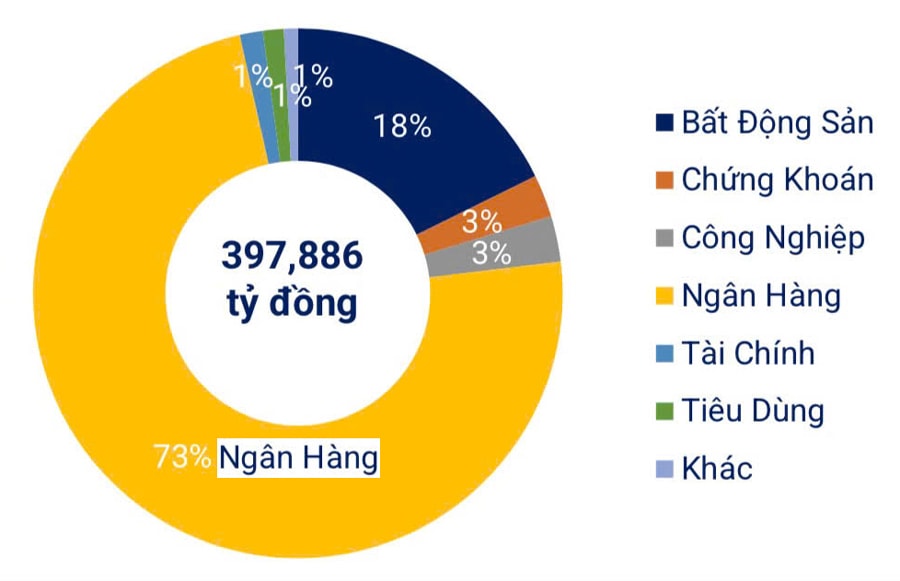
Accordingly, in the first nine months of 2025, the volume of bank bonds issued increased sharply, accounting for 73% of the total volume of corporate bonds.

The banking group issued 313.2 trillion VND.
According to the Vietnam Bond Market Association, in the first nine months of 2025, the total value of corporate bond issuances (including both private and public offerings) reached approximately VND 430.8 trillion, a 35% increase compared to the same period last year. Of this, the banking sector dominated with VND 313.2 trillion, equivalent to 73% of the total issuance, a 38% increase year-on-year.
In the third quarter alone, the market saw 155 corporate bond issuances, including 154 domestic issuances with a total value of VND 156,100 billion, and one international issuance by Vietnam Prosperity Commercial Bank ( VPBank ) with a value of USD 300 million.
Among the banks that issued bonds, Military Commercial Joint Stock Bank (MBBank) raised the most, with 6,000 billion VND, followed by Loc Phat Commercial Joint Stock Bank (LPBank), Asia Commercial Bank (ACB ), and Ho Chi Minh City Development Commercial Joint Stock Bank (HDBank). Representatives from these banks cited the need to supplement medium- and long-term capital, as the bank bonds all have maturities exceeding 3 years.
Thus, after two consecutive months of decline, bond issuance by banks recovered in September, reaching nearly VND 40.7 trillion, an increase of 19.7% compared to August. All of this issuance was through private placements. Alongside this, early redemption activity increased sharply, reaching nearly VND 35 trillion, up 31% from the previous month and 49% year-on-year, equivalent to 86% of the new issuance value in the month.
According to data from Fiin Group (a financial and business information services company), in the first nine months of the year, banks repurchased VND 158.5 trillion worth of bonds, a 37% increase compared to the same period in 2024, equivalent to 51% of the total value of new issuances. The majority of the repurchased bonds were issued after June 30, 2024, to restructure maturities and capital costs.
Meanwhile, coupon rates (fixed annual interest rates that bond issuers pay to bondholders based on the face value of the bond; typically paid every six months or a year and not subject to market interest rates) tended to rise again in the banking sector, after hitting a low point earlier in the year, with the average rate increasing to 6.18% in Q3 (compared to 5.81% in Q2 2025 and 5.95% in Q3 2024), the highest level in the past six quarters.
Most banks that successfully issued bonds in the third quarter recorded higher interest rates than the previous quarter, such as Vietnam Technological and Commercial Bank (TCB), ACB, MBBank, VPBank, Tien Phong Commercial Bank (TPBank), Orient Commercial Bank (OCB), Maritime Commercial Bank (MSB), Saigon - Hanoi Commercial Bank (SHB )...
Representatives from banks issuing bonds all share the view that the demand for bond issuance is trending upwards, along with accelerating credit demand, while interest rates still need to be kept stable to support the economy.
What can be done to mitigate the risks?
The question is: How can banks effectively raise funds through bond issuance while minimizing risks for both the issuing banks and the economy? Experts explain that while a legal framework has been established, many aspects remain lax, particularly in managing the use of capital after issuance. Therefore, regulatory authorities need to thoroughly understand the nature of the bond products issued by banks to prevent misuse.
For banks, it's crucial to avoid issuing bonds indiscriminately without proper control over their purpose and cash flow, as liquidity risks can increase as they approach maturity. Banks should focus on issuing short-term bonds with transparent purposes and transferability, so that this instrument truly becomes a safe channel for raising capital.
Forecasts indicate that the pressure to repay principal and interest on corporate bonds will temporarily decrease in November, but will surge to VND 45 trillion in December 2025, mainly in the real estate sector. In the first half of 2026, this sector alone is expected to have to repay VND 54.8 trillion, accounting for 70% of the total principal obligations due, showing that cash flow pressure remains concentrated in this area.
Regarding the management of banks issuing bonds, the State Bank of Vietnam's leadership affirmed that the agency will continue to supervise commercial banks issuing bonds through legal regulations. The State Bank will also regularly monitor bond issuance activities to ensure banks comply with the law, including checking the purpose of capital use, issuance conditions, and information disclosure. At the same time, it will closely supervise banks, assess financial and operational risks related to bonds, to ensure the stability of the banking system.
In the first nine months of 2025, banks repurchased VND 158.5 trillion worth of bonds, a 37% increase compared to the same period in 2024, equivalent to 51% of the total value of newly issued bonds. The majority of the repurchased bonds were issued after June 30, 2024, to restructure maturities and reduce capital costs.
Source: https://hanoimoi.vn/thi-truong-trai-phieu-ngan-hang-nong-tro-lai-721201.html









































































Comment (0)